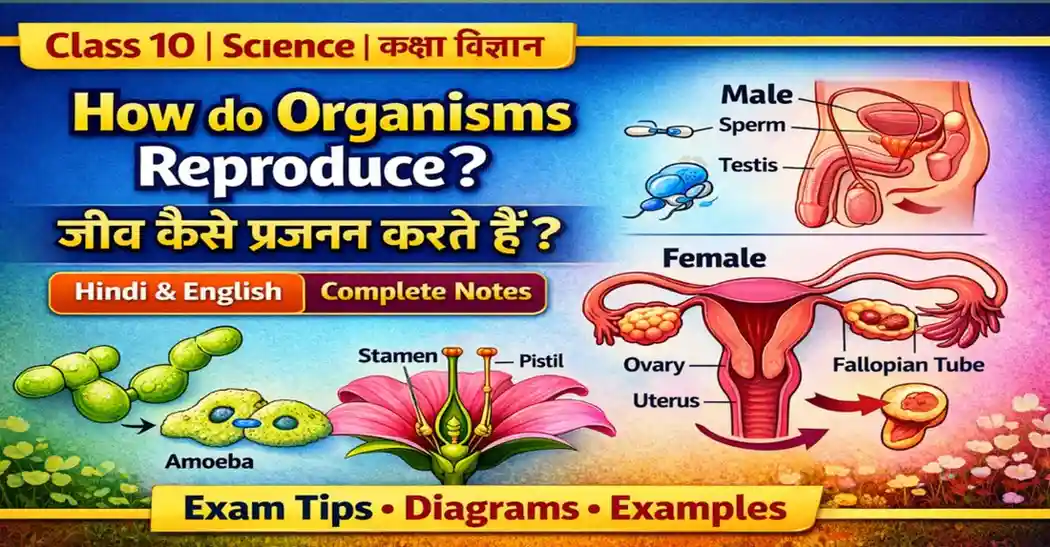
How do Organisms Reproduce Class 10 Notes: प्रजनन (Reproduction) जीवों की एक महत्वपूर्ण जैविक प्रक्रिया है, जिसके माध्यम से वे अपनी प्रजाति को आगे बढ़ाते हैं। कक्षा 10 विज्ञान का अध्याय “How do Organisms Reproduce” छात्रों के लिए बहुत ही महत्वपूर्ण है क्योंकि इससे न केवल परीक्षा में अच्छे अंक प्राप्त किए जा सकते हैं, बल्कि यह जीवन की मूलभूत प्रक्रियाओं को भी समझने में मदद करता है।
इस अध्याय में हम अलैंगिक एवं लैंगिक प्रजनन, पौधों और मनुष्यों में प्रजनन की प्रक्रिया, तथा प्रजनन स्वास्थ्य जैसे महत्वपूर्ण विषयों को सरल और स्पष्ट भाषा में समझेंगे। यह नोट्स हिंदी और अंग्रेज़ी दोनों माध्यम के छात्रों के लिए तैयार किए गए हैं, ताकि हर छात्र आसानी से इसे समझ सके। यदि आप बोर्ड परीक्षा की तैयारी कर रहे हैं, तो यह नोट्स आपके लिए बेहद उपयोगी साबित होंगे। For Objective Questions, Visit Learneasily8.
How do Organisms Reproduce Class 10 Notes: Start from Here
Introduction (परिचय)
Reproduction is the biological process by which living organisms produce new individuals of their own kind. It ensures the continuity of species on Earth.
Hindi:
प्रजनन वह जैविक प्रक्रिया है जिसके द्वारा जीव अपने समान नए जीव उत्पन्न करते हैं। यह पृथ्वी पर प्रजातियों की निरंतरता बनाए रखने में मदद करता है।
Why Reproduction is Important? (प्रजनन क्यों आवश्यक है?)
Reproduction is one of the main feature of living things and this helps them in the following ways:
- Maintains continuity of species
- Transfers genetic information
- Helps in evolution and variation
Hindi:
- प्रजातियों की निरंतरता बनाए रखता है
- आनुवंशिक जानकारी को अगली पीढ़ी में पहुँचाता है
- विविधता और विकास (Evolution) में मदद करता है
Types of Reproduction (प्रजनन के प्रकार)
- Asexual Reproduction (अलैंगिक प्रजनन)
English: Reproduction involving a single parent without gamete formation.
Hindi: एक ही जनक से बिना युग्मक निर्माण के प्रजनन।
Characteristics (विशेषताएँ)
- Only one parent (एक जनक)
- No fertilization (निषेचन नहीं होता)
- Offspring are identical (संतान समान होती है)
Methods of Asexual Reproduction
1. Binary Fission (द्विखंडन)
Example: Amoeba
- One cell divides into two equal cells
- एक कोशिका दो कोशिकाओं में विभाजित हो जाती है
2. Multiple Fission (बहुखंडन)
Example: Plasmodium
- One cell divides into many cells
- एक कोशिका कई कोशिकाओं में विभाजित होती है
3. Budding (कलिका निर्माण)
Example: Yeast, Hydra
- A small bud grows and separates
- एक छोटी कलिका बनती है और अलग हो जाती है
4. Fragmentation (खंडन)
Example: Spirogyra
- Body breaks into pieces and each piece grows
- शरीर के टुकड़े होकर नए जीव बनते हैं
5. Regeneration (पुनर्जनन)
Example: Planaria
- Whole organism grows from body parts
- शरीर के भाग से पूरा जीव बन सकता है
6. Vegetative Propagation (वनस्पतिक प्रजनन)
Example: Potato, Rose
- New plants from roots, stems, leaves
- जड़, तना, पत्तियों से नए पौधे बनते हैं
Sexual Reproduction (लैंगिक प्रजनन)
English: Involves two parents and fusion of male and female gametes.
Hindi: इसमें दो जनक होते हैं और नर एवं मादा युग्मकों का संलयन होता है।
Advantages (लाभ)
- Produces variation (विविधता उत्पन्न करता है)
- Helps in evolution (विकास में सहायक)
- Better survival chances (जीवित रहने की अधिक संभावना)
Reproduction in Plants (पौधों में प्रजनन)
Sexual Reproduction in Flowering Plants
🌺 Parts of Flower (फूल के भाग)
| Part | Function |
|---|---|
| Stamen (पुंकेसर) | Male part |
| Pistil (अंडप) | Female part |
Steps of Reproduction in Plants
- Pollination (परागण)
Transfer of pollen from anther to stigma
पराग का स्थानांतरण - Fertilization (निषेचन)
Fusion of male and female gametes
नर और मादा युग्मकों का मिलन - Seed Formation (बीज निर्माण)
Ovule becomes seed
बीज बनता है
Reproduction in Humans (मनुष्य में प्रजनन)
Male Reproductive System (पुरुष जनन तंत्र)
Parts:
- Testes (वृषण) → sperm production
- Vas deferens → transport
- Penis → delivery
Female Reproductive System (महिला जनन तंत्र)
Parts:
- Ovary (अंडाशय) → egg production
- Fallopian tube → fertilization
- Uterus (गर्भाशय) → development of embryo
Read Also: Carbon and Its Compounds – Complete Notes (Class 10)
Fertilization in Humans (मनुष्य में निषेचन)
- Sperm + Egg → Zygote
- Zygote develops into embryo
🤰 Pregnancy (गर्भावस्था)
- Embryo develops in uterus
- Lasts about 9 months
Reproductive Health (प्रजनन स्वास्थ्य)
Importance (महत्त्व)
- Healthy reproduction
- Prevent diseases
Methods of Contraception (गर्भनिरोध के उपाय)
1. Barrier Methods
- Condom (कंडोम)
2. Chemical Methods
- Pills (गोलियाँ)
3. Surgical Methods
- Vasectomy, Tubectomy
Sexually Transmitted Diseases (यौन रोग)
- HIV/AIDS
- Gonorrhea
Difference Asexual vs Sexual Reproduction
| Feature | Asexual | Sexual |
|---|---|---|
| Parents | One | Two |
| Variation | No | Yes |
| Speed | Fast | Slow |
| Examples | Amoeba | Human |
Key Points for Exam (महत्वपूर्ण बिंदु)
- Asexual reproduction produces identical offspring
- Sexual reproduction creates variation
- Pollination is transfer of pollen
- Fertilization forms zygote
- Humans reproduce sexually
How do Organisms Reproduce Class 10 Notes: Conclusion
Reproduction is essential for the survival of species. Both asexual and sexual reproduction have their own importance in nature.
Hindi:
प्रजनन जीवों के अस्तित्व के लिए अत्यंत आवश्यक है। अलैंगिक और लैंगिक दोनों प्रकार के प्रजनन प्रकृति में महत्वपूर्ण भूमिका निभाते हैं।
Known More: Chemical Reactions and Chemical Equations Class 10 Notes (Hindi + English)
Assertion–Reason Questions (दावा–कारण प्रश्न)
👉 Directions:
Choose the correct option:
(A) Both A and R are true and R is the correct explanation of A
(B) Both A and R are true but R is not the correct explanation of A
(C) A is true but R is false
(D) A is false but R is true
Q1. Assertion (A): Asexual reproduction produces identical offspring.
Reason (R): It involves only one parent without gamete formation.
✅ Answer: (A)
Q2. Assertion (A): Sexual reproduction leads to variation.
Reason (R): It involves fusion of male and female gametes.
✅ Answer: (A)
Q3. Assertion (A): Binary fission is common in Amoeba.
Reason (R): Amoeba divides into two equal halves.
✅ Answer: (A)
Q4. Assertion (A): Pollination is necessary for fertilization in plants.
Reason (R): It transfers pollen grains to stigma.
✅ Answer: (A)
Q5. Assertion (A): Vegetative propagation produces variation.
Reason (R): It involves sexual reproduction.
❌ Answer: (D)
Q6. Assertion (A): Humans reproduce sexually.
Reason (R): Humans produce gametes.
✅ Answer: (A)
Q7. Assertion (A): Regeneration is possible in Planaria.
Reason (R): It has specialized cells that divide and differentiate.
✅ Answer: (A)
Q8. Assertion (A): Fertilization results in zygote formation.
Reason (R): Male and female gametes fuse together.
✅ Answer: (A)
Q9. Assertion (A): Multiple fission occurs in Plasmodium.
Reason (R): One cell divides into many daughter cells.
✅ Answer: (A)
Q10. Assertion (A): Variation is important for survival of species.
Reason (R): It helps organisms adapt to changing environment.
✅ Answer: (A)
Case Study Questions (Board Pattern)
Case Study 1: Asexual Reproduction
A student observes that an Amoeba divides into two daughter cells under a microscope. This process repeats multiple times under favorable conditions.
Questions:
- Name the process observed.
👉 Answer: Binary fission - How many parent organisms are involved?
👉 Answer: One - What type of offspring are produced?
👉 Answer: Identical (clones) - Is variation present in this process? Why?
👉 Answer: No, because there is no genetic mixing
Case Study 2: Reproduction in Plants
A farmer grows new plants using potato tubers and rose stem cuttings.
Questions:
- Name the type of reproduction.
👉 Answer: Vegetative propagation - Is this sexual or asexual reproduction?
👉 Answer: Asexual reproduction - Give one advantage of this method.
👉 Answer: Faster growth / identical plants - Name one more example.
👉 Answer: Sugarcane
Case Study 3: Human Reproduction
In humans, fertilization occurs inside the female body after the fusion of sperm and egg.
Questions:
- Where does fertilization occur?
👉 Answer: Fallopian tube - What is formed after fertilization?
👉 Answer: Zygote - Where does the embryo develop?
👉 Answer: Uterus - What is the mode of reproduction in humans?
👉 Answer: Sexual reproduction
Case Study 4: Flowering Plants
A flower receives pollen grains from another flower through insects.
Questions:
- What is this process called?
👉 Answer: Pollination - What type of pollination is this?
👉 Answer: Cross-pollination - Which part receives pollen?
👉 Answer: Stigma - What happens after pollination?
👉 Answer: Fertilization
Case Study 5: Reproductive Health
A doctor advises the use of condoms to prevent unwanted pregnancy and diseases.
Questions:
- What type of method is condom?
👉 Answer: Barrier method - Name one disease it helps prevent.
👉 Answer: HIV/AIDS - Why is reproductive health important?
👉 Answer: To prevent diseases and ensure healthy life - Name one more contraceptive method.
👉 Answer: Pills / Copper-T