Class 10 English के Footprints Without Feet पुस्तक का Chapter 8 “Bholi” by K.A. Abbas एक बेहद प्रेरणादायक और महत्वपूर्ण कहानी है। यह कहानी सुलेक्खा नाम की एक ऐसी लड़की के जीवन पर आधारित है, जिसे लोग प्यार से नहीं बल्कि उसकी कमजोरियों के कारण भोली कहने लगे थे। बचपन की दुर्घटना, चेचक के निशान और हकलाने की समस्या के कारण वह आत्मविश्वासहीन हो गई थी। लेकिन जब भोली को शिक्षा का अवसर मिलता है, तो उसका पूरा जीवन बदल जाता है। शिक्षा और उसकी शिक्षिका के प्रोत्साहन से एक डरपोक लड़की धीरे-धीरे साहसी, आत्मविश्वासी और आत्मसम्मानी महिला बन जाती है।
इस पोस्ट में आपको Bholi Class 10 Notes in Hindi के साथ आसान Summary, Hindi Explanation, NCERT Question Answers, Extra Important Questions, Character Sketch, Word Meanings और Board Exam Revision Notes मिलेंगे। ये नोट्स सरल भाषा में तैयार किए गए हैं ताकि विद्यार्थी कहानी को आसानी से समझ सकें और परीक्षा की तैयारी बेहतर तरीके से कर सकें। Download NCERT BOOK PDF.
Bholi Class 10 Notes in Hindi: Summary
Chapter: Bholi
Book: Footprints Without Feet – Supplementary Reader
Class: 10th
Author: K.A. Abbas
About the Chapter | पाठ के बारे में
Bholi is an inspiring story written by K.A. Abbas. The chapter tells us about a simple village girl named Sulekha, who is called Bholi because people consider her slow and foolish. She suffers from physical and emotional difficulties during childhood. However, education completely changes her personality and makes her confident, independent, and courageous. The story strongly highlights the importance of education, women empowerment, self-respect, and equality.
About the Author – K.A. Abbas | लेखक के बारे में
Khwaja Ahmad Abbas, popularly known as K.A. Abbas, was a famous Indian writer, journalist, screenwriter, and film director. His writings often focused on social problems and the lives of ordinary people. In Bholi, he presents important issues such as discrimination against girls, lack of education, dowry, and women’s position in society. Through Bholi’s transformation, the author shows that education can give a person confidence and the courage to fight injustice.
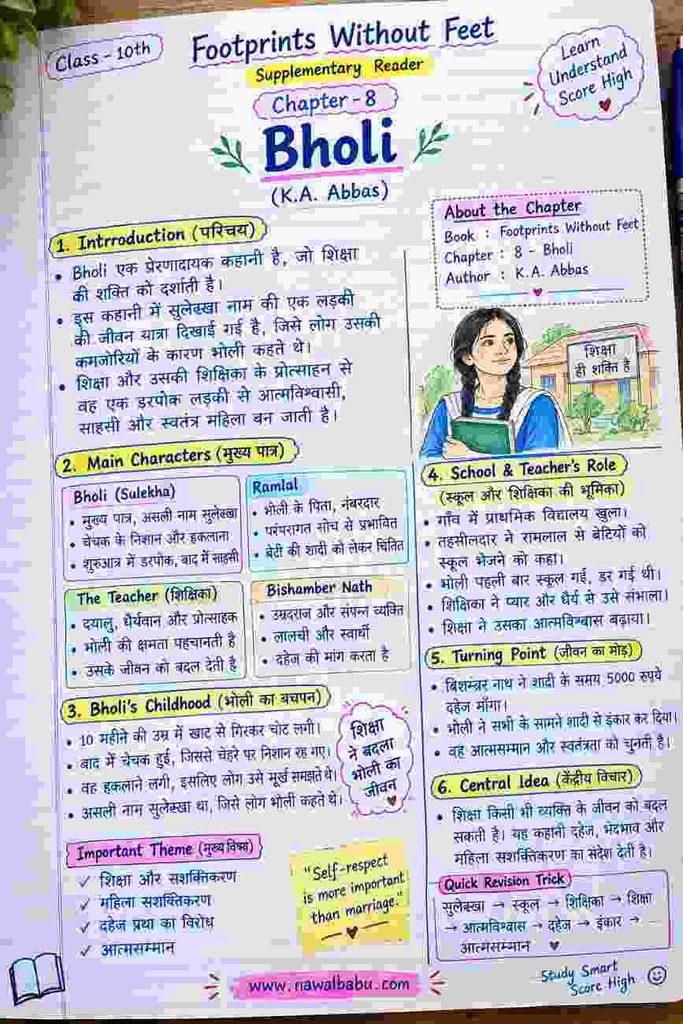
Main Characters | मुख्य पात्र
Bholi (Sulekha)
Bholi is the central character of the story. Her real name is Sulekha, but everyone calls her Bholi because she is slow in learning and speaks with difficulty. As a child, she suffers from smallpox, which leaves marks on her body. She also stammers while speaking. Initially, she is shy, frightened, and lacks confidence. However, education transforms her into a brave, intelligent, and self-respecting young woman.
Ramlal
Ramlal is Bholi’s father and the numberdar of the village. He is influenced by traditional thinking and worries about his daughter’s future because of her appearance and speech problem. Initially, he does not give much importance to Bholi’s education. However, when the government opens a school in the village, Bholi is sent there. Ramlal later arranges her marriage with Bishamber, without realizing his greedy and selfish nature.
The Teacher
Bholi’s teacher plays the most important role in changing her life. She treats Bholi with kindness, patience, and affection. Instead of laughing at her weaknesses, she encourages her to study and speak confidently. The teacher gives Bholi hope and makes her understand that education can change her future. Her love and guidance slowly remove Bholi’s fear and help her become a confident and independent woman.
Bishamber Nath
Bishamber Nath is an older man who agrees to marry Bholi. He is wealthy and has a successful business, but his character is selfish and greedy. When he sees the marks of smallpox on Bholi’s face, he demands five thousand rupees as dowry. His demand reveals his true nature. Bholi bravely refuses to marry him and rejects a man who tries to insult and exploit her family.
Bholi’s Childhood | भोली का बचपन
Bholi was born as Sulekha, the fourth daughter of Ramlal. When she was only ten months old, she fell from a cot and suffered an injury to her brain. Later, she had smallpox, which left permanent marks on her body. She also developed a stammer and could not speak properly. Because of these problems, people considered her foolish and called her Bholi, meaning a simple or innocent girl.
Why Was Sulekha Called Bholi? | सुलेखा को भोली क्यों कहा जाता था?
Sulekha was called Bholi because she was considered slow and simple by the people around her. Her childhood accident affected her development, and she could not learn or speak as quickly as other children. She also stammered while speaking, which made people laugh at her. Instead of understanding her difficulties, society gave her the nickname Bholi. However, the story proves that she was not foolish; she only needed education, encouragement, and confidence.
The Opening of a School in the Village | गाँव में स्कूल खुलना
A primary school was opened in Bholi’s village, and the government encouraged parents to send their daughters to school. The village people were initially doubtful because educating girls was not considered important. Ramlal decided to send one of his daughters to school, but his other daughters were already useful in household work. Therefore, Bholi was chosen because the family believed that she was unlikely to contribute much at home.
Bholi’s First Day at School | स्कूल का पहला दिन
Bholi was frightened when she was taken to school for the first time. She thought that she was being sent away because her family did not love her. However, when she reached the classroom, she saw many girls sitting together. Her teacher spoke to her gently and lovingly. For the first time, someone treated Bholi with kindness and respect. This experience became the beginning of a completely new life for her.
How Did the Teacher Change Bholi’s Life?
The teacher understood that Bholi needed love, patience, and encouragement. She spoke softly and did not make fun of Bholi’s stammering. She encouraged her to say her name and praised her efforts. The teacher promised that education would help her become confident and independent. Slowly, Bholi began attending school regularly. Through learning and the teacher’s support, she overcame her fear and developed the courage to speak for herself.
The Importance of Education in Bholi’s Life | शिक्षा का महत्व
Education is the biggest turning point in Bholi’s life. Before going to school, she was afraid, silent, and dependent on others. She could not express her thoughts because of low confidence. Education gave her knowledge, confidence, and self-respect. She learned that she had the right to make decisions about her own life. The story clearly shows that education is not only about reading and writing; it also gives people the power to think independently.
Bholi’s Transformation | भोली का परिवर्तन
After several years of education, Bholi changes completely. The frightened little girl becomes a confident and intelligent young woman. She learns to speak clearly and express her opinions without fear. Her education helps her understand the difference between right and wrong. The biggest example of her transformation comes during her marriage ceremony when she courageously refuses to marry Bishamber Nath. This moment proves that education has made her mentally strong and independent.
Bholi’s Marriage Proposal | भोली की शादी का प्रस्ताव
When Bholi grows up, her parents worry about her marriage because she has smallpox marks and previously suffered from a speech problem. Bishamber Nath, an older and wealthy man, agrees to marry her. Bholi’s parents consider this proposal a good opportunity because they believe it may be difficult to find another groom. However, they fail to understand Bishamber’s true character and his greedy attitude toward money and dowry.
Bishamber Nath Demands Dowry | दहेज की मांग
During the wedding ceremony, Bishamber Nath sees the marks on Bholi’s face and becomes unhappy. He immediately demands five thousand rupees from Ramlal as dowry. Ramlal feels helpless and agrees to pay the money to save the marriage. This incident exposes the evil practice of dowry and shows Bishamber’s greed. He is ready to insult Bholi and her family simply because he wants money. His behavior makes him morally unacceptable.
Why Did Bholi Refuse to Marry Bishamber?
Bholi refuses to marry Bishamber because she realizes that he is greedy, selfish, and disrespectful. When he demands dowry, she understands that he does not value her as a human being. She courageously throws away the marriage garland and refuses to marry him. Bholi says that she will not marry such a cowardly and greedy man. Her decision represents her self-respect, confidence, and independence gained through education.
Read Also: How do Organisms Reproduce Class 10 Notes in Hindi & English | जीव कैसे प्रजनन करते हैं पूर्ण नोट्स
Bholi’s Courage at the Wedding | शादी में भोली का साहस
The wedding scene is the most powerful part of the story. Everyone expects Bholi to remain silent because they still think she is weak and foolish. Surprisingly, she speaks confidently and clearly. She publicly rejects Bishamber Nath and refuses to accept a marriage based on greed and dowry. Her courage shocks everyone present. This moment shows that the girl once called “Bholi” has become strong enough to stand against injustice.
What Does Bholi Decide at the End?
After refusing to marry Bishamber Nath, Bholi decides that she will take care of her parents in their old age. She also expresses her desire to become a teacher and educate other children. Her decision shows that she no longer depends on marriage for her future. She chooses a meaningful and independent life. The teacher feels proud because her student has become a confident woman who can make her own decisions.
Central Idea | केंद्रीय विचार
The central idea of Bholi is that education can transform a person’s life. The story also attacks social evils such as dowry, discrimination against girls, and judging people based on physical appearance. Bholi begins her life as a frightened and neglected child but becomes a confident woman through education. The chapter teaches us that every person deserves respect, opportunity, and education, regardless of physical appearance or personal difficulties.
Themes of the Chapter | मुख्य विषय
Education and Empowerment
Education transforms Bholi from a weak and frightened girl into a confident woman. It gives her the ability to understand society and make independent decisions.
Women Empowerment
Bholi represents the strength of women. She proves that women should have the freedom to choose their own future and reject injustice.
Dowry System
The story strongly criticizes the evil practice of dowry. Bishamber Nath’s greed exposes how dowry can destroy dignity and relationships.
Self-Respect
Bholi refuses to sacrifice her self-respect for marriage. She chooses dignity over social pressure and personal comfort.
Social Issues Highlighted in Bholi
The story highlights several social problems that existed in society and continue to be relevant today. These include discrimination against girls, lack of education for women, the dowry system, and judging people based on physical appearance. Bholi suffers because society considers her unattractive and weak. However, her transformation proves that human value should not be decided by appearance. The story encourages society to provide equal opportunities to every child.
Character Sketch of Bholi | भोली का चरित्र चित्रण
Bholi is initially presented as a weak, innocent, and frightened girl. She suffers from a stammer and lacks confidence because people constantly laugh at her. However, she is also sensitive and capable of learning. With proper education and encouragement, she becomes confident, courageous, intelligent, and self-respecting. Her greatest quality is her bravery to reject an unfair marriage. Bholi’s character represents the powerful transformation that education can bring.
Character Sketch of the Teacher
The teacher is kind, patient, loving, and understanding. She recognizes Bholi’s potential when others ignore her. Instead of criticizing her weaknesses, she encourages her to improve. Her positive attitude gives Bholi confidence and hope. The teacher believes strongly in the power of education and treats her students equally. She plays the role of a guide and mentor in Bholi’s life. Her character shows how a good teacher can transform a student’s future.
Character Sketch of Bishamber Nath
Bishamber Nath appears to be a respectable and wealthy man, but his actions reveal his selfish nature. He agrees to marry Bholi despite being much older than her. However, when he sees the marks on her face, he demands dowry. His behavior shows that he values money more than human dignity. He is greedy, cowardly, and disrespectful. Through his character, the author strongly criticizes the dowry system and traditional social hypocrisy.
Important Message of the Story | कहानी का संदेश
The story gives a powerful message that education is the key to freedom and confidence. No child should be considered useless because of physical or mental difficulties. With proper guidance and opportunity, every person can develop their abilities. The story also teaches us to oppose dowry and respect women’s choices. Bholi proves that true beauty lies in confidence, courage, knowledge, and self-respect rather than physical appearance.
Bholi Summary in Short | Short Summary
Bholi, whose real name is Sulekha, is considered foolish because of her childhood difficulties and stammering. She is sent to school when a primary school opens in her village. Her teacher treats her kindly and encourages her to study. Education changes her personality completely. When Bishamber Nath demands dowry during their wedding, Bholi courageously refuses to marry him. She decides to become independent and serve society as a teacher.
Important Word Meanings | कठिन शब्दों के अर्थ
- Stammer – हकलाना
- Pockmarks – चेचक के निशान
- Numberdar – गाँव का मुखिया/राजस्व अधिकारी
- Dowry – दहेज
- Coward – कायर
- Self-respect – आत्मसम्मान
- Encouragement – प्रोत्साहन
- Transformation – परिवर्तन
- Confident – आत्मविश्वासी
- Independent – स्वतंत्र/स्वावलंबी
- Greedy – लालची
- Courageous – साहसी
Important Questions and Answers
Q1. Why was Sulekha called Bholi?
Sulekha was called Bholi because she was considered slow and simple by everyone. She suffered a brain injury after falling from a cot in childhood. Later, smallpox left marks on her body, and she developed a stammer. Because she could not speak or learn quickly, people thought she was foolish. However, the story later proves that she was intelligent and capable when given proper education and encouragement.
Q2. How did the teacher help Bholi?
The teacher helped Bholi by treating her with kindness, patience, and affection. She did not laugh at Bholi’s stammer or weaknesses. Instead, she encouraged her to speak and learn. The teacher gave her confidence and made her believe that education could change her life. Her loving behavior removed Bholi’s fear and helped her develop self-confidence. The teacher’s guidance played a major role in Bholi’s transformation.
Q3. Why did Bholi refuse to marry Bishamber Nath?
Bholi refused to marry Bishamber Nath because he demanded five thousand rupees as dowry after seeing the marks on her face. She realized that he was greedy and did not respect her dignity. Education had made her confident and independent. Therefore, she courageously rejected him in front of everyone. Bholi preferred self-respect over an unhappy marriage and refused to become the wife of such a selfish man.
Q4. How did education transform Bholi?
Education completely transformed Bholi’s personality. Before going to school, she was frightened, shy, and unable to express herself confidently. Her teacher encouraged her and gave her hope. Gradually, she became educated, confident, and courageous. She learned to think independently and understand her rights. At the end of the story, she boldly rejects a greedy groom. Thus, education gives Bholi confidence, self-respect, and the power to control her own future.
Q5. What message does the story Bholi give?
The story gives the message that education can change a person’s life completely. It teaches us not to judge people by their physical appearance or weaknesses. The chapter also strongly opposes the dowry system and discrimination against girls. Bholi’s transformation shows that every child deserves education and encouragement. The story promotes women’s empowerment, independence, courage, and self-respect. It teaches us that knowledge gives people the strength to fight injustice.
Know More: Madam Rides the Bus Class 10 Notes in Hindi: Summary, Explanation, Question Answers & MCQs
Important Exam Points | परीक्षा के लिए महत्वपूर्ण बिंदु
- Bholi’s real name: Sulekha
- Author: K.A. Abbas
- Book: Footprints Without Feet
- Main theme: Education and Women Empowerment
- Bholi’s problem: Stammering and smallpox marks
- Person who changed her life: Her teacher
- Groom’s name: Bishamber Nath
- Main social evil: Dowry System
- Bholi’s greatest quality: Courage and Self-respect
- Main message: Education gives confidence and independence.
Moral of the Story | कहानी की शिक्षा
The moral of Bholi is that education has the power to transform weak and neglected people into confident individuals. We should never judge someone based on appearance, disability, or present weaknesses. Every child needs love, respect, and proper opportunities. The story also teaches us to reject social evils such as dowry. Most importantly, it teaches that self-respect and dignity are more valuable than marriage, money, or social approval.
One-Line Revision | Quick Revision
“Bholi is the story of a neglected and frightened girl who becomes confident, courageous, and self-respecting through the power of education.”
⭐ याद रखने की Trick
Bholi → School → Teacher → Education → Confidence → Dowry Rejection → Self-Respect → Independence
This sequence can help you remember the complete story quickly for exams.