
Dust of Snow Class 10 Notes in Hindi उन छात्रों के लिए तैयार किए गए हैं जो NCERT First Flight की इस महत्वपूर्ण कविता को आसान भाषा में समझना चाहते हैं। यह कविता प्रसिद्ध अमेरिकी कवि Robert Frost द्वारा लिखी गई है और हमें सिखाती है कि जीवन की छोटी-सी सकारात्मक घटना भी हमारी सोच और पूरे दिन को बदल सकती है। बोर्ड परीक्षा की दृष्टि से यह कविता अत्यंत महत्वपूर्ण है क्योंकि इससे Summary, Explanation, Word Meanings, Literary Devices, Theme, Central Idea, Question Answers तथा MCQs जैसे प्रश्न अक्सर पूछे जाते हैं।
इस पोस्ट में आपको हिंदी + English दोनों भाषाओं में सरल और विस्तृत नोट्स मिलेंगे, जिससे कविता को याद रखना और समझना आसान हो जाएगा। यदि आप CBSE, Bihar Board या अन्य NCERT आधारित बोर्ड परीक्षाओं की तैयारी कर रहे हैं, तो ये नोट्स आपके लिए त्वरित रिवीजन और अच्छे अंक प्राप्त करने में बेहद उपयोगी साबित होंगे। Download NCERT BOOK PDF.
Dust of Snow Class 10 Notes in Hindi |: Summary, Q&A & MCQs
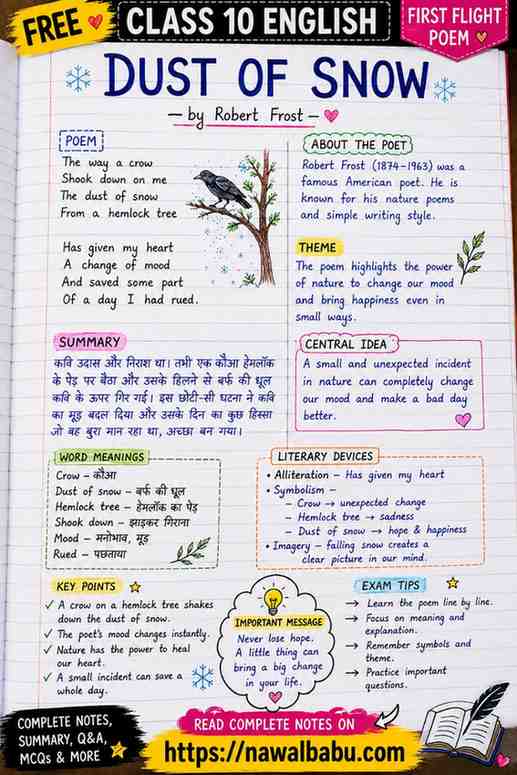
Dust of Snow is a beautiful short poem written by Robert Frost. It tells us that even a small incident in nature can completely change our mood and thinking. A crow sitting on a hemlock tree shakes down the dust of snow on the poet. This simple event removes his sadness and regret. The poem teaches that nature has the power to heal our mind and that every moment in life can bring a positive change.
About the Poet (कवि परिचय)
Robert Frost (1874–1963) was a famous American poet known for writing simple poems based on nature and rural life. His poems contain deep meanings hidden behind ordinary events. He received several Pulitzer Prizes for Poetry. Frost believed that nature is the best teacher and can help people understand life. His writing style is easy to read but full of wisdom and inspiration.
Theme of the Poem (कविता का विषय)
The main theme of the poem is hope, positivity, and the healing power of nature. The poet shows that even a small natural event can remove sadness and fill life with happiness. The crow and the dust of snow, which usually have negative meanings, become symbols of positive change. The poem encourages us to never lose hope because a simple moment can completely transform our day and our thinking.
Central Idea (केंद्रीय भाव)
The poem explains that happiness can come from unexpected places. The dust of snow falling from the hemlock tree changes the poet’s mood and saves the rest of his day from being wasted. Nature teaches us to appreciate small moments instead of focusing only on problems. The poet reminds us that every bad situation can turn into a good one if we change our attitude.
Summary in Hindi (हिंदी सारांश)
कवि उदास और निराश था। तभी एक कौआ हेमलॉक के पेड़ पर बैठा और उसकी हरकत से बर्फ की धूल (Dust of Snow) कवि के ऊपर गिर गई। इस छोटी-सी घटना ने कवि का मूड बदल दिया। उसे अपनी गलतियों पर पछतावा तो रहा, लेकिन उसने महसूस किया कि उसका पूरा दिन अभी भी अच्छा बन सकता है। कविता हमें सिखाती है कि प्रकृति की छोटी-छोटी घटनाएँ भी जीवन में नई आशा और खुशी ला सकती हैं।
Summary in English
The poet was feeling sad and regretful. Suddenly, a crow sitting on a hemlock tree shook down the dust of snow onto him. This small incident changed his mood completely. He realized that the rest of his day could still become meaningful. The poem teaches that nature has the power to remove sadness and inspire hope. Even the smallest event can bring positivity and make life beautiful.
Read Also: Consumer Rights Class 10 Notes in Hindi & English | NCERT Economics Chapter 5 Complete Notes
Stanza 1 Explanation
“The way a crow
Shook down on me
The dust of snow
From a hemlock tree”
The poet describes how a crow sitting on a hemlock tree shakes its body. As a result, the soft snow falls on the poet. Both the crow and the hemlock tree are generally considered symbols of sadness or bad luck. However, here they become the reason for happiness. This shows that good things can come from unexpected sources.
Stanza 2 Explanation
“Has given my heart
A change of mood
And saved some part
Of a day I had rued.”
The falling snow changes the poet’s mood from sadness to happiness. Earlier, he was regretting the day, but now he feels cheerful and hopeful. The simple act of nature saves the remaining part of his day from being wasted. The poet realizes that even a small positive experience can make life better.
Difficult Words with Meanings (Word Meanings)
- Dust of Snow – Fine particles of snow (बर्फ की हल्की परत)
- Crow – A black bird (कौआ)
- Hemlock Tree – A poisonous tree (हेमलॉक का पेड़)
- Shook Down – Caused something to fall (झाड़कर गिराना)
- Mood – State of mind (मनोदशा)
- Rued – Regretted deeply (पछताया)
Literary Devices (अलंकार)
- Alliteration: Has given my heart (repetition of ‘h’ sound)
- Symbolism: Crow and Hemlock Tree represent sadness, while Dust of Snow represents hope.
- Imagery: The falling snow creates a clear visual picture.
- Enjambment: The idea continues from one line to the next without punctuation.
Poetic Devices (काव्य उपकरण)
The poem follows a simple rhyme scheme of ABAB CDCD, making it pleasant to read. Robert Frost uses symbols from nature to express human emotions. The short lines and simple language make the message powerful. The poem proves that ordinary natural events can carry extraordinary meanings.
Know More: Surface Areas and Volumes Class 10: आसान तरीके से समझें और बोर्ड में पूरे मार्क्स लाएं
Important Characters / Symbols
- Poet: Represents every person facing sadness.
- Crow: Symbol of unexpected change.
- Hemlock Tree: Symbol of sorrow or negativity.
- Dust of Snow: Symbol of hope, happiness, and positive transformation.
Moral of the Poem (शिक्षा)
The poem teaches us that we should never lose hope in difficult times. A small incident can completely change our mood and perspective. Nature has the power to heal emotional pain and inspire positivity. Instead of regretting the past, we should appreciate the present because every moment gives us a new chance to be happy.
Important Questions & Answers
Q1. Who is the poet of Dust of Snow?
Answer: Robert Frost is the poet of Dust of Snow.
Q2. What changed the poet’s mood?
Answer: The dust of snow falling from the hemlock tree changed the poet’s mood.
Q3. Which bird appears in the poem?
Answer: A crow appears in the poem.
Q4. What does the hemlock tree symbolize?
Answer: It symbolizes sadness, negativity, and sorrow.
Q5. What is the main message of the poem?
Answer: Even a small positive incident can remove sadness and fill life with hope and happiness.
Important Exam Points (Quick Revision)
- Poem: Dust of Snow
- Poet: Robert Frost
- Theme: Hope, Nature, Positive Thinking
- Rhyme Scheme: ABAB CDCD
- Symbols: Crow, Hemlock Tree, Dust of Snow
- Message: Small moments can bring big changes in life.
- NCERT Value: Nature has the power to heal the human mind.