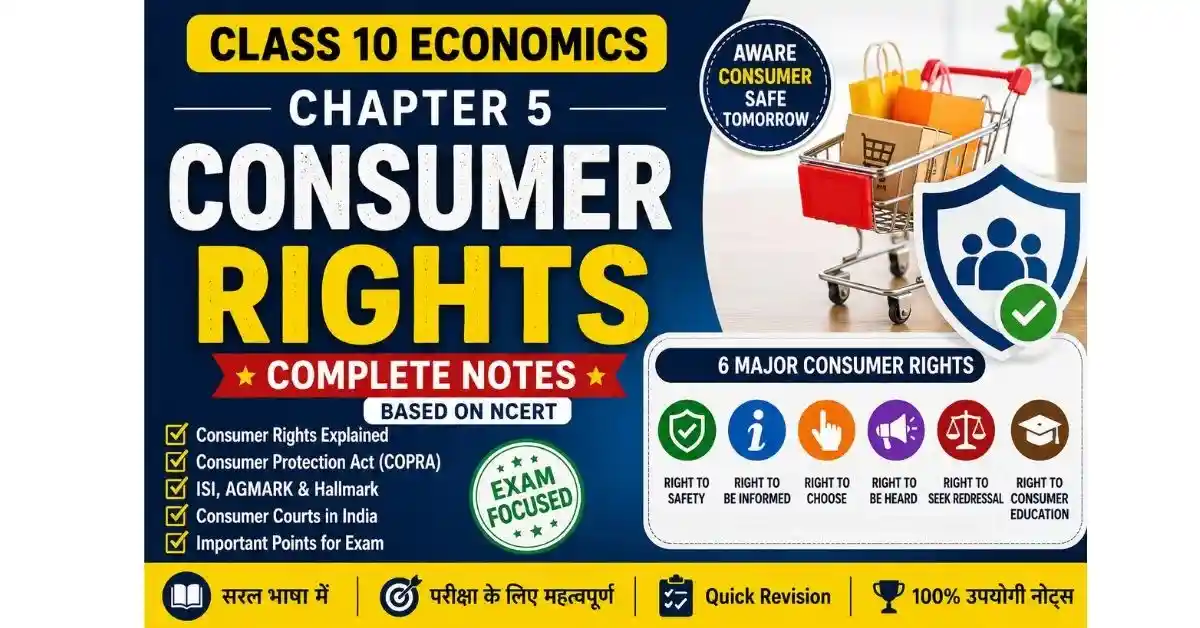
उपभोक्ता अधिकार (Consumer Rights) आधुनिक अर्थव्यवस्था का एक महत्वपूर्ण विषय है, जो प्रत्येक नागरिक को बाजार में होने वाले शोषण से सुरक्षा प्रदान करता है। कक्षा 10 अर्थशास्त्र (Understanding Economic Development) के अध्याय 5 में उपभोक्ता अधिकारों, उपभोक्ता संरक्षण अधिनियम (COPRA), उपभोक्ता आंदोलन, गुणवत्ता प्रमाणन चिन्ह (ISI, AGMARK, Hallmark) तथा उपभोक्ता न्यायालयों के बारे में विस्तार से बताया गया है। Download NCERT BOOK PDF.
आज के समय में जागरूक उपभोक्ता बनना अत्यंत आवश्यक है क्योंकि कई बार गलत विज्ञापन, खराब गुणवत्ता वाले उत्पाद, अधिक मूल्य वसूली तथा मिलावटी वस्तुओं के कारण उपभोक्ताओं का शोषण होता है। इस नोट्स में आपको सभी महत्वपूर्ण अवधारणाएँ सरल हिंदी एवं अंग्रेज़ी भाषा में, परीक्षा की दृष्टि से महत्वपूर्ण बिंदुओं, उदाहरणों तथा त्वरित पुनरावृत्ति (Quick Revision) के साथ मिलेंगी। यह नोट्स CBSE, NCERT तथा अन्य राज्य बोर्डों के विद्यार्थियों के लिए अत्यंत उपयोगी हैं।
Consumer Rights Class 10 Notes: NCERT Economics Chapter 5
Every person who buys goods or services is called a consumer. In daily life, consumers purchase food items, clothes, electronic products, education services, transportation services, and many other things. Sometimes consumers are cheated through poor-quality products, overpricing, misleading advertisements, or defective services. To protect consumers from such unfair practices, consumer rights and laws have been introduced. The Consumer Protection Act provides legal protection and helps consumers seek justice. Understanding consumer rights is essential for becoming an aware and responsible citizen.
What is a Consumer? (उपभोक्ता कौन होता है?)
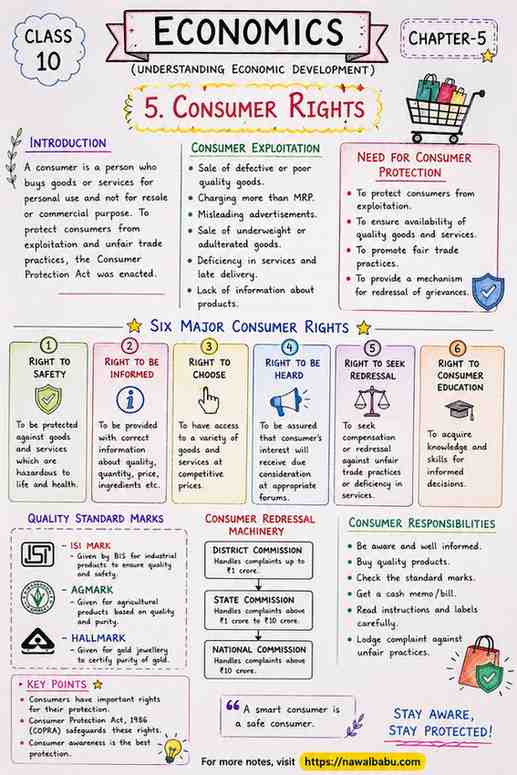
A consumer is a person who purchases goods or services for personal use and not for resale or commercial purposes.
Important Points
- A consumer buys products such as food, clothes, books, or electronics.
- A consumer can also use services like banking, transport, healthcare, and education.
- Consumers pay money to receive goods or services.
- Every citizen becomes a consumer at some stage of life.
- Consumers have rights that protect them from unfair trade practices.
- Awareness of these rights helps consumers make informed decisions.
- Consumers play an important role in the economy through their purchasing decisions.
Consumer Exploitation (उपभोक्ताओं का शोषण)
Consumer exploitation occurs when sellers or producers take unfair advantage of consumers.
Common Forms of Exploitation
- Selling defective or poor-quality products.
- Charging prices higher than the Maximum Retail Price (MRP).
- Selling underweight or adulterated goods.
- Giving false or misleading advertisements.
- Providing incomplete information about products.
- Refusing after-sales services or warranties.
- Selling expired medicines or food products.
Reasons for Consumer Exploitation
- Lack of consumer awareness.
- Limited information about products.
- Consumers’ weak bargaining power.
- Large number of producers and sellers.
- Illiteracy and ignorance about legal rights.
- Attractive advertisements that mislead buyers.
Need for Consumer Protection (उपभोक्ता संरक्षण की आवश्यकता)
Consumer protection is necessary to ensure fairness in the market and safeguard consumers’ interests.
Importance
- Protects consumers from exploitation.
- Ensures quality products and services.
- Encourages ethical business practices.
- Provides legal remedies for grievances.
- Promotes consumer awareness.
- Builds trust between buyers and sellers.
- Strengthens the economy through fair trade.
Consumer Movement in India (भारत में उपभोक्ता आंदोलन)
The consumer movement started because consumers were often exploited in the market.
Development of Consumer Movement
- Initially, consumers had very little protection.
- Social activists and voluntary organizations raised awareness.
- Government introduced laws to protect consumers.
- Consumer organizations started educating people.
- The movement gained strength during the 1960s and 1970s.
- It focused on fair prices, quality products, and consumer rights.
- Today, consumer protection is an important part of governance.
Read Also: Gender, Religion and Caste Class 10 Notes in Hindi + English | Gender Religion and Caste Notes PDF
Consumer Protection Act (COPRA) (उपभोक्ता संरक्षण अधिनियम)
The Consumer Protection Act was passed in 1986 to protect consumers’ interests.
Main Features
- Provides legal protection to consumers.
- Establishes consumer courts at different levels.
- Offers speedy and inexpensive justice.
- Protects against unfair trade practices.
- Gives consumers the right to file complaints.
- Encourages consumer awareness.
- Strengthens consumer rights in the marketplace.
Rights of Consumers (उपभोक्ताओं के अधिकार)
Consumers are given several rights to protect them from exploitation.
1. Right to Safety (सुरक्षा का अधिकार)
Consumers have the right to be protected against goods and services that are harmful to health and life.
Key Points
- Protection from dangerous products.
- Ensures product safety standards.
- Important for medicines, electrical appliances, and food items.
- Consumers should look for quality certification marks.
- Unsafe products can be legally challenged.
- Helps prevent accidents and health risks.
- Promotes safer production practices.
2. Right to be Informed (सूचना पाने का अधिकार)
Consumers have the right to receive complete information about products and services.
Information Must Include
- Price of the product.
- Manufacturing date.
- Expiry date.
- Ingredients used.
- Quantity and weight.
- Quality standards.
- Directions for use.
Consumers should carefully read labels before purchasing.
3. Right to Choose (चुनाव का अधिकार)
Consumers have the freedom to select from a variety of products at competitive prices.
Importance
- Prevents monopoly in the market.
- Encourages healthy competition.
- Gives consumers better quality options.
- Allows comparison between products.
- Protects against forced purchases.
- Promotes fair market practices.
- Increases customer satisfaction.
4. Right to be Heard (सुनवाई का अधिकार)
Consumers have the right to express complaints and concerns.
Benefits
- Consumers can raise grievances.
- Businesses must listen to complaints.
- Consumer courts provide a platform for justice.
- Helps improve product quality.
- Encourages accountability among sellers.
- Ensures fair treatment.
- Strengthens consumer confidence.
5. Right to Seek Redressal (प्रतितोष प्राप्त करने का अधिकार)
Consumers can seek compensation for defective products or poor services.
Examples
- Refund of money.
- Replacement of product.
- Repair of defective goods.
- Compensation for losses.
- Removal of deficiencies in services.
- Correction of unfair practices.
- Legal action against offenders.
6. Right to Consumer Education (उपभोक्ता शिक्षा का अधिकार)
Consumers have the right to acquire knowledge and skills needed to make informed decisions.
Importance
- Creates awareness about rights.
- Helps identify unfair practices.
- Encourages informed purchasing decisions.
- Reduces chances of exploitation.
- Promotes responsible consumption.
- Improves market transparency.
- Strengthens consumer empowerment.
Consumer Responsibilities (उपभोक्ता की जिम्मेदारियाँ)
Consumers must also perform certain responsibilities.
Responsibilities
- Always ask for a cash memo or bill.
- Check quality marks before purchasing.
- Read product labels carefully.
- Compare prices and quality.
- Report unfair practices.
- Keep purchase records safely.
- Use products according to instructions.
Quality Standard Marks (गुणवत्ता प्रमाणन चिन्ह)
Quality marks help consumers identify safe and reliable products.
ISI Mark
Features
- Issued by the Bureau of Indian Standards (BIS).
- Indicates product quality and safety.
- Common on electrical appliances.
- Ensures compliance with standards.
- Builds consumer trust.
- Helps avoid unsafe products.
- Widely recognized across India.
AGMARK
Features
- Used for agricultural products.
- Certifies product quality.
- Ensures purity and grading.
- Common on food grains and spices.
- Protects consumers from adulteration.
- Maintains quality standards.
- Encourages better agricultural practices.
Hallmark
Features
- Used for gold jewellery.
- Certifies purity of gold.
- Issued under BIS standards.
- Protects buyers from fraud.
- Increases trust in jewellery purchases.
- Ensures accurate quality measurement.
- Important while purchasing gold.
Consumer Redressal System (उपभोक्ता शिकायत निवारण प्रणाली)
Consumer disputes are settled through consumer courts.
District Commission
Functions
- Handles complaints at the district level.
- Provides quick dispute resolution.
- Accessible to local consumers.
- Deals with lower-value cases.
- Offers affordable justice.
- Encourages consumer participation.
- Reduces legal complexities.
State Commission
Functions
- Handles appeals from district commissions.
- Deals with higher-value disputes.
- Operates at the state level.
- Ensures fair decisions.
- Protects consumer interests.
- Reviews lower court judgments.
- Provides additional legal support.
National Commission
Functions
- Highest consumer court in India.
- Handles major disputes.
- Hears appeals from state commissions.
- Ensures uniform justice.
- Protects national consumer interests.
- Provides final decisions in many cases.
- Strengthens consumer protection framework.
Role of Consumer Organizations (उपभोक्ता संगठनों की भूमिका)
Consumer organizations work to protect and educate consumers.
Major Functions
- Spread consumer awareness.
- Conduct educational campaigns.
- Help consumers file complaints.
- Provide legal guidance.
- Monitor unfair trade practices.
- Promote ethical business behavior.
- Strengthen consumer rights.
Importance of Consumer Awareness (उपभोक्ता जागरूकता का महत्व)
Consumer awareness is the key to effective consumer protection.
Benefits
- Prevents exploitation.
- Encourages informed decisions.
- Promotes quality consumption.
- Supports fair trade practices.
- Strengthens consumer confidence.
- Improves market efficiency.
- Helps in exercising consumer rights.
Important NCERT Keywords
- Consumer (उपभोक्ता)
- Consumer Rights (उपभोक्ता अधिकार)
- Consumer Protection (उपभोक्ता संरक्षण)
- Consumer Exploitation (उपभोक्ता शोषण)
- COPRA (Consumer Protection Act)
- Redressal (प्रतितोष)
- ISI Mark
- AGMARK
- Hallmark
- Consumer Awareness
Quick Revision Points
- Consumer is a buyer of goods and services.
- Consumers often face exploitation in the market.
- Consumer Protection Act (1986) safeguards consumer interests.
- Six major consumer rights are provided under the law.
- ISI, AGMARK, and Hallmark ensure product quality.
- Consumers should always demand a bill or cash memo.
- Consumer courts help resolve disputes.
- Consumer awareness is the strongest protection against exploitation.
Conclusion (निष्कर्ष)
Consumer rights are essential for protecting individuals from unfair market practices. An aware consumer can make better decisions, avoid exploitation, and seek justice when wronged. The Consumer Protection Act and consumer courts provide strong legal support to consumers. By understanding their rights and responsibilities, consumers can contribute to a fair, transparent, and efficient marketplace. Awareness, education, and active participation are the keys to becoming a smart and responsible consumer.
Frequently Asked Questions (FAQs) – Consumer Rights Class 10 Notes
Q1. उपभोक्ता (Consumer) किसे कहते हैं?
उत्तर: वह व्यक्ति जो अपनी व्यक्तिगत आवश्यकता के लिए किसी वस्तु या सेवा को खरीदता या उपयोग करता है, उपभोक्ता कहलाता है। जो व्यक्ति वस्तुओं को पुनः बेचने के लिए खरीदता है, वह उपभोक्ता नहीं माना जाता।
Q2. उपभोक्ता अधिकार (Consumer Rights) क्या हैं?
उत्तर: उपभोक्ताओं को शोषण से बचाने और उनके हितों की रक्षा करने के लिए दिए गए कानूनी अधिकारों को उपभोक्ता अधिकार कहते हैं। इनमें सुरक्षा का अधिकार, सूचना पाने का अधिकार, चुनाव का अधिकार आदि शामिल हैं।
Q3. उपभोक्ता शोषण (Consumer Exploitation) क्या है?
उत्तर: जब विक्रेता या उत्पादक उपभोक्ताओं को गलत जानकारी देकर, घटिया वस्तुएँ बेचकर, अधिक मूल्य वसूलकर या मिलावटी सामान बेचकर उनका नुकसान करते हैं, तो इसे उपभोक्ता शोषण कहते हैं।
Q4. COPRA क्या है?
उत्तर: COPRA (Consumer Protection Act) अर्थात उपभोक्ता संरक्षण अधिनियम, 1986 एक कानून है जो उपभोक्ताओं के अधिकारों की रक्षा करता है और उन्हें शिकायत करने का अधिकार प्रदान करता है।
Q5. उपभोक्ताओं के छह प्रमुख अधिकार कौन-कौन से हैं?
उत्तर: उपभोक्ताओं के छह प्रमुख अधिकार हैं:
सुरक्षा का अधिकार (Right to Safety)
सूचना पाने का अधिकार (Right to be Informed)
चुनाव का अधिकार (Right to Choose)
सुनवाई का अधिकार (Right to be Heard)
प्रतितोष प्राप्त करने का अधिकार (Right to Seek Redressal)
उपभोक्ता शिक्षा का अधिकार (Right to Consumer Education)
Q6. ISI मार्क क्या दर्शाता है?
उत्तर: ISI मार्क भारतीय मानक ब्यूरो (BIS) द्वारा जारी किया जाता है। यह उत्पाद की गुणवत्ता और सुरक्षा का प्रमाण होता है।
Q7. AGMARK का उपयोग किन उत्पादों पर किया जाता है?
उत्तर: AGMARK मुख्य रूप से कृषि उत्पादों जैसे अनाज, मसाले, दालें और खाद्य पदार्थों की गुणवत्ता प्रमाणित करने के लिए उपयोग किया जाता है।
Q8. Hallmark क्या है?
उत्तर: Hallmark सोने के आभूषणों की शुद्धता का प्रमाण चिन्ह है, जो भारतीय मानक ब्यूरो (BIS) द्वारा जारी किया जाता है।
Q9. उपभोक्ता शिकायत कहाँ दर्ज कर सकता है?
उत्तर: उपभोक्ता अपनी शिकायत जिला उपभोक्ता आयोग, राज्य उपभोक्ता आयोग या राष्ट्रीय उपभोक्ता आयोग में दर्ज कर सकता है।
Q10. उपभोक्ता को खरीदारी के समय बिल क्यों लेना चाहिए?
उत्तर: बिल खरीदारी का प्रमाण होता है। किसी वस्तु में दोष होने या शिकायत दर्ज कराने की स्थिति में बिल महत्वपूर्ण साक्ष्य के रूप में काम करता है।