कक्षा 10 अर्थशास्त्र (Economics) के अध्याय “Globalisation and the Indian Economy (वैश्वीकरण और भारतीय अर्थव्यवस्था)” में हम समझते हैं कि किस प्रकार दुनिया के विभिन्न देशों की अर्थव्यवस्थाएँ आपस में जुड़ती जा रही हैं। आज के समय में मोबाइल फोन, इंटरनेट, विदेशी कंपनियाँ और अंतरराष्ट्रीय व्यापार ने विश्व को एक वैश्विक बाजार में बदल दिया है। Download NCERT BOOK PDF.
इस अध्याय में बहुराष्ट्रीय कंपनियों (MNCs), विदेशी व्यापार, उदारीकरण (Liberalisation), विश्व व्यापार संगठन (WTO) तथा भारत पर वैश्वीकरण के प्रभावों का विस्तृत अध्ययन किया जाता है। यह अध्याय बोर्ड परीक्षा की दृष्टि से अत्यंत महत्वपूर्ण है क्योंकि इससे संबंधित लघु एवं दीर्घ उत्तरीय प्रश्न अक्सर पूछे जाते हैं। इस पोस्ट में आपको सरल हिंदी और अंग्रेज़ी भाषा में NCERT आधारित संपूर्ण नोट्स, महत्वपूर्ण बिंदु, परिभाषाएँ तथा परीक्षा उपयोगी सारांश मिलेगा, जिससे आपकी तैयारी आसान और प्रभावी बनेगी।
Globalisation and the Indian Economy Class 10: NCERT Economics
Globalisation is the process through which different countries of the world become connected through trade, investment, technology, information, and culture. It allows goods, services, people, and ideas to move more freely across national borders. In India, globalisation increased rapidly after the economic reforms of 1991. It has created many opportunities for businesses and consumers but has also brought challenges for workers and small producers.
वैश्वीकरण (Globalisation) वह प्रक्रिया है जिसके द्वारा विश्व के विभिन्न देश व्यापार, निवेश, तकनीक, सूचना और संस्कृति के माध्यम से एक-दूसरे से जुड़ जाते हैं। भारत में 1991 के आर्थिक सुधारों के बाद वैश्वीकरण की गति तेज हुई। इससे उपभोक्ताओं और व्यवसायों को लाभ मिला, लेकिन कुछ चुनौतियाँ भी सामने आईं।
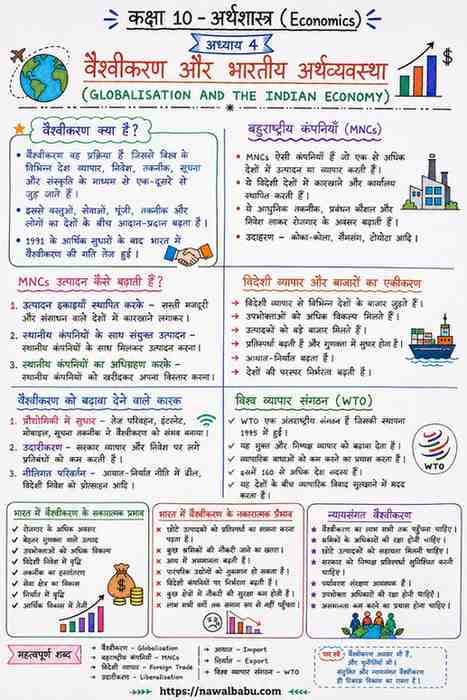
What is Globalisation? (वैश्वीकरण क्या है?)
- Globalisation means integration of economies across the world.
- It connects producers and consumers of different countries.
- Goods, services, investments, and technology move across borders.
- Markets of different countries become interconnected.
- It increases international trade and economic cooperation.
- Multinational companies play an important role in globalisation.
- Improved communication and transportation support globalisation.
- Consumers get a wider variety of products.
- Competition among companies increases.
- Economic activities become global rather than local.
हिंदी में
- वैश्वीकरण का अर्थ विश्व की अर्थव्यवस्थाओं का एकीकरण है।
- यह विभिन्न देशों के उत्पादकों और उपभोक्ताओं को जोड़ता है।
- वस्तुओं, सेवाओं, पूंजी और तकनीक का आदान-प्रदान बढ़ता है।
- विभिन्न देशों के बाजार आपस में जुड़ जाते हैं।
- अंतरराष्ट्रीय व्यापार में वृद्धि होती है।
- बहुराष्ट्रीय कंपनियाँ इसमें महत्वपूर्ण भूमिका निभाती हैं।
- संचार और परिवहन के विकास से वैश्वीकरण को बढ़ावा मिला।
- उपभोक्ताओं को अधिक विकल्प प्राप्त होते हैं।
- कंपनियों के बीच प्रतिस्पर्धा बढ़ती है।
- आर्थिक गतिविधियाँ वैश्विक स्वरूप धारण कर लेती हैं।
Production Across Countries (विभिन्न देशों में उत्पादन)
- Large companies divide production processes among different countries.
- Each country specializes in a particular stage of production.
- This reduces production costs and increases efficiency.
- Different parts of a product may be produced in different countries.
- Companies select locations based on labour cost and resources.
- Global production networks have become common.
- Developing countries attract industries due to cheap labour.
- Production becomes faster and more efficient.
- International cooperation in manufacturing increases.
- It is an important feature of globalisation.
हिंदी में
- बड़ी कंपनियाँ उत्पादन प्रक्रिया को विभिन्न देशों में बाँट देती हैं।
- प्रत्येक देश किसी विशेष कार्य में विशेषज्ञता प्राप्त करता है।
- इससे लागत कम होती है और उत्पादन बढ़ता है।
- किसी वस्तु के अलग-अलग भाग अलग-अलग देशों में बन सकते हैं।
- कंपनियाँ सस्ती मजदूरी और संसाधनों वाले देशों को चुनती हैं।
- वैश्विक उत्पादन नेटवर्क विकसित हुए हैं।
- विकासशील देशों में उद्योगों का विस्तार हुआ है।
- उत्पादन अधिक कुशल और तेज हो गया है।
- देशों के बीच औद्योगिक सहयोग बढ़ा है।
- यह वैश्वीकरण की प्रमुख विशेषता है।
Multinational Corporations (MNCs) (बहुराष्ट्रीय कंपनियाँ)
- MNCs are companies that own or control production in more than one country.
- They invest in factories, offices, and infrastructure abroad.
- Examples include Coca-Cola, Samsung, and Toyota.
- MNCs bring modern technology and management skills.
- They create employment opportunities.
- They increase competition in local markets.
- Large investments help economic growth.
- They often collaborate with local companies.
- They influence global trade patterns.
- They are major drivers of globalisation.
हिंदी में
- बहुराष्ट्रीय कंपनियाँ एक से अधिक देशों में उत्पादन या व्यापार करती हैं।
- वे विदेशों में कारखाने और कार्यालय स्थापित करती हैं।
- ये आधुनिक तकनीक और प्रबंधन कौशल लाती हैं।
- रोजगार के अवसर उत्पन्न करती हैं।
- स्थानीय बाजारों में प्रतिस्पर्धा बढ़ाती हैं।
- निवेश के माध्यम से आर्थिक विकास को बढ़ावा देती हैं।
- स्थानीय कंपनियों के साथ साझेदारी करती हैं।
- अंतरराष्ट्रीय व्यापार को बढ़ाती हैं।
- वैश्वीकरण की प्रमुख शक्ति हैं।
- विश्व अर्थव्यवस्था को जोड़ने में महत्वपूर्ण भूमिका निभाती हैं।
Ways in Which MNCs Spread Production (MNCs उत्पादन कैसे बढ़ाती हैं?)
1. Setting up Production Units (उत्पादन इकाइयाँ स्थापित करना)
- MNCs establish factories in different countries.
- They choose locations with cheap labour and resources.
- Production costs decrease significantly.
- Employment opportunities increase.
- Local industries get business opportunities.
- Technology transfer takes place.
- Exports increase.
- Industrial development is promoted.
2. Joint Production with Local Companies (स्थानीय कंपनियों के साथ संयुक्त उत्पादन)
- MNCs collaborate with local companies.
- Local firms gain access to technology.
- Production quality improves.
- Companies share risks and profits.
- Market reach expands.
- Productivity increases.
- Knowledge transfer occurs.
- Both companies benefit.
3. Buying Local Companies (स्थानीय कंपनियों का अधिग्रहण)
- MNCs buy local firms to expand quickly.
- Existing customer base is acquired.
- Production facilities become available immediately.
- Market control increases.
- Competition may decrease.
- Business operations become easier.
- Investment inflow rises.
- Expansion becomes faster.
Foreign Trade and Integration of Markets (विदेशी व्यापार और बाजारों का एकीकरण)
- Foreign trade connects markets of different countries.
- Products from one country reach consumers worldwide.
- Consumers get more choices.
- Producers find larger markets.
- Competition improves quality.
- Prices become more competitive.
- Imports and exports increase.
- Global market integration strengthens.
- Economic interdependence grows.
- Trade promotes globalisation.
हिंदी में
- विदेशी व्यापार विभिन्न देशों के बाजारों को जोड़ता है।
- उत्पाद विश्वभर के उपभोक्ताओं तक पहुँचते हैं।
- उपभोक्ताओं को अधिक विकल्प मिलते हैं।
- उत्पादकों को बड़े बाजार प्राप्त होते हैं।
- प्रतिस्पर्धा से गुणवत्ता बढ़ती है।
- कीमतें प्रतिस्पर्धी बनती हैं।
- आयात और निर्यात में वृद्धि होती है।
- वैश्विक बाजार मजबूत होते हैं।
- देशों की परस्पर निर्भरता बढ़ती है।
- व्यापार वैश्वीकरण को प्रोत्साहित करता है।
Factors Enabling Globalisation (वैश्वीकरण को संभव बनाने वाले कारक)
Improvement in Technology (प्रौद्योगिकी में सुधार)
- Faster transportation reduces delivery time.
- Air transport facilitates international trade.
- Modern shipping lowers transportation costs.
- Internet enables instant communication.
- Mobile phones connect businesses globally.
- Digital technology improves efficiency.
- Information can be shared quickly.
- Online trade has expanded rapidly.
हिंदी में
- तेज परिवहन से समय की बचत होती है।
- हवाई परिवहन व्यापार को आसान बनाता है।
- आधुनिक जहाज लागत कम करते हैं।
- इंटरनेट तत्काल संचार की सुविधा देता है।
- मोबाइल फोन वैश्विक संपर्क बढ़ाते हैं।
- डिजिटल तकनीक कार्यक्षमता बढ़ाती है।
- जानकारी तेजी से साझा की जा सकती है।
- ऑनलाइन व्यापार का विस्तार हुआ है।
Liberalisation of Foreign Trade and Investment Policy (उदारीकरण)
- Liberalisation means removing trade barriers.
- Government allows easier imports and exports.
- Foreign companies can invest more freely.
- Competition increases in domestic markets.
- Consumers benefit from better products.
- Economic growth accelerates.
- New technologies enter the country.
- India adopted liberalisation in 1991.
- Foreign investment increased significantly.
- Integration with the world economy improved.
हिंदी में
- उदारीकरण का अर्थ व्यापारिक प्रतिबंधों को कम करना है।
- सरकार आयात-निर्यात को आसान बनाती है।
- विदेशी निवेश को बढ़ावा दिया जाता है।
- बाजार में प्रतिस्पर्धा बढ़ती है।
- उपभोक्ताओं को बेहतर उत्पाद मिलते हैं।
- आर्थिक विकास तेज होता है।
- नई तकनीक देश में आती है।
- भारत ने 1991 में उदारीकरण अपनाया।
- विदेशी निवेश बढ़ा।
- विश्व अर्थव्यवस्था से जुड़ाव मजबूत हुआ।
World Trade Organization (WTO) (विश्व व्यापार संगठन)
- WTO is an international organization dealing with trade rules.
- It was established in 1995.
- It promotes free and fair trade.
- It aims to reduce trade barriers.
- Member countries follow agreed trade rules.
- It resolves trade disputes among nations.
- Over 160 countries are members.
- Developing countries seek fair treatment.
- WTO encourages international cooperation.
- It influences global trade policies.
हिंदी में
- WTO एक अंतरराष्ट्रीय व्यापार संगठन है।
- इसकी स्थापना 1995 में हुई।
- यह मुक्त और निष्पक्ष व्यापार को बढ़ावा देता है।
- व्यापारिक बाधाओं को कम करने का प्रयास करता है।
- सदस्य देश इसके नियमों का पालन करते हैं।
- देशों के बीच व्यापारिक विवाद सुलझाता है।
- 160 से अधिक देश इसके सदस्य हैं।
- विकासशील देश समान अवसर की मांग करते हैं।
- यह अंतरराष्ट्रीय सहयोग को बढ़ावा देता है।
- वैश्विक व्यापार नीतियों को प्रभावित करता है।
Know More: Federalism Class 10 Notes in Hindi | संघवाद Notes PDF, Important Questions & Summary
Impact of Globalisation in India (भारत में वैश्वीकरण का प्रभाव)
Positive Effects (सकारात्मक प्रभाव)
- More employment opportunities.
- Better quality products.
- Greater consumer choice.
- Increased foreign investment.
- Technology transfer.
- Growth of service sector.
- Rise in exports.
- Improved infrastructure.
- Increased competition.
- Economic growth.
Negative Effects (नकारात्मक प्रभाव)
- Small producers face competition.
- Some workers lose jobs.
- Income inequality increases.
- Traditional industries may suffer.
- Dependence on foreign companies rises.
- Job security decreases in some sectors.
- Benefits are not equally distributed.
- Environmental concerns may increase.
- Local businesses struggle.
- Market dominance by large companies.
Fair Globalisation (न्यायसंगत वैश्वीकरण)
- Benefits of globalisation should reach everyone.
- Workers’ rights must be protected.
- Small producers need support.
- Government should ensure fair competition.
- Labour laws should be implemented.
- Environmental protection is necessary.
- Consumer rights must be safeguarded.
- Developing countries need equal opportunities.
- Sustainable development should be encouraged.
- Globalisation should reduce inequality.
हिंदी में
- वैश्वीकरण का लाभ सभी तक पहुँचना चाहिए।
- श्रमिकों के अधिकारों की रक्षा होनी चाहिए।
- छोटे उत्पादकों को सहायता मिलनी चाहिए।
- सरकार को निष्पक्ष प्रतिस्पर्धा सुनिश्चित करनी चाहिए।
- श्रम कानूनों का पालन होना चाहिए।
- पर्यावरण की सुरक्षा आवश्यक है।
- उपभोक्ता अधिकारों की रक्षा होनी चाहिए।
- विकासशील देशों को समान अवसर मिलने चाहिए।
- सतत विकास को बढ़ावा देना चाहिए।
- असमानता कम करने का प्रयास होना चाहिए।
Important NCERT Keywords (महत्वपूर्ण शब्दावली)
| English Term | Hindi Meaning |
|---|---|
| Globalisation | वैश्वीकरण |
| MNCs | बहुराष्ट्रीय कंपनियाँ |
| Foreign Trade | विदेशी व्यापार |
| Investment | निवेश |
| Liberalisation | उदारीकरण |
| WTO | विश्व व्यापार संगठन |
| Export | निर्यात |
| Import | आयात |
| Consumer | उपभोक्ता |
| Producer | उत्पादक |
Exam-Oriented Summary (परीक्षा हेतु सारांश)
- Globalisation connects economies of different countries.
- MNCs are the main force behind globalisation.
- Foreign trade integrates markets.
- Technology and liberalisation promote globalisation.
- WTO regulates international trade.
- Globalisation has both positive and negative effects.
- Fair globalisation ensures benefits for all sections of society.
- India experienced rapid globalisation after 1991 economic reforms.
- Consumers gained more choices and better products.
- Small producers and workers face challenges due to competition.