Class 10 Maths Chapter 1 Real Numbers Notes (वास्तविक संख्याएँ) CBSE Board परीक्षा की तैयारी के लिए सबसे महत्वपूर्ण अध्यायों में से एक है। गणित के अधिकांश अध्यायों की नींव इसी अध्याय पर आधारित होती है। इस अध्याय में विद्यार्थियों को विभिन्न प्रकार की संख्याओं जैसे Natural Numbers (प्राकृतिक संख्याएँ), Whole Numbers (पूर्ण संख्याएँ), Integers (पूर्णांक), Rational Numbers (परिमेय संख्याएँ) तथा Irrational Numbers (अपरिमेय संख्याएँ) के बारे में विस्तृत जानकारी प्राप्त होती है।
इसके अतिरिक्त इस अध्याय में Euclid’s Division Lemma (यूक्लिड विभाजन प्रमेय), Euclid’s Division Algorithm (यूक्लिड एल्गोरिथ्म), Highest Common Factor (HCF), Lowest Common Multiple (LCM) तथा Fundamental Theorem of Arithmetic (अंकगणित का मूल प्रमेय) जैसे महत्वपूर्ण विषयों को सरल एवं उदाहरण सहित समझाया जाता है। ये अवधारणाएँ न केवल बोर्ड परीक्षा बल्कि प्रतियोगी परीक्षाओं के लिए भी अत्यंत उपयोगी हैं। Download NCERT BOOK PDF.
इन Notes को Hindi + English (Bilingual) Format में तैयार किया गया है ताकि हिंदी एवं अंग्रेज़ी माध्यम दोनों के विद्यार्थी आसानी से विषयवस्तु को समझ सकें। इस पोस्ट में आपको Chapter की सम्पूर्ण Theory, Important Formulas, Solved Examples, MCQs, Important Questions, FAQs तथा Quick Revision Notes एक ही स्थान पर मिलेंगे। यदि आप Class 10 CBSE Board Exam में Mathematics में अच्छे अंक प्राप्त करना चाहते हैं, तो यह Notes आपके लिए अत्यंत उपयोगी सिद्ध होंगे।
Class 10 Maths Chapter 1 Real Numbers Notes
Real Numbers (वास्तविक संख्याएँ) Mathematics का एक महत्वपूर्ण अध्याय है। इस अध्याय में हम Natural Numbers (प्राकृतिक संख्याएँ), Whole Numbers (पूर्ण संख्याएँ), Integers (पूर्णांक), Rational Numbers (परिमेय संख्याएँ) तथा Irrational Numbers (अपरिमेय संख्याएँ) के बारे में अध्ययन करते हैं।
इसके अलावा Euclid’s Division Lemma (यूक्लिड विभाजन प्रमेय), HCF (महत्तम समापवर्तक), LCM (लघुत्तम समापवर्त्य) तथा Fundamental Theorem of Arithmetic (अंकगणित का मूल प्रमेय) को भी समझते हैं।
1. Real Numbers (वास्तविक संख्याएँ)
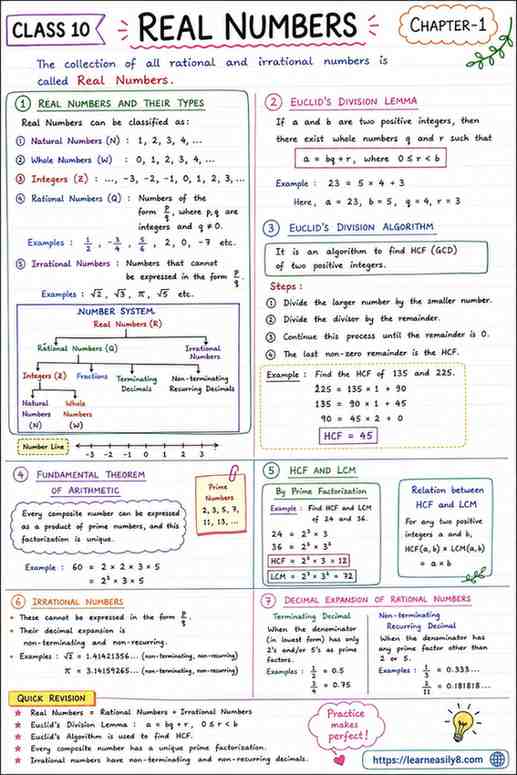
वे सभी संख्याएँ जिन्हें Number Line (संख्या रेखा) पर प्रदर्शित किया जा सकता है, Real Numbers कहलाती हैं।
Types of Real Numbers (वास्तविक संख्याओं के प्रकार)
A. Natural Numbers (प्राकृतिक संख्याएँ)
Counting Numbers को Natural Numbers कहते हैं।
Examples (उदाहरण):
1, 2, 3, 4, 5, …
B. Whole Numbers (पूर्ण संख्याएँ)
Natural Numbers तथा 0 मिलकर Whole Numbers बनाते हैं।
Examples:
0, 1, 2, 3, 4, 5, …
C. Integers (पूर्णांक)
धनात्मक, ऋणात्मक तथा शून्य मिलकर Integers कहलाते हैं।
Examples:
…, -3, -2, -1, 0, 1, 2, 3, …
D. Rational Numbers (परिमेय संख्याएँ)
वे संख्याएँ जिन्हें p/q के रूप में लिखा जा सकता है, जहाँ q ≠ 0 हो।
Examples:
1/2, 3/4, 5/8
E. Irrational Numbers (अपरिमेय संख्याएँ)
वे संख्याएँ जिन्हें p/q के रूप में नहीं लिखा जा सकता।
Examples:
√2, √3, π
Read More: Chemical Reactions and Chemical Equations Class 10 Notes (Hindi + English)
2. Euclid’s Division Lemma (यूक्लिड विभाजन प्रमेय)
Statement (कथन)
यदि a और b दो धनात्मक पूर्णांक हैं, तो
a = bq + r
जहाँ,
- q = Quotient (भागफल)
- r = Remainder (शेषफल)
- 0 ≤ r < b
Example (उदाहरण)
23 = 5 × 4 + 3
यहाँ,
- Dividend (भाज्य) = 23
- Divisor (भाजक) = 5
- Quotient (भागफल) = 4
- Remainder (शेषफल) = 3
3. Euclid’s Algorithm (यूक्लिड एल्गोरिथ्म)
Euclid’s Algorithm का उपयोग HCF (Highest Common Factor) ज्ञात करने के लिए किया जाता है।
Example
225 = 135 × 1 + 90
135 = 90 × 1 + 45
90 = 45 × 2 + 0
अतः,
HCF = 45
Important Formulae (महत्वपूर्ण सूत्र)
| English Term | Hindi Meaning | Formula |
|---|---|---|
| Euclid’s Division Lemma | यूक्लिड विभाजन प्रमेय | a = bq + r |
| Highest Common Factor | महत्तम समापवर्तक | HCF |
| Lowest Common Multiple | लघुत्तम समापवर्त्य | LCM |
| Fundamental Theorem of Arithmetic | अंकगणित का मूल प्रमेय | Prime Factorization |
Quick Revision (त्वरित पुनरावृत्ति)
✅ Real Numbers = Rational Numbers + Irrational Numbers
✅ Euclid’s Division Lemma:
a = bq + r
✅ HCF निकालने के लिए Euclid’s Algorithm का प्रयोग किया जाता है।
✅ Irrational Numbers का Decimal Expansion Non-Terminating और Non-Repeating होता है।
MCQs with Answers (बहुविकल्पीय प्रश्न)
1. Which of the following is an irrational number?
A. 3/5
B. 0.75
C. √2
D. 7
✅ Answer: C. √2
2. Euclid’s Division Lemma is represented by:
A. a = b + r
B. a = bq + r
C. a = qr
D. a = b – r
✅ Answer: B. a = bq + r
3. HCF of 12 and 18 is:
A. 2
B. 3
C. 6
D. 12
✅ Answer: C. 6
4. LCM of 12 and 18 is:
A. 24
B. 36
C. 48
D. 72
✅ Answer: B. 36
5. Which of the following is a rational number?
A. √3
B. π
C. √5
D. 7/8
✅ Answer: D. 7/8
6. The decimal expansion of an irrational number is:
A. Terminating
B. Repeating
C. Non-Terminating and Non-Repeating
D. Whole Number
✅ Answer: C
7. Prime factorization of 72 is:
A. 2³ × 3²
B. 2² × 3²
C. 2 × 3 × 12
D. 8 × 9
✅ Answer: A
8. HCF × LCM of two numbers is equal to:
A. Sum of numbers
B. Difference of numbers
C. Product of numbers
D. Quotient of numbers
✅ Answer: C
9. Which number is not a Real Number?
A. √2
B. π
C. 5
D. None of these
✅ Answer: D
10. The last divisor in Euclid’s Algorithm gives:
A. Quotient
B. Remainder
C. HCF
D. LCM
✅ Answer: C
Important Questions with Answers
Short Answer Questions
Q1. What are Real Numbers?
Answer:
All numbers that can be represented on the number line are called Real Numbers.
Examples: 2, -5, 3/4, √2, π
Q2. State Euclid’s Division Lemma.
Answer:
For any two positive integers a and b,
a = bq + r
where
0 ≤ r < b
Q3. What is an Irrational Number?
Answer:
A number that cannot be expressed in the form p/q where q ≠ 0 is called an Irrational Number.
Examples: √2, √3, π
Long Answer Questions
Q4. Find the HCF of 135 and 225 using Euclid’s Algorithm.
Answer:
225 = 135 × 1 + 90
135 = 90 × 1 + 45
90 = 45 × 2 + 0
Therefore,
HCF = 45
Q5. Find the HCF and LCM of 24 and 36 using Prime Factorization.
Answer:
24 = 2³ × 3
36 = 2² × 3²
HCF = 2² × 3
= 12
LCM = 2³ × 3²
= 72
Q6. Explain Fundamental Theorem of Arithmetic.
Answer:
Every composite number can be expressed as a product of prime numbers and this factorization is unique except for the order of factors.
Example:
60 = 2² × 3 × 5
NCERT Exercise Solutions (Selected)
Exercise 1.1
Question 1
Use Euclid’s Algorithm to find HCF of 135 and 225.
Solution:
225 = 135 × 1 + 90
135 = 90 × 1 + 45
90 = 45 × 2 + 0
Hence,
HCF = 45
Question 2
Find HCF of 196 and 38220.
Solution:
38220 = 196 × 195 + 0
Therefore,
HCF = 196
Exercise 1.2
Question
Express 156 as a product of its prime factors.
Solution:
156 = 2 × 78
= 2 × 2 × 39
= 2 × 2 × 3 × 13
= 2² × 3 × 13
Question
Find the prime factorization of 5005.
Solution:
5005 = 5 × 1001
= 5 × 7 × 143
= 5 × 7 × 11 × 13
Exercise 1.3
Question
Show that √5 is irrational.
Solution:
Assume √5 is rational.
Then
√5 = p/q
Squaring both sides,
5 = p²/q²
p² = 5q²
This implies p is divisible by 5.
Let p = 5k
Substituting,
25k² = 5q²
5k² = q²
Thus q is also divisible by 5.
This contradicts the assumption that p and q are co-prime.
Hence,
√5 is irrational.
Frequently Asked Questions (FAQs)
Q1. What are Real Numbers?
Real Numbers include all Rational Numbers and Irrational Numbers.
Q2. What is Euclid’s Division Lemma?
It is a mathematical statement given by Euclid:
a = bq + r
where 0 ≤ r < b.
Q3. What is the difference between Rational and Irrational Numbers?
Rational Numbers can be written as p/q.
Irrational Numbers cannot be written as p/q.
Q4. How do we find HCF?
HCF can be found using:
Prime Factorization Method
Euclid’s Algorithm
Q5. What is the Fundamental Theorem of Arithmetic?
Every composite number can be expressed as a unique product of prime numbers.
Q6. Is √2 a Real Number?
Yes.
√2 is an Irrational Number and hence it is also a Real Number.
Q7. Is 0 a Whole Number?
Yes.
0 belongs to the set of Whole Numbers.
Q8. Why is this chapter important for board exams?
Questions based on Euclid’s Algorithm, HCF, LCM, Prime Factorization and Irrational Numbers are frequently asked in CBSE Board Exams.