
Class 10 Maths Chapter 2 Polynomials Notes: यदि आप कक्षा 10 गणित के अध्याय 2 “Polynomials (बहुपद)” के सरल, विस्तृत और परीक्षा उपयोगी नोट्स खोज रहे हैं, तो यह लेख आपके लिए अत्यंत महत्वपूर्ण है। इस अध्याय में बहुपद की परिभाषा, घात (Degree), शून्यक (Zeroes), बहुपदों के प्रकार, शून्यकों और गुणांकों के बीच संबंध तथा Polynomial Division Algorithm जैसे महत्वपूर्ण विषयों को आसान हिंदी और अंग्रेजी भाषा में समझाया गया है।
NCERT पाठ्यक्रम के अनुसार तैयार किए गए ये नोट्स विद्यार्थियों को बोर्ड परीक्षा, स्कूल परीक्षा तथा प्रतियोगी परीक्षाओं की तैयारी में सहायता करेंगे। साथ ही अध्याय के अंत में MCQs, महत्वपूर्ण प्रश्न-उत्तर, सूत्र (Formulas) और FAQ सेक्शन भी दिया गया है, जिससे पुनरावृत्ति (Revision) करना और भी आसान हो जाता है। यदि आप Chapter 2 Polynomials को आसानी से समझना और अच्छे अंक प्राप्त करना चाहते हैं, तो इस लेख को अंत तक अवश्य पढ़ें। Download NCERT BOOK PDF.
Class 10 Maths Chapter 2 Polynomials Notes : NCERT बहुपद Notes, MCQs & Solutions
Introduction to Polynomials (बहुपद का परिचय)
In Mathematics, a Polynomial is an algebraic expression consisting of variables and constants connected by addition, subtraction, and multiplication. The powers of variables in a polynomial are always non-negative integers.
गणित में बहुपद (Polynomial) एक बीजीय व्यंजक (Algebraic Expression) होता है जिसमें चर (Variables) और नियतांक (Constants) जोड़, घटाव तथा गुणा के माध्यम से जुड़े होते हैं। किसी बहुपद में चर की घात (Power) सदैव 0 या धनात्मक पूर्णांक होती है।
Examples:
- x² + 3x + 2
- 5x³ – 2x + 7
- 4y² + 9
Not Polynomials:
- 1/x
- √x + 2
- x⁻² + 3
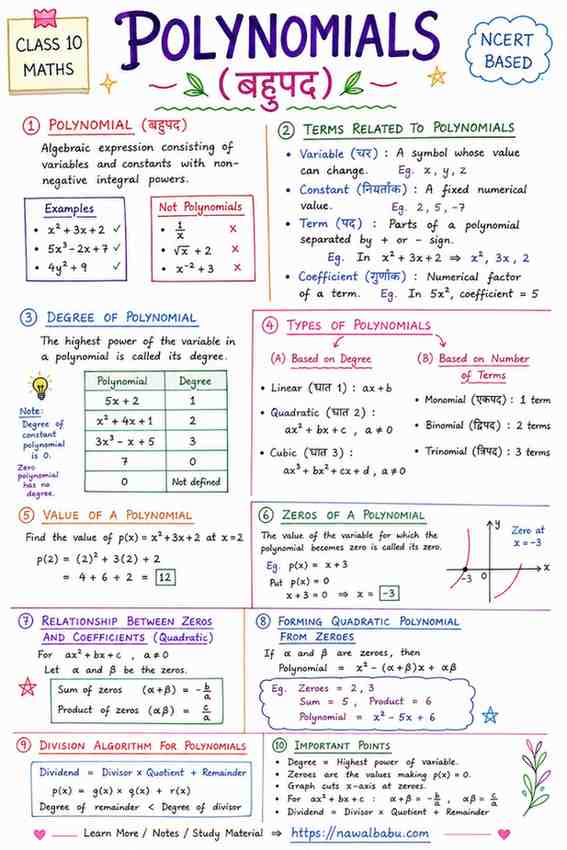
Terms Related to Polynomials (बहुपद से संबंधित शब्दावली)
To understand polynomials properly, we must know some important terms.
Variable (चर)
A symbol whose value can change.
Example: x, y, z
Constant (नियतांक)
A fixed numerical value.
Example: 2, 5, -7
Term (पद)
Each part of a polynomial separated by + or – signs.
Example: In x² + 3x + 2
- x²
- 3x
- 2
are terms.
Coefficient (गुणांक)
The numerical factor attached to a variable.
Example:
In 5x², coefficient = 5
In -3x, coefficient = -3
Degree of a Polynomial (बहुपद की घात)
The highest power of the variable in a polynomial is called its degree.
किसी बहुपद में चर की सबसे बड़ी घात को उस बहुपद की घात (Degree) कहते हैं।
Examples
| Polynomial | Degree |
|---|---|
| 5x + 2 | 1 |
| x² + 4x + 1 | 2 |
| 3x³ – x + 5 | 3 |
| 7 | 0 |
Important Points
- Constant polynomial degree = 0
- Zero polynomial degree is not defined.
- Degree determines the type of polynomial.
Types of Polynomials Based on Degree (घात के आधार पर बहुपद)
Linear Polynomial (रैखिक बहुपद)
Degree = 1
Examples:
- x + 2
- 3x – 5
General Form:
ax + b
Quadratic Polynomial (द्विघात बहुपद)
Degree = 2
Examples:
- x² + 5x + 6
- 2x² – 3
General Form:
ax² + bx + c
where a ≠ 0
Cubic Polynomial (त्रिघात बहुपद)
Degree = 3
Examples:
- x³ + 2x² + 3x + 1
- 4x³ – x
General Form:
ax³ + bx² + cx + d
Types of Polynomials Based on Number of Terms (पदों की संख्या के आधार पर)
Monomial (एकपद)
Polynomial having one term.
Examples:
- 5x
- 3x²
- 7
Binomial (द्विपद)
Polynomial having two terms.
Examples:
- x + 2
- 5x² – 3
Trinomial (त्रिपद)
Polynomial having three terms.
Examples:
- x² + 3x + 2
- 2x² + x – 5
Read Also: CBSE Class 10 Science Syllabus 2026–27 (Latest) – Complete Guide, Chapter Wise, PDF Analysis
Value of a Polynomial (बहुपद का मान)
The value of a polynomial is obtained by substituting a particular value of the variable.
Example
Find value of p(x) = x² + 3x + 2 at x = 2
p(2) = (2)² + 3(2) + 2
= 4 + 6 + 2
= 12
Answer = 12
Zeros of a Polynomial (बहुपद के शून्यक)
A zero of a polynomial is the value of the variable that makes the polynomial equal to zero.
यदि किसी x के मान पर p(x)=0 हो जाए, तो वह मान बहुपद का शून्यक कहलाता है।
Example
p(x) = x + 3
Put p(x)=0
x + 3 = 0
x = -3
Therefore,
Zero = -3
Geometrical Meaning of Zeroes (शून्यकों का ज्यामितीय अर्थ)
The zero of a polynomial represents the x-coordinate where the graph intersects the x-axis.
बहुपद का शून्यक वह बिंदु होता है जहाँ उसका ग्राफ x-अक्ष को काटता है।
Important Facts
- Linear polynomial → One zero
- Quadratic polynomial → Maximum two zeros
- Cubic polynomial → Maximum three zeros
Relationship Between Zeroes and Coefficients of Quadratic Polynomial
For a quadratic polynomial:
ax² + bx + c
Let α and β be the zeroes.
Then,
Sum of Zeroes
α + β = -b/a
Product of Zeroes
αβ = c/a
Example
x² – 5x + 6
a = 1, b = -5, c = 6
Sum of zeroes
= -(-5)/1
= 5
Product of zeroes
= 6/1
= 6
Forming Quadratic Polynomial from Given Zeroes
If α and β are zeroes, then
Polynomial:
x² – (α + β)x + αβ
Example
Zeroes = 2 and 3
Sum = 5
Product = 6
Polynomial:
x² – 5x + 6
Division Algorithm for Polynomials (बहुपदों का विभाजन एल्गोरिथ्म)
When one polynomial is divided by another polynomial, the following relation holds:
Dividend = Divisor × Quotient + Remainder
Formula
p(x) = g(x) × q(x) + r(x)
Where,
- p(x) = Dividend (भाज्य)
- g(x) = Divisor (भाजक)
- q(x) = Quotient (भागफल)
- r(x) = Remainder (शेषफल)
Important Condition
Degree of remainder < Degree of divisor
Polynomial Division Example
Divide:
x² + 3x + 2 by x + 1
Using long division:
Quotient = x + 2
Remainder = 0
Verification:
Dividend
= Divisor × Quotient + Remainder
= (x + 1)(x + 2) + 0
= x² + 3x + 2
Hence verified.
Important NCERT Points (NCERT Exam Tips)
✔ Degree of polynomial = highest power of variable.
✔ Zero polynomial has no defined degree.
✔ Zeroes are values making polynomial equal to zero.
✔ Graph intersects x-axis at zeroes.
✔ Sum of zeroes = -b/a
✔ Product of zeroes = c/a
✔ Dividend = Divisor × Quotient + Remainder
✔ Degree of remainder must be less than degree of divisor.
Multiple Choice Questions (MCQs)
Q1. Degree of x² + 5x + 7 is
A) 1
B) 2
C) 3
D) 0
Answer: B) 2
Q2. Zero of x + 4 is
A) 4
B) -4
C) 0
D) 1
Answer: B) -4
Q3. Which is a quadratic polynomial?
A) x + 2
B) x² + 3x + 1
C) x³ + 1
D) 5
Answer: B) x² + 3x + 1
Q4. Sum of zeroes of x² – 7x + 10
A) 7
B) 10
C) -7
D) -10
Answer: A) 7
Important Questions with Answers
Q1. What is a polynomial?
Answer: A polynomial is an algebraic expression consisting of variables and constants with non-negative integral powers.
Q2. What is the degree of 5x³ + 2x² – 7?
Answer: Degree = 3
Q3. Find the zero of p(x)=x−5.
Answer:
x − 5 = 0
x = 5
Zero = 5
Q4. Find sum and product of zeroes of x² − 6x + 8.
Answer:
Sum = -(-6)/1 = 6
Product = 8/1 = 8
Chapter Summary (सारांश)
Polynomials are important algebraic expressions used throughout mathematics. The degree of a polynomial is determined by its highest power. The values that make a polynomial equal to zero are called zeroes. For quadratic polynomials, the sum and product of zeroes can be found directly from coefficients. Polynomial division follows the Division Algorithm. Understanding these concepts is essential for solving higher-level algebra problems and board examination questions.
Frequently Asked Questions (FAQ)
Q1. What is a polynomial?
A polynomial is an algebraic expression containing variables with non-negative integer powers.
Q2. What is the degree of a polynomial?
The highest power of the variable is called the degree.
Q3. What are zeroes of a polynomial?
Values of variables that make the polynomial equal to zero.
Q4. Can a polynomial have negative powers?
No, a polynomial cannot contain negative powers.
Q5. What is the relation between zeroes and coefficients?
For ax² + bx + c:
- Sum of zeroes = -b/a
- Product of zeroes = c/a
Q6. What is the Division Algorithm?
Dividend = Divisor × Quotient + Remainder.