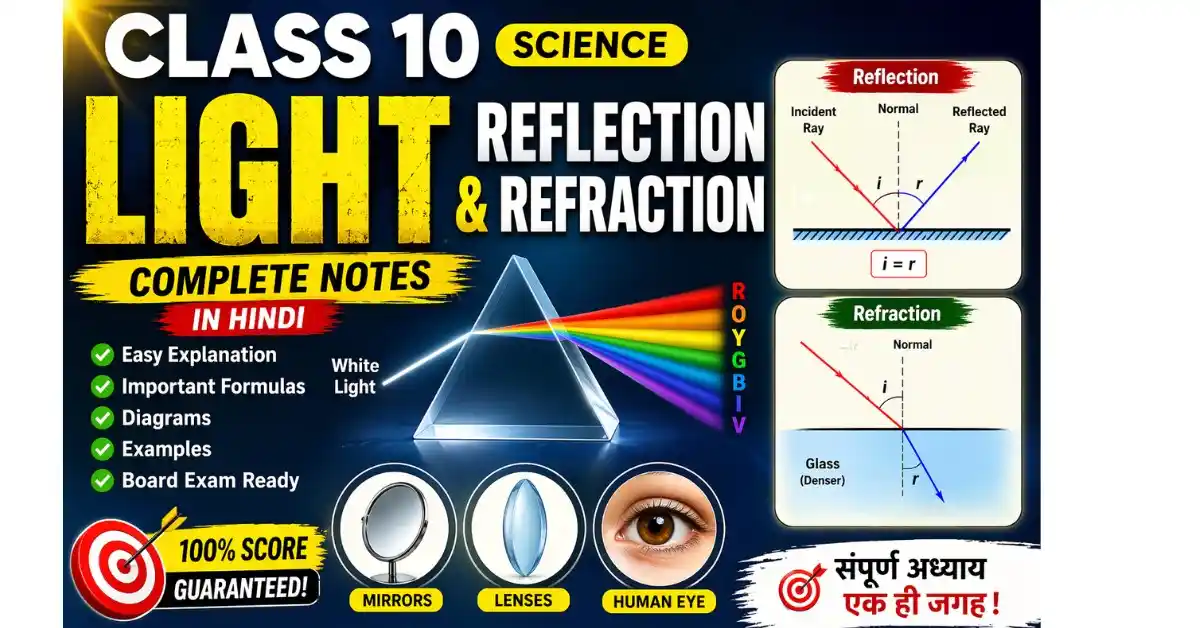
Light Reflection Refraction Class 10 Notes: प्रकाश (Light) हमारे जीवन का एक महत्वपूर्ण हिस्सा है, जिसके बिना हम किसी भी वस्तु को देख नहीं सकते। कक्षा 10 का अध्याय “Light – Reflection and Refraction” विज्ञान का एक बहुत ही महत्वपूर्ण टॉपिक है, जो बोर्ड परीक्षा में अक्सर पूछे जाने वाले प्रश्नों का आधार बनता है। इस अध्याय में हम जानेंगे कि प्रकाश किस प्रकार किसी सतह से टकराकर वापस लौटता है (Reflection) और कैसे एक माध्यम से दूसरे माध्यम में जाने पर मुड़ जाता है (Refraction)।
इसके साथ ही आप यहाँ दर्पण (Mirrors), लेंस (Lenses), अपवर्तनांक (Refractive Index), मानव नेत्र (Human Eye) और दृष्टि दोषों के बारे में सरल भाषा में समझ पाएंगे। यह नोट्स विशेष रूप से CBSE और बिहार बोर्ड के छात्रों के लिए तैयार किया गया है, ताकि वे कम समय में पूरे अध्याय को आसानी से revise कर सकें और परीक्षा में अच्छे अंक प्राप्त कर सकें। For objective questions, Visit Learneasily8.
Light Reflection Refraction Class 10 Notes: Start From Here 👇
Light (प्रकाश) is a form of energy which helps us to see objects.
👉 जब प्रकाश किसी वस्तु से टकराकर हमारी आँखों तक पहुँचता है, तब हम उस वस्तु को देख पाते हैं।
Examples: Sunlight, bulb light, torch light
Reflection of Light (प्रकाश का परावर्तन)
Definition: Reflection is the bouncing back of light from a surface.
👉 जब प्रकाश किसी सतह से टकराकर वापस लौटता है, उसे परावर्तन कहते हैं।
Laws of Reflection (परावर्तन के नियम)
- Angle of incidence (i) = Angle of reflection (r)
👉 आपतन कोण = परावर्तन कोण - Incident ray, reflected ray, and normal lie in the same plane
👉 आपतन किरण, परावर्तित किरण और अभिलम्ब एक ही तल में होते हैं।
Read More: How do Organisms Reproduce Class 10 Notes in Hindi & English | जीव कैसे प्रजनन करते हैं पूर्ण नोट्स
Types of Reflection
1. Regular Reflection (नियमित परावर्तन)
- Smooth surface (mirror)
- Clear image formed
👉 Example: Plane mirror
2. Diffused Reflection (अनियमित परावर्तन)
- Rough surface
- No clear image
👉 Example: Wall, paper
Spherical Mirrors (गोलीय दर्पण)
Types
1. Concave Mirror (अवतल दर्पण)
- Converging mirror
- Used in shaving mirror, headlights
2. Convex Mirror (उत्तल दर्पण)
- Diverging mirror
- Used as rear-view mirror
Important Terms
- Pole (P) – Mirror center
- Focus (F) – Point where rays meet
- Centre of Curvature (C)
- Radius of Curvature (R)
Mirror Formula
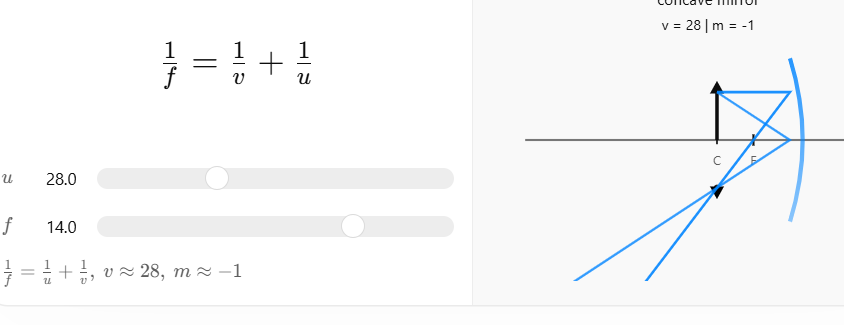
Where:
- f = focal length
- v = image distance
- u = object distance
Magnification (आवर्धन)
Refraction of Light (प्रकाश का अपवर्तन)
Definition: Refraction is bending of light when it passes from one medium to another.
👉 जब प्रकाश एक माध्यम से दूसरे माध्यम में जाता है और मुड़ता है, उसे अपवर्तन कहते हैं।
Examples:
- Straw appears bent in water
- Swimming pool looks shallow
Laws of Refraction (Snell’s Law)
OR
Where n = refractive index
Refractive Index (अपवर्तनांक)
- c = speed of light in vacuum
- v = speed of light in medium
Read Also: How do Organisms Reproduce Class 10 Notes in Hindi & English | जीव कैसे प्रजनन करते हैं पूर्ण नोट्स
Refraction through Glass Slab
- Light bends at entry and exit
- Emergent ray is parallel to incident ray
- Lateral displacement occurs
👉 Example: Glass window
Lenses (लेंस)
Types of Lenses
1. Convex Lens (उत्तल लेंस)
- Converging lens
- Used in magnifying glass
2. Concave Lens (अवतल लेंस)
- Diverging lens
- Used in spectacles
Lens Formula:
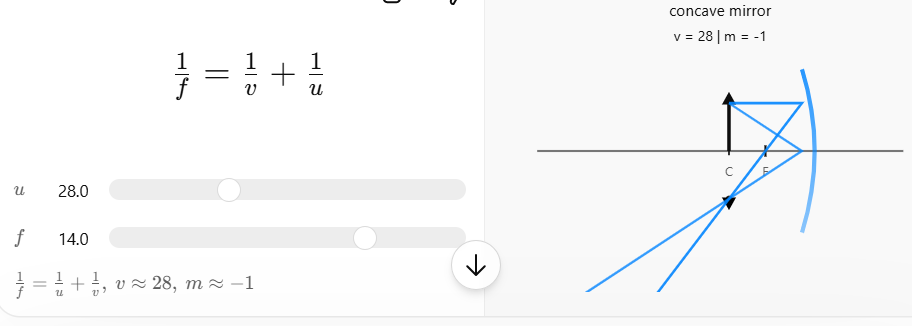
Magnification in Lens
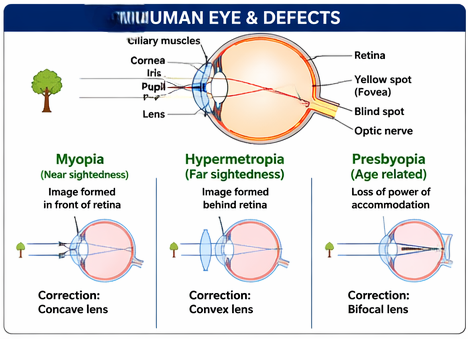
Human Eye (मानव नेत्र)
Defects of Vision
1. Myopia (निकट दृष्टि दोष)
- Near objects clear, far objects blurry
- Corrected by concave lens
2. Hypermetropia (दूर दृष्टि दोष)
- Far objects clear, near objects blurry
- Corrected by convex lens
3. Presbyopia
- Age-related defect
Power of Lens (लेंस की शक्ति)
Unit = Dioptre (D)
Important Exam Points (परीक्षा के लिए महत्वपूर्ण)
✔ Always follow sign convention
✔ Draw ray diagrams clearly
✔ Learn formulas properly
✔ Practice numericals
✔ Write definitions in simple language
Quick Revision (त्वरित पुनरावृत्ति)
- Reflection = bouncing back
- Refraction = bending of light
- Mirror formula & lens formula same
- Concave = converging
- Convex = diverging (mirror), converging (lens)
Light Reflection Refraction Class 10 Notes: Conclusion
Light plays a very important role in our daily life. Understanding reflection and refraction helps us to explain many natural phenomena and optical devices.
👉 यदि आप इन concepts को अच्छे से समझ लेते हैं, तो बोर्ड परीक्षा में इस chapter से पूरे marks लाना आसान हो जाता है।
Know More: Acids, Bases and Salts Class 10 Notes in Hindi + English | Assertion Reason & Case Study Questions
Assertion–Reason Questions (अभिकथन–कारण)
👉 Directions:
For each question, choose the correct option:
A. Both Assertion and Reason are true and Reason is the correct explanation
B. Both are true but Reason is not the correct explanation
C. Assertion is true, Reason is false
D. Assertion is false, Reason is true
Q1. Assertion: Angle of incidence is equal to angle of reflection.
Reason: Reflection follows laws of reflection.
Answer: A
Q2. Assertion: Image formed by a plane mirror is always virtual.
Reason: Reflected rays actually meet behind the mirror.
Answer: C
Q3. Assertion: Concave mirror can form real and inverted image.
Reason: It is a converging mirror.
Answer: A
Q4. Assertion: Convex mirror always forms diminished image.
Reason: It diverges light rays.
Answer: A
Q5. Assertion: Refraction occurs due to change in speed of light.
Reason: Light travels at same speed in all media.
Answer: C
Q6. Assertion: A ray of light bends towards normal when entering denser medium.
Reason: Speed of light decreases in denser medium.
Answer: A
Q7. Assertion: Refractive index has no unit.
Reason: It is a ratio of two similar quantities.
Answer: A
Q8. Assertion: Convex lens can form virtual image.
Reason: When object is placed between focus and lens.
Answer: A
Q9. Assertion: Power of lens is measured in dioptre.
Reason: It is reciprocal of focal length.
Answer: A
Q10. Assertion: Myopia is corrected using convex lens.
Reason: Myopia occurs due to image formation behind retina.
Answer: D
Case Study Questions (केस स्टडी प्रश्न)
Case Study 1: Mirror in Daily Life
Ravi uses a mirror while shaving. He observes that his face looks bigger and upright.
Questions:
- Which mirror is used by Ravi?
Answer: Concave mirror - Where is the object placed?
Answer: Between pole and focus - Nature of image formed?
Answer: Virtual and erect - Why is image enlarged?
Answer: Due to converging nature of concave mirror
Case Study 2: Refraction in Water
A pencil partially dipped in water appears bent.
Questions:
- Which phenomenon is observed?
Answer: Refraction - Why does the pencil appear bent?
Answer: Due to change in speed of light - Which medium is denser?
Answer: Water - Direction of bending?
Answer: Towards normal
Case Study 3: Use of Convex Mirror
Convex mirrors are used as rear-view mirrors in vehicles.
Questions:
- Why convex mirror is used?
Answer: Wide field of view - Nature of image formed?
Answer: Virtual, erect, diminished - Where is image formed?
Answer: Behind the mirror - Type of mirror?
Answer: Diverging mirror
Case Study 4: Human Eye Defect
A person cannot see distant objects clearly.
Questions:
- Which defect is this?
Answer: Myopia - Where is image formed?
Answer: In front of retina - Which lens is used?
Answer: Concave lens - Cause of defect?
Answer: Eyeball elongation or high curvature
Case Study 5: Lens Application
A student uses a magnifying glass to read small letters.
Questions:
- Which lens is used?
Answer: Convex lens - Nature of image?
Answer: Virtual, erect, magnified - Position of object?
Answer: Between focus and lens - Why magnification occurs?
Answer: Due to converging rays