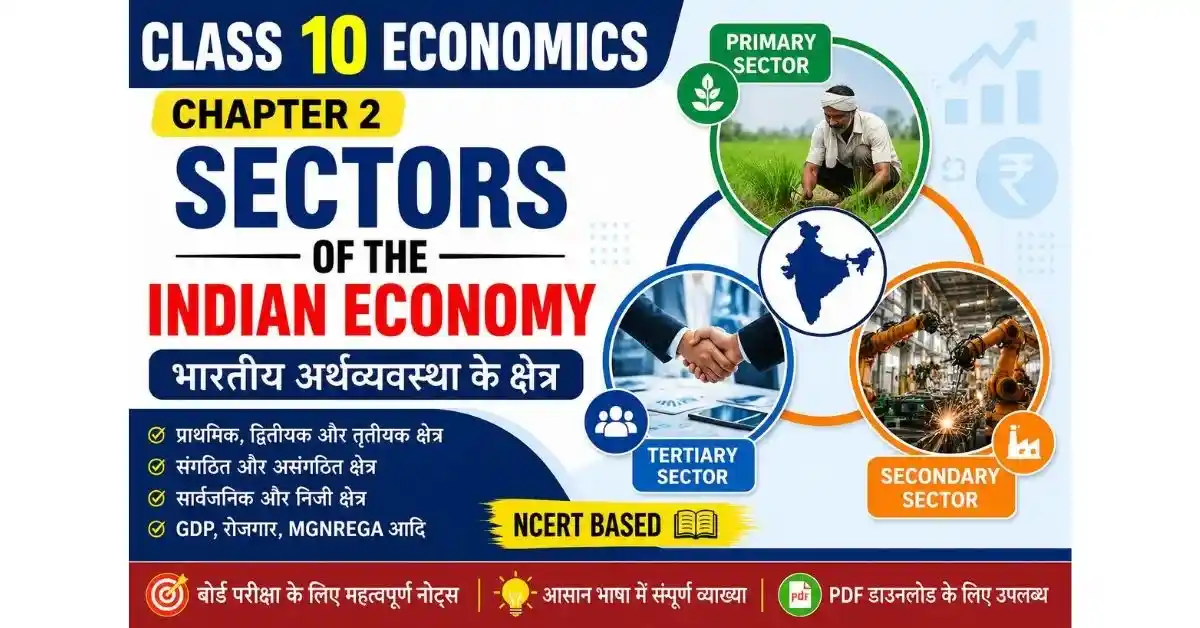
क्या आप Class 10 Economics Chapter 2 “Sectors of Indian Economy” के आसान और समझने योग्य Notes खोज रहे हैं? यदि हाँ, तो यह पोस्ट आपके लिए बहुत उपयोगी है। इस अध्याय में भारतीय अर्थव्यवस्था के विभिन्न क्षेत्रों जैसे Primary Sector, Secondary Sector और Tertiary Sector को सरल Hindi + English भाषा में विस्तार से समझाया गया है। साथ ही Organised Sector, Unorganised Sector, Public Sector, Private Sector, GDP, Disguised Unemployment तथा MGNREGA जैसे महत्वपूर्ण Topics को NCERT आधारित तरीके से शामिल किया गया है।
ये Notes बोर्ड परीक्षा की तैयारी, Revision और Quick Learning के लिए बेहद सहायक हैं। सभी Topics को आसान भाषा, Tables और Bullet Points में प्रस्तुत किया गया है ताकि विद्यार्थी कम समय में अच्छे से याद कर सकें। यदि आप Bihar Board, CBSE या अन्य बोर्ड के छात्र हैं, तो ये Notes आपके लिए अत्यंत महत्वपूर्ण हैं। Download NCERT BOOK PDF.
Sectors of Indian Economy: Class 10 Economics Chapter 2 Notes
Indian Economy is divided into different sectors on the basis of work activities. These sectors help in production of goods and services and provide employment to people. In this chapter, we study different types of sectors, their importance, employment conditions, and the role of government in economic activities.
भारतीय अर्थव्यवस्था को विभिन्न कार्यों के आधार पर अलग-अलग क्षेत्रों में बाँटा गया है। ये क्षेत्र वस्तुओं एवं सेवाओं का उत्पादन करते हैं तथा लोगों को रोजगार प्रदान करते हैं। इस अध्याय में हम विभिन्न क्षेत्रों, उनकी विशेषताओं, रोजगार की स्थिति तथा सरकार की भूमिका का अध्ययन करेंगे।
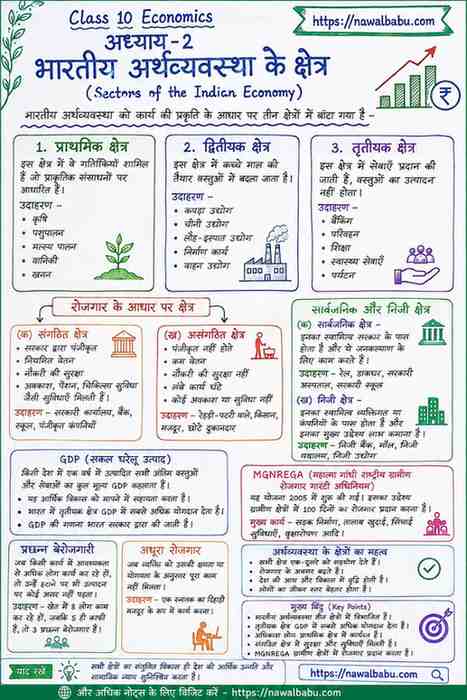
Sectors of Economic Activities: आर्थिक गतिविधियों के क्षेत्र
Economic activities are divided into three sectors:
- Primary Sector
- Secondary Sector
- Tertiary Sector
आर्थिक गतिविधियों को मुख्यतः तीन क्षेत्रों में बाँटा जाता है – प्राथमिक, द्वितीयक और तृतीयक क्षेत्र।
These sectors are classified according to the nature of work done by people.
Primary Sector (प्राथमिक क्षेत्र)
The primary sector includes activities related directly to natural resources. People depend on land, water, forests, minerals, etc. for production. Agriculture is the most important activity in this sector.
प्राथमिक क्षेत्र में वे गतिविधियाँ शामिल होती हैं जो सीधे प्राकृतिक संसाधनों पर आधारित होती हैं। जैसे – खेती, पशुपालन, मछली पालन, वनों से उत्पाद प्राप्त करना आदि।
Examples of Primary Sector
- Agriculture (कृषि)
- Dairy (दुग्ध उत्पादन)
- Fishing (मत्स्य पालन)
- Forestry (वानिकी)
- Mining (खनन)
Importance
- Provides food to people.
- Supplies raw materials to industries.
- Gives employment to a large population in India.
भारत में आज भी बड़ी संख्या में लोग प्राथमिक क्षेत्र पर निर्भर हैं।
Secondary Sector (द्वितीयक क्षेत्र)
The secondary sector is related to manufacturing and industries. In this sector, raw materials are converted into finished goods.
द्वितीयक क्षेत्र में कच्चे माल को तैयार वस्तुओं में बदला जाता है। यह क्षेत्र उद्योग और निर्माण कार्यों से संबंधित होता है।
Examples
- Textile industry
- Sugar industry
- Automobile industry
- Construction work
Features
- Uses machines and technology.
- Increases value of raw materials.
- Helps in industrial development.
उदाहरण के लिए, कपास से कपड़ा बनाना द्वितीयक क्षेत्र का कार्य है।
Tertiary Sector (तृतीयक क्षेत्र)
The tertiary sector is also called the service sector. It provides services instead of producing goods.
तृतीयक क्षेत्र को सेवा क्षेत्र भी कहा जाता है क्योंकि इसमें वस्तुओं के बजाय सेवाएँ प्रदान की जाती हैं।
Examples
- Banking
- Transport
- Education
- Health services
- Communication
- Insurance
- Tourism
Importance
- Supports primary and secondary sectors.
- Creates employment opportunities.
- Essential for modern economy.
आज भारत में सेवा क्षेत्र सबसे तेजी से बढ़ने वाला क्षेत्र है।
Comparison among Three Sectors: तीनों क्षेत्रों की तुलना
| Basis | Primary Sector | Secondary Sector | Tertiary Sector |
|---|---|---|---|
| Nature of Work | Use of natural resources | Manufacturing | Providing services |
| Output | Raw materials | Finished goods | Services |
| Examples | Farming, fishing | Industries | Banking, teaching |
Rising Importance of Tertiary Sector: सेवा क्षेत्र का बढ़ता महत्व
The tertiary sector is becoming more important due to many reasons:
Reasons
- Increase in population
- Growth of industries
- Development of transport and communication
- Rise in education and health facilities
- Expansion of banking and IT services
सेवा क्षेत्र की वृद्धि से देश की आय और रोजगार दोनों में वृद्धि हुई है।
Read Also: Acids, Bases and Salts Class 10 Notes in Hindi + English | Assertion Reason & Case Study Questions
GDP (Gross Domestic Product): सकल घरेलू उत्पाद
GDP means the total value of all final goods and services produced within a country during one year.
GDP = देश में एक वर्ष में उत्पादित सभी अंतिम वस्तुओं और सेवाओं का कुल मूल्य।
Important Points
- GDP helps to measure economic growth.
- In India, tertiary sector contributes the highest share in GDP.
- Central Government calculates GDP.
Division of Sectors on the Basis of Employment: रोजगार के आधार पर क्षेत्र
Sectors are also divided into:
- Organised Sector
- Unorganised Sector
Organised Sector (संगठित क्षेत्र)
The organised sector includes workplaces registered by the government and follows rules and regulations.
संगठित क्षेत्र में सरकारी नियमों का पालन किया जाता है।
Features
- Fixed working hours
- Job security
- Paid holidays
- Pension and medical facilities
- Regular salary
Examples
- Government offices
- Banks
- Schools
- Registered companies
Unorganised Sector (असंगठित क्षेत्र)
The unorganised sector includes small and scattered units which are not registered.
असंगठित क्षेत्र में काम करने वाले लोगों को कम सुरक्षा मिलती है।
Features
- Low wages
- No job security
- Long working hours
- No paid leave
- Poor working conditions
Examples
- Street vendors
- Farmers
- Labourers
- Small shopkeepers
भारत में अधिकांश लोग असंगठित क्षेत्र में कार्य करते हैं।
Comparison between Organised and Unorganised Sector
| Basis | Organised Sector | Unorganised Sector |
|---|---|---|
| Registration | Registered | Not registered |
| Salary | Fixed and regular | Low and uncertain |
| Job Security | Available | Not available |
| Government Rules | Followed | Mostly ignored |
H2: Public Sector and Private Sector: सार्वजनिक और निजी क्षेत्र
Economic activities are also divided on the basis of ownership.
Public Sector (सार्वजनिक क्षेत्र)
In the public sector, the government owns most of the assets and provides services.
सार्वजनिक क्षेत्र का संचालन सरकार द्वारा किया जाता है।
Examples
- Indian Railways
- Government hospitals
- Post office
- Public schools
Objectives
- Public welfare
- Development of infrastructure
- Employment generation
Private Sector (निजी क्षेत्र)
In the private sector, individuals or companies own and manage businesses.
निजी क्षेत्र का मुख्य उद्देश्य लाभ कमाना होता है।
Examples
- Private banks
- Shopping malls
- Private schools
- Industries
Features
- Profit motive
- Better technology
- Faster decision-making
Importance of Public Sector: सार्वजनिक क्षेत्र का महत्व
The government runs many activities for public welfare which private companies may not perform.
Examples
- Building roads and dams
- Providing education and healthcare
- Running railways and electricity services
सरकार समाज के गरीब और कमजोर वर्गों की सहायता के लिए सार्वजनिक क्षेत्र का संचालन करती है।
Know More: Metals and Non-Metals Class 10 Notes in Hindi + English | Assertion Reason & Case Study Questions
Employment in Different Sectors: विभिन्न क्षेत्रों में रोजगार
In India, many people are employed in the primary sector, but its contribution to GDP is less.
Important Facts
- Agriculture employs many people.
- Productivity in agriculture is low.
- Service sector contributes more to GDP.
यह स्थिति disguised unemployment को दर्शाती है।
Disguised Unemployment: प्रच्छन्न बेरोजगारी
Disguised unemployment means more people are working than actually required.
प्रच्छन्न बेरोजगारी में कुछ लोग काम से हट जाएँ तो भी उत्पादन पर कोई प्रभाव नहीं पड़ता।
Example
If 8 people are working on a farm where only 5 are needed, then 3 people are disguisedly unemployed.
Common in
- Agriculture sector
- Rural areas
Underemployment (अधूरा रोजगार)
Underemployment means people are working less than their capacity or skill.
जब व्यक्ति को उसकी योग्यता के अनुसार पूरा काम नहीं मिलता, तो उसे अधूरा रोजगार कहते हैं।
Example
A graduate working as a daily wage labourer.
Need for More Employment: अधिक रोजगार की आवश्यकता
India needs more employment opportunities because:
- Population is increasing.
- Many people are unemployed.
- Rural poverty still exists.
Solutions
- Development of industries
- Promotion of small businesses
- Improvement in education and skills
- Government employment schemes
MGNREGA: महात्मा गांधी राष्ट्रीय ग्रामीण रोजगार गारंटी अधिनियम
MGNREGA was introduced in 2005 to provide employment in rural areas.
यह योजना ग्रामीण लोगों को 100 दिनों का रोजगार प्रदान करती है।
Objectives
- Reduce unemployment
- Improve rural infrastructure
- Increase income of poor families
Works Included
- Road construction
- Pond digging
- Irrigation facilities
Sustainable Development and Sectors: सतत विकास और क्षेत्र
Economic development should not harm the environment.
आर्थिक विकास ऐसा होना चाहिए जिससे भविष्य की पीढ़ियों की आवश्यकताएँ प्रभावित न हों।
Important Measures
- Use natural resources carefully
- Reduce pollution
- Promote renewable energy
Key Terms (महत्वपूर्ण शब्द)
| Term | Meaning |
|---|---|
| GDP | Total value of final goods and services |
| Primary Sector | Sector related to natural resources |
| Tertiary Sector | Service sector |
| Organised Sector | Registered sector with job security |
| Disguised Unemployment | More workers than required |
Important NCERT Points
Very Important Facts
- Tertiary sector contributes maximum to GDP.
- Most workers are in primary sector.
- Organised sector workers get social security.
- Government controls public sector activities.
- MGNREGA provides rural employment.
Conclusion (निष्कर्ष)
The Indian economy is divided into primary, secondary, and tertiary sectors. Each sector plays an important role in the development of the country. Today, the service sector contributes the highest share to GDP, but a large population still depends on agriculture. Balanced growth of all sectors is necessary for employment generation and economic progress.
भारतीय अर्थव्यवस्था के सभी क्षेत्र देश के विकास में महत्वपूर्ण भूमिका निभाते हैं। संतुलित विकास, रोजगार सृजन और गरीबी हटाने के लिए सभी क्षेत्रों का समान विकास आवश्यक है।
FAQ – Sectors of Indian Economy Class 10
Q1. भारतीय अर्थव्यवस्था के मुख्य क्षेत्र कौन-कौन से हैं?
Ans: भारतीय अर्थव्यवस्था के मुख्य तीन क्षेत्र हैं –
प्राथमिक क्षेत्र (Primary Sector)
द्वितीयक क्षेत्र (Secondary Sector)
तृतीयक क्षेत्र (Tertiary Sector)
Q2. प्राथमिक क्षेत्र क्या है?
Ans: वह क्षेत्र जो सीधे प्राकृतिक संसाधनों पर आधारित होता है, प्राथमिक क्षेत्र कहलाता है। जैसे – कृषि, मत्स्य पालन, पशुपालन आदि।
Q3. द्वितीयक क्षेत्र किसे कहते हैं?
Ans: वह क्षेत्र जिसमें कच्चे माल को तैयार वस्तुओं में बदला जाता है, द्वितीयक क्षेत्र कहलाता है। जैसे – उद्योग, निर्माण कार्य आदि।
Q4. तृतीयक क्षेत्र को सेवा क्षेत्र क्यों कहा जाता है?
Ans: क्योंकि यह क्षेत्र वस्तुओं का उत्पादन नहीं करता बल्कि सेवाएँ प्रदान करता है, इसलिए इसे सेवा क्षेत्र कहा जाता है।
Q5. GDP का पूरा नाम क्या है?
Ans: GDP का पूरा नाम Gross Domestic Product (सकल घरेलू उत्पाद) है।
Q6. GDP क्या दर्शाता है?
Ans: GDP किसी देश में एक वर्ष में उत्पादित सभी अंतिम वस्तुओं और सेवाओं के कुल मूल्य को दर्शाता है।
Q7. संगठित क्षेत्र क्या है?
Ans: वह क्षेत्र जो सरकार के अधीन पंजीकृत होता है और जहाँ श्रमिकों को वेतन, छुट्टी तथा सुरक्षा जैसी सुविधाएँ मिलती हैं, संगठित क्षेत्र कहलाता है।
Q8. असंगठित क्षेत्र की मुख्य समस्या क्या है?
Ans: असंगठित क्षेत्र में कम वेतन, नौकरी की असुरक्षा और खराब कार्य परिस्थितियाँ मुख्य समस्याएँ हैं।
Q9. सार्वजनिक क्षेत्र किसे कहते हैं?
Ans: जिस क्षेत्र का स्वामित्व और नियंत्रण सरकार के पास होता है, उसे सार्वजनिक क्षेत्र कहते हैं।
Q10. निजी क्षेत्र का मुख्य उद्देश्य क्या होता है?
Ans: निजी क्षेत्र का मुख्य उद्देश्य लाभ कमाना होता है।