“Human Eye and Colourful World Notes” Class 10 Science का एक बेहद महत्वपूर्ण चैप्टर है, जो हमें यह समझने में मदद करता है कि हम इस खूबसूरत और रंगीन दुनिया को कैसे देख पाते हैं। इस अध्याय में मानव नेत्र की संरचना (Structure of Human Eye), उसकी कार्यप्रणाली, दृष्टि दोष (Vision Defects) जैसे Myopia और Hypermetropia, तथा उनके सुधार के तरीके को सरल भाषा में समझाया गया है।
साथ ही, हम जानेंगे कि आसमान नीला क्यों दिखाई देता है, सूर्यास्त के समय सूरज लाल क्यों होता है, और तारे टिमटिमाते क्यों हैं। यह नोट्स Hindi + English (Bilingual) में तैयार किए गए हैं ताकि सभी छात्रों को आसानी से समझ आ सके। अगर आप बोर्ड परीक्षा की तैयारी कर रहे हैं, तो यह नोट्स आपके लिए बेहद उपयोगी और स्कोर बढ़ाने में सहायक साबित होंगे। For MCQS, Visit Learneasily8.
Human Eye and Colourful World Notes: Human Eye (मानव नेत्र)
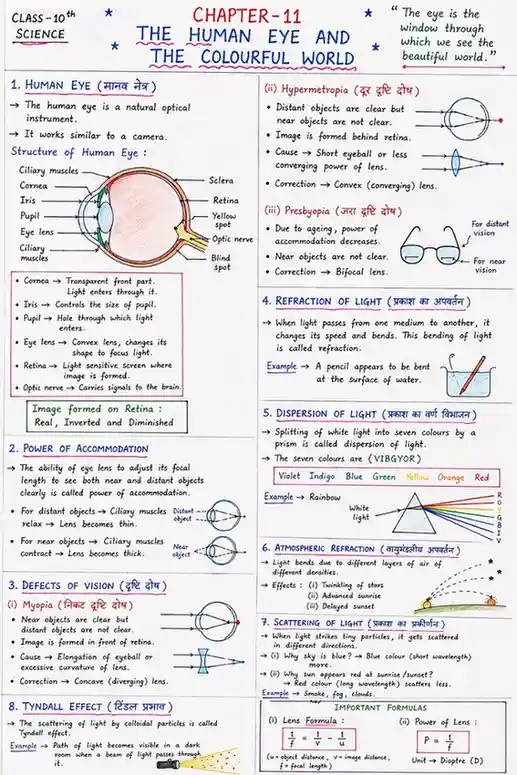
Structure of Human Eye (आँख की संरचना)
- Cornea (कॉर्निया): Transparent front part, light enters here.
- Iris (आईरिस): Controls size of pupil.
- Pupil (पुतली): Hole through which light enters.
- Eye Lens (लेंस): Convex lens that forms image.
- Retina (रेटिना): Screen where image is formed.
- Optic Nerve (ऑप्टिक नर्व): Sends signals to brain.
👉 Important Point:
Image formed on retina is real, inverted and diminished.
Power of Accommodation (समायोजन की क्षमता)
The ability of eye lens to adjust its focal length is called power of accommodation.
Example:
- दूर की वस्तु देखने पर lens thin हो जाता है
- पास की वस्तु देखने पर lens thick हो जाता है
Defects of Vision (दृष्टि दोष)
Myopia (निकट दृष्टि दोष)
- Near objects clear, distant objects blurred
- Image forms in front of retina
✔ Correction: Concave lens
Hypermetropia (दूर दृष्टि दोष)
- Distant objects clear, near objects blurred
- Image forms behind retina
✔ Correction: Convex lens
Presbyopia (जरा दृष्टि दोष)
- Age-related defect
- Near objects not clear
✔ Correction: Bifocal lens
Refraction of Light (प्रकाश का अपवर्तन)
When light changes medium, it bends. This is called refraction.
Example: Water में रखा pencil टेढ़ा दिखाई देता है
Read More: Heredity and Evolution Class 10 Notes (Hindi + English) | आसान भाषा में पूरा अध्याय, उदाहरण सहित
Dispersion of Light (प्रकाश का वर्ण विक्षेपण)
White light splits into 7 colours (VIBGYOR)
VIBGYOR=Violet,Indigo,Blue,Green,Yellow,Orange,Red
Example: Rainbow formation
Atmospheric Refraction (वायुमंडलीय अपवर्तन)
Light bends due to layers of air with different density.
Effects:
(1) Twinkling of Stars (तारों का टिमटिमाना)
- Stars appear to twinkle due to changing refraction
(2) Advanced Sunrise & Delayed Sunset
- Sun दिखाई देता है even before actual sunrise
Scattering of Light (प्रकाश का प्रकीर्णन)
When light interacts with particles, it spreads.
Why Sky is Blue? (आसमान नीला क्यों?)
- Short wavelength (blue) scatters more
Why Sun appears Red at Sunset?
- Long wavelength (red) reaches eyes
Example: Dust particles scatter light
Tyndall Effect (टिंडल प्रभाव)
Scattering of light by colloidal particles
Example: Sunlight visible in dusty room
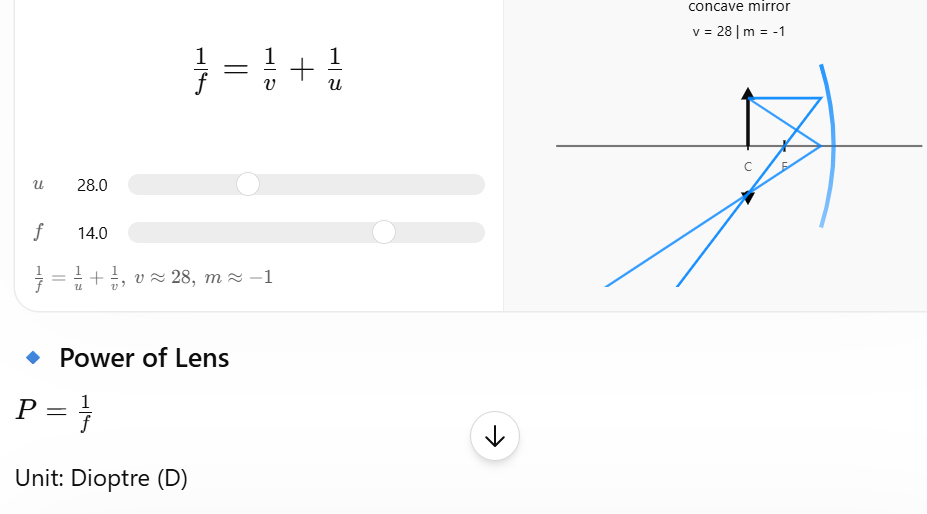
Important Formulas for Lense
Important Examples (उदाहरण)
✔ Rainbow formation
✔ Blue sky
✔ Twinkling stars
✔ Red sunset
Read Also: How do Organisms Reproduce Class 10 Notes in Hindi & English | जीव कैसे प्रजनन करते हैं पूर्ण नोट्स
Key Points for Board Exam (बोर्ड के लिए महत्वपूर्ण बिंदु)
- Human eye works like a camera
- Retina forms real and inverted image
- Myopia → Concave lens
- Hypermetropia → Convex lens
- Sky appears blue due to scattering
- Stars twinkle due to atmospheric refraction
Conclusion (निष्कर्ष)
The human eye is an amazing natural device that allows us to see the colourful world. इस चैप्टर में हमने सीखा कि हमारी आँख कैसे काम करती है, vision defects क्या होते हैं, और आसमान के रंग का कारण क्या है। यह चैप्टर बोर्ड परीक्षा के लिए बहुत महत्वपूर्ण है।
Assertion–Reason Questions
(Choose the correct option)
A. Both Assertion (A) and Reason (R) are true and R is the correct explanation of A
B. Both A and R are true but R is not the correct explanation of A
C. A is true but R is false
D. A is false but R is true
1. Assertion (A): Human eye forms a real and inverted image on the retina.
Reason (R): Eye lens is a convex lens.
Answer: A
2. Assertion (A): Myopia can be corrected using a concave lens.
Reason (R): Concave lens diverges the light rays.
Answer: A
3. Assertion (A): Hypermetropia is corrected using a convex lens.
Reason (R): Convex lens converges light rays to focus on retina.
Answer: A
4. Assertion (A): Stars appear to twinkle.
Reason (R): Due to atmospheric refraction of light.
Answer: A
5. Assertion (A): The sky appears blue.
Reason (R): Blue light is scattered more than red light.
Answer: A
6. Assertion (A): Sun appears red during sunrise and sunset.
Reason (R): Red light has longer wavelength and scatters less.
Answer: A
7. Assertion (A): Tyndall effect is due to scattering of light.
Reason (R): Light interacts with colloidal particles.
Answer: A
8. Assertion (A): A person with presbyopia cannot see nearby objects clearly.
Reason (R): Eye lens loses its power of accommodation with age.
Answer: A
9. Assertion (A): A convex lens can correct both myopia and hypermetropia.
Reason (R): Convex lens always converges light rays.
Answer: D
10. Assertion (A): Image formed on retina is diminished.
Reason (R): Eye lens has small aperture.
Answer: B
11. Assertion (A): Advanced sunrise occurs due to atmospheric refraction.
Reason (R): Light bends when it passes through layers of air.
Answer: A
12.Assertion (A): The colour of the sky appears red at noon.
Reason (R): Red light scatters more than blue light.
Answer: D
13. Assertion (A): Dispersion of light occurs through a prism.
Reason (R): Different colours have different wavelengths.
Answer: A
14. Assertion (A): A person with myopia cannot see distant objects clearly.
Reason (R): Image is formed behind the retina.
Answer: C
15. Assertion (A): The eye lens changes its shape.
Reason (R): It helps to adjust focal length.
Answer: A
16. Assertion (A): Scattering of light depends on wavelength.
Reason (R): Shorter wavelength scatters more.
Answer: A
17. Assertion (A): A concave lens is used to correct hypermetropia.
Reason (R): Concave lens diverges light rays.
Answer: D
18. Assertion (A): The retina acts like a screen.
Reason (R): Image is formed on it.
Answer: A
19. Assertion (A): The pupil regulates the amount of light entering the eye.
Reason (R): Iris controls the size of pupil.
Answer: A
20. Assertion (A): When light passes through prism, it splits into colours.
Reason (R): Different colours bend differently.
Answer: A
Case Study Based Questions
Case Study 1: Human Eye & Vision Defects
Ravi is unable to see distant objects clearly but can read a book easily. His teacher advised him to wear spectacles. After checkup, doctor suggested a specific lens.
Questions:
- Ravi is suffering from:
(a) Hypermetropia
(b) Myopia
(c) Presbyopia
(d) Astigmatism
Answer: (b) Myopia - In this defect, image is formed:
(a) On retina
(b) Behind retina
(c) In front of retina
(d) At infinity
Answer: (c) In front of retina - Which lens is used to correct it?
(a) Convex lens
(b) Concave lens
(c) Cylindrical lens
(d) Bifocal lens
Answer: (b) Concave lens - What is the main cause of this defect?
Answer: Elongation of eyeball or excessive curvature of lens
Case Study 2: Hypermetropia
Sita can see distant objects clearly but faces difficulty while reading nearby text. She consults a doctor.
Questions:
- Sita is suffering from:
(a) Myopia
(b) Hypermetropia
(c) Presbyopia
(d) Colour blindness
Answer: (b) Hypermetropia - Image is formed:
(a) In front of retina
(b) Behind retina
(c) On retina
(d) Nowhere
Answer: (b) Behind retina - Which lens is used?
Answer: Convex lens - Give one cause of hypermetropia.
Answer: Short eyeball or low converging power of lens
Case Study 3: Atmospheric Refraction
During early morning, Ramesh observes that the Sun is visible even before it actually rises above the horizon.
Questions:
- This phenomenon is called:
(a) Scattering
(b) Dispersion
(c) Atmospheric refraction
(d) Reflection
Answer: (c) Atmospheric refraction - This leads to:
(a) Delayed sunrise
(b) Advanced sunrise
(c) No change
(d) Reflection
Answer: (b) Advanced sunrise - Reason for this phenomenon:
Answer: Bending of light due to layers of atmosphere
Case Study 4: Scattering of Light
On a clear day, Rahul observes that the sky appears blue, but during sunset, the Sun appears reddish.
Questions:
- Sky appears blue due to:
(a) Reflection
(b) Refraction
(c) Scattering
(d) Dispersion
Answer: (c) Scattering - Blue colour scatters more because:
Answer: It has shorter wavelength - Sun appears red at sunset because:
Answer: Red light has longer wavelength and scatters less
Case Study 5: Dispersion of Light
A beam of white light passes through a glass prism and splits into different colours.
Questions:
- This phenomenon is called:
(a) Reflection
(b) Refraction
(c) Dispersion
(d) Scattering
Answer: (c) Dispersion - Number of colours obtained:
(a) 5
(b) 6
(c) 7
(d) 8
Answer: (c) 7 - Write the sequence of colours.
Answer: VIBGYOR
Case Study 6: Tyndall Effect
In a dusty room, sunlight entering through a window becomes visible.
Questions:
- This effect is called:
(a) Dispersion
(b) Reflection
(c) Tyndall Effect
(d) Refraction
Answer: (c) Tyndall Effect - Cause of this effect:
Answer: Scattering of light by small particles - This effect is seen in:
Answer: Colloidal solutions
Case Study 7: Twinkling of Stars
At night, stars appear to twinkle continuously.
Questions:
- Twinkling occurs due to:
(a) Reflection
(b) Dispersion
(c) Atmospheric refraction
(d) Scattering
Answer: (c) Atmospheric refraction - Planets do not twinkle because:
Answer: They are closer and appear as extended sources