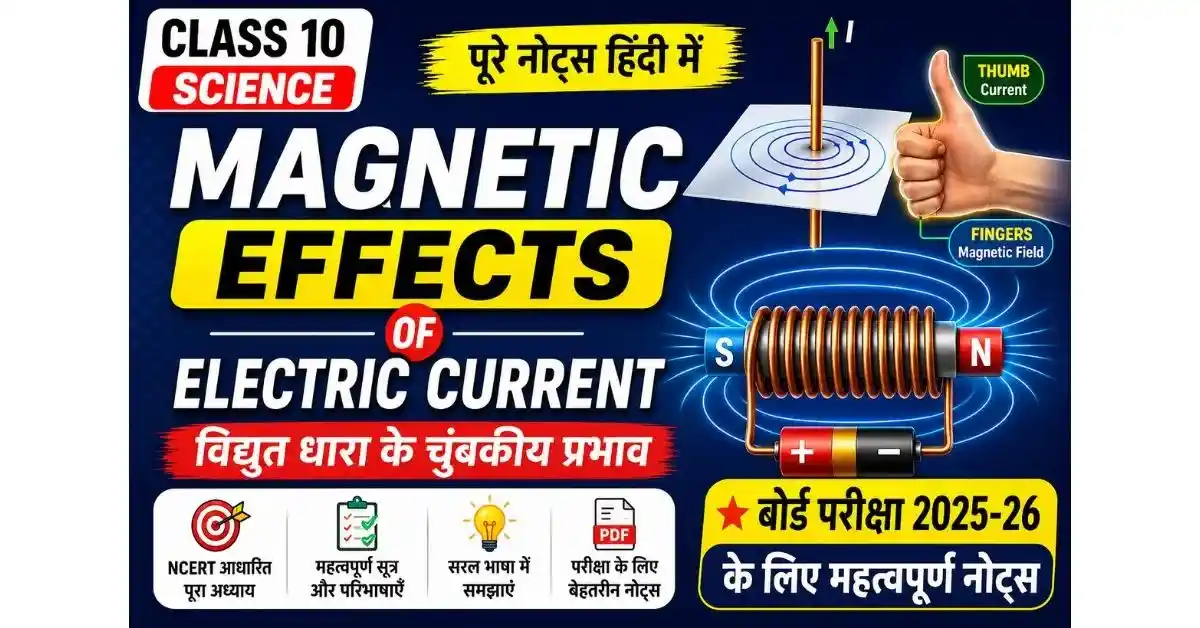
Magnetic Effects of Electric Current Class 10 Notes: कक्षा 10 विज्ञान का अध्याय “Magnetic Effects of Electric Current” बोर्ड परीक्षा के लिए अत्यंत महत्वपूर्ण है। इस अध्याय में हम सीखते हैं कि जब किसी चालक में विद्युत धारा प्रवाहित होती है, तो उसके आसपास चुंबकीय क्षेत्र कैसे उत्पन्न होता है और यह हमारे दैनिक जीवन में कैसे उपयोगी है। इस टॉपिक के माध्यम से छात्र Right Hand Thumb Rule, Fleming’s Left Hand Rule, Electric Motor, Electric Generator और Solenoid जैसे महत्वपूर्ण concepts को आसानी से समझ सकते हैं।
यह नोट्स सरल भाषा में तैयार किए गए हैं ताकि हर छात्र इसे आसानी से समझ सके और परीक्षा में अच्छे अंक प्राप्त कर सके। साथ ही इसमें महत्वपूर्ण सूत्र, उदाहरण और diagrams भी शामिल हैं, जो आपकी तैयारी को और मजबूत बनाएंगे।
अगर आप Class 10 Science के इस chapter को जल्दी और अच्छे से revise करना चाहते हैं, तो ये नोट्स आपके लिए बिल्कुल perfect हैं। For Objective Questions, Visit Learneasily8.
Magnetic Effects of Electric Current Class 10 Notes: Important Terms
जब किसी conductor (चालक) में electric current flow करता है, तो उसके आसपास magnetic field (चुंबकीय क्षेत्र) उत्पन्न होता है।
This phenomenon is called Magnetic Effect of Electric Current. Example: जब हम wire में current pass करते हैं, तो उसके पास रखा compass needle deflect करता है।
Magnetic Field (चुंबकीय क्षेत्र)
Definition (परिभाषा):
A region around a magnet or current-carrying conductor where its magnetic force can be felt is called a magnetic field. It is represented by magnetic field lines (चुंबकीय क्षेत्र रेखाएँ)
Properties of Magnetic Field Lines:
- They are closed curves (बंद वक्र)
- Outside magnet: North → South
- Inside magnet: South → North
- Never intersect each other
- Closer lines = Strong field
Magnetic Field due to Current in a Straight Conductor
जब straight wire में current flow करता है, तो उसके चारों ओर circular magnetic field lines बनती हैं।
👉 Direction Rule (Right-Hand Thumb Rule):
- Thumb → Current direction
- Fingers → Magnetic field direction
👉 Example:
यदि current ऊपर की ओर है, तो field anti-clockwise होगा।
Magnetic Field due to Circular Loop
जब wire को circular shape में रखा जाता है:
- Field lines center पर strong हो जाती हैं
- सभी circular fields मिलकर एक strong magnetic field बनाते हैं
👉 More turns = Stronger field
Solenoid (सोलिनॉइड)
Definition:
A coil of many circular turns of insulated wire is called a solenoid.
Properties:
- Produces uniform magnetic field
- Behaves like a bar magnet
- Has North & South poles
👉 Inside solenoid → Strong & uniform field
👉 Outside → Weak field
Read More: Electricity Class 10 Notes in Hindi + English | Important Formulas, Numericals & Board Exam Guide
Electromagnet (विद्युतचुंबक)
जब current-carrying solenoid में soft iron core डाला जाता है, तो वह electromagnet बन जाता है।
Advantages:
- Can be switched ON/OFF
- Strength can be controlled
- Temporary magnet
👉 Uses:
- Electric bell
- Cranes (iron lifting)
- Relays
Force on a Current Carrying Conductor
जब conductor को magnetic field में रखा जाता है, तो उस पर force लगता है।
👉 Fleming’s Left-Hand Rule:
- Thumb → Force
- Forefinger → Magnetic field
- Middle finger → Current
👉 All three are mutually perpendicular
Magnetic Effects of Electric Current Class 10 Notes: Electric Motor (विद्युत मोटर)
Principle:
A current-carrying conductor placed in a magnetic field experiences a force.
Working:
- Converts Electrical Energy → Mechanical Energy
Parts:
- Armature (coil)
- Magnet
- Split ring (commutator)
- Brushes
👉 Example: Fan, mixer, pump
Electromagnetic Induction (विद्युत चुंबकीय प्रेरण)
Definition:
When magnetic field changes around a conductor, an electric current is induced.
👉 Discovered by Michael Faraday
Electric Generator (विद्युत जनित्र)
Principle:
Electromagnetic Induction
Function:
- Converts Mechanical Energy → Electrical Energy
Types:
- AC Generator
- DC Generator
👉 Example: Power plants
Domestic Electric Circuit (घरेलू विद्युत परिपथ)
Key Components:
- Live wire (Phase)
- Neutral wire
- Earth wire
Safety Devices:
- Fuse (फ्यूज)
- MCB (Miniature Circuit Breaker)
Fuse (फ्यूज)
Function:
Protects circuit from overload
👉 Works on heating effect of current
Short Circuit (शॉर्ट सर्किट)
When live and neutral wires touch each other, very high current flows → Short circuit
👉 Causes:
- Fire hazard
- Damage to appliances
Important Formulas (महत्वपूर्ण सूत्र)
Magnetic Field Strength:
B ∝ I
B ∝ 1/r
👉 Where:
B = Magnetic field
I = Current
r = Distance
Real Life Examples
- Electric fan → Motor
- Power station → Generator
- MRI machine → Electromagnet
- Compass → Magnetic field detection
Quick Revision Points
✔ Current produces magnetic field
✔ Right-hand thumb rule → Direction
✔ Solenoid → Strong magnet
✔ Motor → Electrical → Mechanical
✔ Generator → Mechanical → Electrical
✔ Fuse protects circuit
Know More: Heredity and Evolution Class 10 Notes (Hindi + English) | आसान भाषा में पूरा अध्याय, उदाहरण सहित
Magnetic Effects of Electric Current Class 10 Notes: Conclusion
“Magnetic Effects of Electric Current” chapter हमें यह समझाता है कि electricity और magnetism आपस में जुड़े हुए हैं।
This concept is the foundation of many modern devices like motors, generators, and transformers.
Assertion-Reason Questions
Directions (निर्देश):
प्रत्येक प्रश्न में Assertion (A) और Reason (R) दिए गए हैं। सही विकल्प चुनें:
A. Both A and R are true and R is the correct explanation of A
B. Both A and R are true but R is NOT the correct explanation of A
C. A is true but R is false
D. A is false but R is true
Questions
- Assertion (A): A current-carrying conductor produces a magnetic field around it.
Reason (R): Moving electric charges produce magnetic effects.
Answer: A
2. Assertion (A): Magnetic field lines never intersect each other.
Reason (R): At any point, magnetic field has a unique direction.
Answer: A
3. Assertion (A): Strength of magnetic field increases with increase in current.
Reason (R): Magnetic field is directly proportional to current.
Answer: A
4. Assertion (A): A solenoid behaves like a bar magnet.
Reason (R): Magnetic field lines inside a solenoid are parallel and uniform.
Answer: A
5. Assertion (A): Direction of magnetic field can be found using Right-Hand Thumb Rule.
Reason (R): Thumb shows direction of magnetic field.
Answer: C
6. Assertion (A): A compass needle gets deflected near a current-carrying wire.
Reason (R): Electric current produces magnetic field around it.
Answer: A
7. Assertion (A): Electric motor converts electrical energy into mechanical energy.
Reason (R): It works on the principle of electromagnetic induction.
Answer: C
8. Assertion (A): Electric generator produces electric current.
Reason (R): It works on the principle of electromagnetic induction.
Answer: A
9. Assertion (A): Magnetic field inside a solenoid is weak.
Reason (R): Field lines inside a solenoid are crowded.
Answer: D
10. Assertion (A): Fleming’s Left Hand Rule is used to find direction of force.
Reason (R): It gives relation between current, magnetic field and force.
Answer: A
11. Assertion (A): A fuse protects the circuit from overload.
Reason (R): Fuse wire has high melting point.
Answer: C
12. Assertion (A): Magnetic field lines form closed loops.
Reason (R): Magnetic monopoles do not exist.
Answer: A
13. Assertion (A): Increasing number of turns in a coil increases magnetic field.
Reason (R): More turns produce stronger combined magnetic effect.
Answer: A
14. Assertion (A): Magnetic field strength decreases with distance from conductor.
Reason (R): Magnetic field is inversely proportional to distance.
Answer: A
15. Assertion (A): In an electromagnet, soft iron core is used.
Reason (R): Soft iron retains magnetism permanently.
Answer: C
Case Study Questions
Case Study 1: Current Carrying Conductor
Passage:
When an electric current flows through a straight conductor, it produces a magnetic field around it. The direction of this magnetic field can be determined using the Right-Hand Thumb Rule. If the current increases, the strength of the magnetic field also increases.
प्रश्न:
- A current-carrying conductor produces:
a) Electric field only
b) Magnetic field only
c) Both electric and magnetic field
d) No field
Answer: c - The direction of magnetic field is determined by:
a) Fleming’s Right Hand Rule
b) Right-Hand Thumb Rule
c) Ohm’s Law
d) Newton’s Law
Answer: b - If current increases, magnetic field will:
a) Decrease
b) Increase
c) Remain same
d) Become zero
Answer: b - Magnetic field lines around straight conductor are:
a) Straight lines
b) Circular
c) Elliptical
d) Random
Answer: b
Case Study 2: Solenoid and Electromagnet
Passage:
A solenoid is a long coil of wire that produces a uniform magnetic field when current flows through it. When a soft iron core is placed inside the solenoid, it becomes a strong electromagnet.
प्रश्न:
- Solenoid produces:
a) Non-uniform field
b) Uniform magnetic field
c) No field
d) Electric field
Answer: b - Electromagnet is formed by:
a) Steel core
b) Copper core
c) Soft iron core
d) Aluminium core
Answer: c - Strength of electromagnet depends on:
a) Current only
b) Number of turns only
c) Both current and turns
d) None
Answer: c - Magnetic field inside solenoid is:
a) Weak
b) Uniform and strong
c) Zero
d) Irregular
Answer: b
Case Study 3: Electric Motor
Passage:
An electric motor converts electrical energy into mechanical energy. It works on the principle that a current-carrying conductor placed in a magnetic field experiences a force. The direction of force is given by Fleming’s Left Hand Rule.
प्रश्न:
- Electric motor converts:
a) Mechanical → Electrical
b) Electrical → Mechanical
c) Heat → Electrical
d) Light → Mechanical
Answer: b - Motor works on:
a) Ohm’s Law
b) Electromagnetic induction
c) Force on current-carrying conductor
d) Reflection
Answer: c - Direction of force is given by:
a) Right-Hand Rule
b) Fleming’s Left-Hand Rule
c) Newton’s Law
d) Ampere’s Law
Answer: b - A motor is used in:
a) Generator
b) Fan
c) Transformer
d) Fuse
Answer: b
Case Study 4: Electric Generator
Passage:
An electric generator converts mechanical energy into electrical energy. It works on the principle of electromagnetic induction discovered by Michael Faraday.
प्रश्न:
- Generator converts:
a) Electrical → Mechanical
b) Mechanical → Electrical
c) Heat → Mechanical
d) Light → Electrical
Answer: b - Principle used is:
a) Ohm’s Law
b) Electromagnetic induction
c) Reflection
d) Refraction
Answer: b - Who discovered this principle?
a) Newton
b) Faraday
c) Einstein
d) Tesla
Answer: b - Generator is used in:
a) Electric fan
b) Power plants
c) Bulb
d) Fuse
Answer: b
Case Study 5: Domestic Electric Circuit
Passage:
In domestic circuits, live, neutral and earth wires are used. Fuse is a safety device that protects appliances from overload by melting when current exceeds a limit.
प्रश्न:
- Fuse works on:
a) Magnetic effect
b) Heating effect
c) Chemical effect
d) Optical effect
Answer: b - Earth wire is used for:
a) Increasing current
b) Safety
c) Voltage supply
d) Heating
Answer: b - Overload causes:
a) Low current
b) High current
c) No current
d) Constant current
Answer: b - Live wire carries:
a) Zero current
b) Current to appliance
c) Return current
d) Earth current
Answer: b