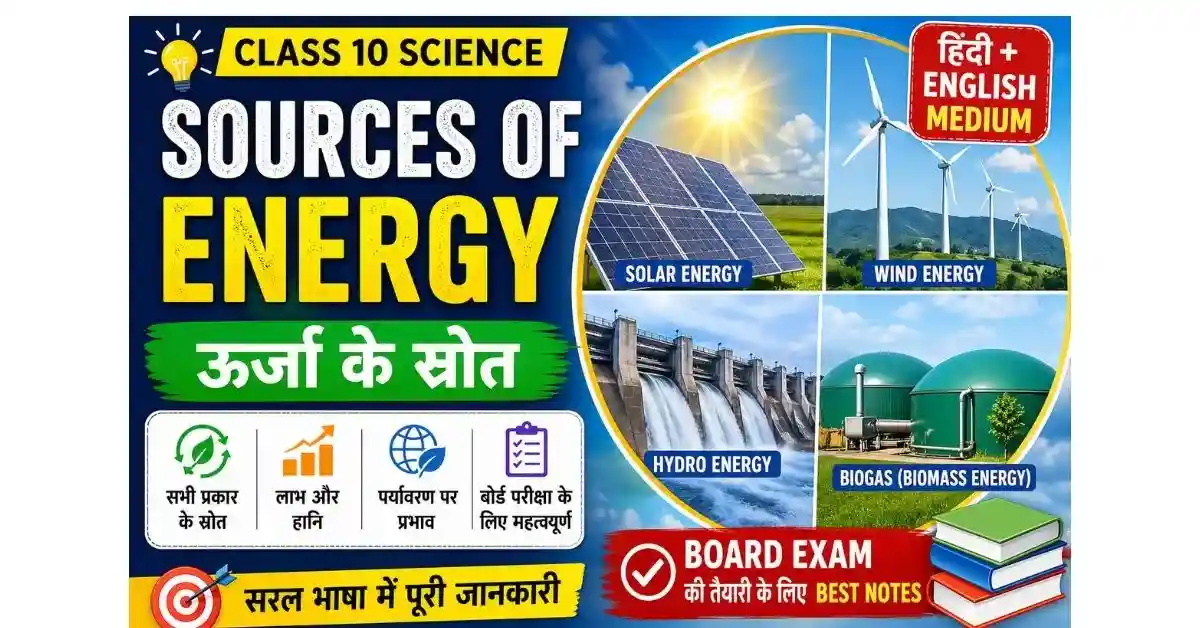
Sources of Energy Class 10 Notes: ऊर्जा हमारे दैनिक जीवन का सबसे महत्वपूर्ण हिस्सा है। खाना बनाने से लेकर मोबाइल चार्ज करने और वाहन चलाने तक हर कार्य के लिए ऊर्जा की आवश्यकता होती है। लेकिन क्या आपने कभी सोचा है कि यह ऊर्जा हमें कहां से मिलती है? यही प्रश्न हमें “ऊर्जा के स्रोत” (Sources of Energy) की ओर ले जाता है। कक्षा 10 विज्ञान का यह अध्याय बोर्ड परीक्षा के लिए बहुत महत्वपूर्ण है क्योंकि इसमें ऊर्जा के प्रकार, उनके उपयोग, लाभ-हानि तथा पर्यावरण पर प्रभाव को विस्तार से समझाया गया है।
इस पोस्ट में हम सरल और आसान भाषा में सभी प्रकार के ऊर्जा स्रोतों जैसे सौर ऊर्जा, पवन ऊर्जा, जल ऊर्जा और जीवाश्म ईंधन को उदाहरण सहित समझेंगे। साथ ही, यह भी जानेंगे कि भविष्य के लिए कौन से ऊर्जा स्रोत सबसे बेहतर हैं और हमें ऊर्जा का संरक्षण क्यों करना चाहिए। For Objective Questions, Visit Learneasily8.
Sources of Energy Class 10 Notes: Start Now
इस पोस्ट में हमलोग जानेगें की ऊर्जा के कौन -कौन से श्रोत हैं । इसके अलावे इनके कौन से श्रोत अच्छे हैं कौन खराब । अच्छे ऊर्जा के कौन सा श्रोत की आगे भविष्य में संभावनए है। इन ऊर्जा श्रोत का हमारे पर्यावरण पर क्या प्रभाव पड़ता है ।
Sources of Energy (ऊर्जा के स्रोत) – Class 10 Notes
Energy is required for all activities like cooking, transport, electricity generation, industries, etc.
Energy comes from different sources, which are called Sources of Energy.
ऊर्जा हमारे जीवन की हर गतिविधि के लिए आवश्यक है जैसे खाना बनाना, वाहन चलाना, बिजली उत्पादन आदि।
ऊर्जा जिन स्रोतों से प्राप्त होती है उन्हें ऊर्जा के स्रोत कहते हैं।
What is a Good Source of Energy?
(अच्छे ऊर्जा स्रोत के गुण)
A good source of energy should have the following characteristics:
1. High Calorific Value (उच्च ऊष्मीय मान)
- It should produce large amount of heat per unit mass.
- Example: Petrol, LPG
👉 अधिक ऊर्जा देने वाला होना चाहिए।
2. Easy Availability (सुलभता)
- It should be easily available.
👉 आसानी से मिलना चाहिए।
3. Easy Storage and Transport (संग्रहण व परिवहन में आसान)
- It should be easy to store and transport.
👉 आसानी से रखा और ले जाया जा सके।
4. Economical (सस्ता)
- It should be cost-effective.
👉 किफायती होना चाहिए।
5. Less Pollution (कम प्रदूषण)
- It should not harm the environment.
👉 पर्यावरण को नुकसान नहीं पहुंचाना चाहिए।
Types of Sources of Energy
(ऊर्जा के स्रोतों के प्रकार)
Energy sources are mainly divided into:
Non-Renewable Sources (अपरिवर्तनीय / समाप्त होने वाले स्रोत)
Definition:
These sources are limited and can be exhausted.
👉 ये सीमित होते हैं और खत्म हो सकते हैं।
Examples:
- Coal (कोयला)
- Petroleum (पेट्रोलियम)
- Natural Gas (प्राकृतिक गैस)
Fossil Fuels (जीवाश्म ईंधन)
Formed from dead plants and animals over millions of years.
👉 लाखों वर्षों में बने होते हैं।
Advantages:
- High energy
- Easy to use
Disadvantages:
- Cause pollution
- Limited supply
Renewable Sources (नवीकरणीय ऊर्जा स्रोत)
Definition:
These sources are replenished naturally and are unlimited.
👉 ये प्राकृतिक रूप से पुनः बनते रहते हैं।
Examples:
- Solar Energy (सौर ऊर्जा)
- Wind Energy (पवन ऊर्जा)
- Hydropower (जल ऊर्जा)
- Biomass (बायोमास)
Read More: Heredity and Evolution Class 10 Notes (Hindi + English) | आसान भाषा में पूरा अध्याय, उदाहरण सहित
Solar Energy (सौर ऊर्जा)
Energy obtained from the Sun.
👉 सूर्य से प्राप्त ऊर्जा।
Uses:
- Solar cooker
- Solar panels
- Solar water heater
Advantages:
- Clean and renewable
- No pollution
Disadvantages:
- Depends on sunlight
- Expensive setup
Wind Energy (पवन ऊर्जा)
Energy obtained from moving air using windmills.
Advantages:
- No pollution
- Renewable
Disadvantages:
- Needs large area
- Not available everywhere
Hydroelectric Energy (जल विद्युत)
Energy produced from flowing water.
Example:
Dams like Bhakra Nangal
Advantages:
- Clean energy
- Renewable
Disadvantages:
- Affects environment
- High cost of dams
Biomass Energy (बायोमास ऊर्जा)
Energy from plant and animal waste.
Examples:
- Wood
- Cow dung
- Biogas
Biogas (बायोगैस)
Produced from decomposition of organic waste.
Advantages:
- Clean fuel
- Reduces waste
Thermal Power Plant (ताप विद्युत संयंत्र)
Uses fossil fuels to generate electricity.
Working:
Coal is burned → Heat → Steam → Turbine → Electricity
Nuclear Energy (परमाणु ऊर्जा)
Energy obtained from nuclear reactions.
Example:
Uranium
Advantages:
- Large amount of energy
Disadvantages:
- Radioactive waste
- Risky
Read Also: How do Organisms Reproduce Class 10 Notes in Hindi & English | जीव कैसे प्रजनन करते हैं पूर्ण नोट्स
Conventional vs Non-Conventional Sources
| Conventional (पारंपरिक) | Non-Conventional (अपरंपरागत) |
|---|---|
| Coal, Petroleum | Solar, Wind |
| Limited | Unlimited |
| Polluting | Eco-friendly |
Environmental Consequences
(पर्यावरणीय प्रभाव)
Problems:
- Air pollution
- Global warming
- Acid rain
👉 जीवाश्म ईंधन के उपयोग से पर्यावरण को नुकसान होता है।
Energy Conservation (ऊर्जा संरक्षण)
Methods:
- Use LED bulbs
- Switch off appliances
- Use renewable energy
👉 ऊर्जा बचाना जरूरी है।
Important Examples for Board Exams
✔ Solar cooker – uses sunlight
✔ Windmill – converts wind into electricity
✔ Biogas plant – produces clean fuel
✔ Hydropower dam – uses flowing water
Conclusion (निष्कर्ष)
Energy is essential for development, but we must use it wisely.
Renewable sources are the future as they are eco-friendly and unlimited.
👉 ऊर्जा का सही उपयोग और संरक्षण हमारे भविष्य के लिए आवश्यक है।
Assertion–Reason Questions (ऊर्जा के स्रोत)
👉 Directions (निर्देश):
For each question, choose the correct option:
(A) Both Assertion and Reason are true and Reason is the correct explanation of Assertion
(B) Both Assertion and Reason are true but Reason is NOT the correct explanation
(C) Assertion is true but Reason is false
(D) Assertion is false but Reason is true
Questions
Q1. Assertion (A): Fossil fuels are non-renewable sources of energy.
Reason (R): They are formed over millions of years from dead organisms.
Answer: (A)
Q2. Assertion (A): Solar energy is considered a clean source of energy.
Reason (R): It does not produce harmful gases during use.
Answer: (A)
Q3. Assertion (A): Wind energy can be used everywhere in India.
Reason (R): Wind energy depends on the availability of strong winds.
Answer: (D)
Q4. Assertion (A): Biogas is an eco-friendly fuel.
Reason (R): It is produced by burning fossil fuels.
Answer: (C)
Q5. Assertion (A): Hydroelectric power plants produce electricity without pollution.
Reason (R): They use flowing water to generate electricity.
Answer: (A)
Q6. Assertion (A): A good fuel should have high calorific value.
Reason (R): It produces more heat energy per unit mass.
Answer: (A)
Q7. Assertion (A): Nuclear energy produces a large amount of energy.
Reason (R): It involves chemical reactions.
Answer: (C)
Q8. Assertion (A): Renewable sources of energy are unlimited.
Reason (R): They can be replenished naturally.
Answer: (A)
Q9. Assertion (A): Burning of coal causes air pollution.
Reason (R): It releases carbon dioxide and other gases.
Answer: (A)
Q10. Assertion (A): Biomass is a renewable source of energy.
Reason (R): It is obtained from plant and animal waste.
Answer: (A)
Q11. Assertion (A): Solar cookers can be used at night.
Reason (R): Solar energy depends on sunlight.
Answer: (D)
Q12. Assertion (A): Fossil fuels are exhaustible.
Reason (R): Their supply is limited.
Answer: (A)
Q13. Assertion (A): Wind energy does not cause pollution.
Reason (R): It uses moving air to generate electricity.
Answer: (A)
Q14. Assertion (A): Thermal power plants use coal to generate electricity.
Reason (R): Coal is burned to produce steam.
Answer: (A)
Q15. Assertion (A): Renewable energy sources are harmful to environment.
Reason (R): They produce greenhouse gases.
Answer: (D)
Q16. Assertion (A): Biogas plants help in waste management.
Reason (R): They convert organic waste into useful fuel.
Answer: (A)
Q17. Assertion (A): Petroleum is a renewable source of energy.
Reason (R): It is formed naturally in the earth.
Answer: (D)
Q18. Assertion (A): Hydropower projects may disturb ecological balance.
Reason (R): Large dams submerge forests and habitats.
Answer: (A)
Q19. Assertion (A): LPG is a cleaner fuel than coal.
Reason (R): It produces less smoke and harmful gases.
Answer: (A)
Q20. Assertion (A): Energy conservation is important.
Reason (R): Energy resources are limited.
Answer: (A)
Case Study Questions – Sources of Energy
Case Study 1: Solar Village (सौर ऊर्जा गांव)
A village in Rajasthan has installed solar panels on rooftops. The villagers use solar cookers and solar water heaters. This has reduced their dependence on coal and LPG. However, during cloudy days, electricity production decreases.
राजस्थान के एक गांव में घरों की छतों पर सोलर पैनल लगाए गए हैं। लोग सोलर कुकर और सोलर हीटर का उपयोग करते हैं। इससे कोयला और LPG पर निर्भरता कम हुई है। लेकिन बादलों वाले दिनों में बिजली उत्पादन कम हो जाता है।
Questions:
Q1. Why is solar energy considered renewable?
सौर ऊर्जा को नवीकरणीय क्यों कहा जाता है?
Answer: Because it is continuously available from the Sun.
Q2. What is one limitation of solar energy?
सौर ऊर्जा की एक कमी बताइए।
Answer: It depends on sunlight (not available at night or cloudy days).
Q3. Which device is used to convert solar energy into electricity?
Answer: Solar panel
Q4. How does solar energy help the environment?
Answer: It reduces pollution and use of fossil fuels.
Case Study 2: Thermal Power Plant (ताप विद्युत संयंत्र)
A thermal power plant burns coal to produce heat. This heat converts water into steam, which rotates turbines to generate electricity. However, it also releases harmful gases into the atmosphere.
एक ताप विद्युत संयंत्र कोयला जलाकर ऊष्मा उत्पन्न करता है। यह ऊष्मा पानी को भाप में बदलती है जो टरबाइन घुमाकर बिजली उत्पन्न करती है। लेकिन यह वातावरण में हानिकारक गैसें भी छोड़ता है।
Questions:
Q1. Which fuel is used in thermal power plants?
Answer: Coal
Q2. What is the disadvantage of thermal power plants?
Answer: Air pollution due to harmful gases.
Q3. Why is coal called a non-renewable resource?
Answer: It takes millions of years to form.
Q4. What is the role of steam in electricity generation?
Answer: It rotates the turbine.
Case Study 3: Wind Energy Project (पवन ऊर्जा परियोजना)
In coastal areas, windmills are installed to generate electricity. Wind rotates the blades of windmills, which drives turbines. However, wind energy is not available all the time.
तटीय क्षेत्रों में पवन चक्कियाँ लगाई जाती हैं। हवा पंखों को घुमाती है जिससे टरबाइन चलती है और बिजली बनती है। लेकिन हवा हमेशा उपलब्ध नहीं होती।
Questions:
Q1. What type of energy is wind energy?
Answer: Renewable energy
Q2. Why are windmills installed in coastal areas?
Answer: Because wind speed is high there.
Q3. What is one limitation of wind energy?
Answer: Wind is not constant.
Q4. Does wind energy cause pollution?
Answer: No
Case Study 4: Biogas Plant (बायोगैस संयंत्र)
A farmer uses cow dung and kitchen waste in a biogas plant. Microorganisms decompose the waste and produce biogas, which is used for cooking. The leftover slurry is used as manure.
एक किसान गोबर और रसोई के कचरे से बायोगैस बनाता है। सूक्ष्मजीव इस कचरे को विघटित कर गैस बनाते हैं। बचा हुआ पदार्थ खाद के रूप में उपयोग होता है।
Questions:
Q1. What type of fuel is biogas?
Answer: Clean and renewable fuel
Q2. What is the raw material for biogas?
Answer: Organic waste (cow dung, kitchen waste)
Q3. What is the by-product of biogas plant?
Answer: Manure
Q4. Why is biogas eco-friendly?
Answer: It reduces waste and pollution.
Case Study 5: Hydropower Project (जल विद्युत परियोजना)
A dam is built across a river to store water. The stored water is released to rotate turbines and generate electricity. However, large areas of land get submerged.
एक नदी पर बांध बनाया जाता है। संग्रहित पानी को छोड़कर टरबाइन घुमाई जाती है जिससे बिजली बनती है। लेकिन इससे बड़ी भूमि जलमग्न हो जाती है।
Questions:
Q1. Which energy is used in hydropower plants?
Answer: Kinetic energy of flowing water
Q2. What is one disadvantage of dams?
Answer: Submergence of land and forests
Q3. Is hydropower renewable?
Answer: Yes
Q4. Name one example of a dam.
Answer: Bhakra Nangal Dam