The Tale of Custard the Dragon Class 10 English Notes विद्यार्थियों के लिए आसान भाषा में तैयार किए गए हैं। यह कविता Ogden Nash द्वारा लिखी गई है और NCERT की First Flight पुस्तक का महत्वपूर्ण हिस्सा है। इस कविता में Belinda और उसके पालतू जानवरों—Ink, Blink, Mustard और Custard—की मजेदार कहानी प्रस्तुत की गई है। सभी पात्र खुद को बहादुर मानते हैं, लेकिन असली साहस का परिचय केवल Custard तब देता है, जब एक खतरनाक pirate उनके घर में प्रवेश करता है।
ये notes विद्यार्थियों को कविता का Hindi Summary, English Explanation, Central Idea, Theme, Character Sketch, Poetic Devices, Word Meanings और Important Questions & Answers सरल तरीके से समझने में मदद करेंगे। साथ ही, परीक्षा की तैयारी के लिए Quick Revision Notes और महत्वपूर्ण प्रश्न भी दिए गए हैं। यदि आप Class 10 English में अच्छे अंक प्राप्त करना चाहते हैं, तो ये notes आपके revision और board exam preparation के लिए बेहद उपयोगी होंगे। Download PDF of these notes.
The Tale of Custard the Dragon Class 10 Notes: Summary, Explanation
Poet: Ogden Nash
Book: First Flight – NCERT Class 10 English
Poem: The Tale of Custard the Dragon
मुख्य विषय: Courage, appearance vs. reality, humility and true bravery
Introduction / परिचय
The Tale of Custard the Dragon is a humorous and interesting narrative poem written by Ogden Nash. The poem tells the story of Belinda, her pets and a dragon named Custard. Belinda and her other pets always boast about their bravery, while Custard appears timid and cowardly. However, when a pirate enters the house, Custard is the only one who actually faces the danger. The poem teaches us that true courage is shown through actions, not through words or boasting.
About the Poet – Ogden Nash
Ogden Nash was a famous American poet known for his humorous and witty poems. His poems often use simple language, unusual rhymes and funny situations to communicate meaningful ideas. In this poem, Nash creates amusing characters and presents an important lesson about courage. He uses exaggerated descriptions, playful rhymes and comic situations to make the poem enjoyable for students. Through Custard, Nash shows that a person who looks weak or fearful may actually be the bravest person in a difficult situation.
Main Characters / मुख्य पात्र
Belinda
Belinda is a young girl who lives in a little white house. She has several pets—Ink, Blink, Mustard and Custard. She considers herself very brave and is proud of her courage. However, when the pirate enters her house, she becomes frightened and cries for help. Her character shows the difference between claiming to be brave and actually showing bravery. Belinda represents people who may boast about their courage but fail to act when real danger appears.
Custard – The Dragon
Custard is Belinda’s pet dragon. He has large teeth, sharp claws, spikes on his back and a frightening appearance. Despite his appearance, he is repeatedly called cowardly by Belinda and the other animals. However, when the pirate arrives, Custard courageously attacks and eats him. Therefore, Custard proves that real bravery lies in action. After saving everyone, he remains humble and does not boast about his achievement.
Ink
Ink is Belinda’s black cat. He is presented as a brave and confident animal. Along with the other characters, Ink claims that he can face danger easily. However, when the pirate appears, Ink runs away and hides. His behaviour proves that his earlier claims of bravery were only words. Ink represents people who appear confident but become frightened when they face a genuine challenge.
Blink
Blink is Belinda’s little grey mouse. Like Ink, Blink is described as brave and fearless. He joins the others in making fun of Custard because Custard asks for a safe cage. However, when the pirate comes, Blink also runs away. His actions reveal that he is not as brave as he claims. Through Blink, the poet humorously contrasts imaginary courage with practical courage.
Mustard
Mustard is Belinda’s yellow dog. He is described as brave and fierce, and Belinda believes that he can defeat anyone. But when the pirate enters the house, Mustard becomes frightened and runs away. Later, when the danger has disappeared, he again behaves as if he were very brave. Mustard therefore represents those who talk confidently about their strength but fail to demonstrate it when a real challenge comes.
The Pirate
The pirate is the main source of danger in the poem. He enters Belinda’s house carrying a pistol and looking frightening. His arrival gives all the characters an opportunity to prove their bravery. However, everyone except Custard becomes scared. Custard attacks the pirate and saves Belinda and the other animals. The pirate therefore becomes an important part of the poem because his appearance reveals who is genuinely courageous and who only pretends to be brave.
Summary of the Poem / कविता का सारांश
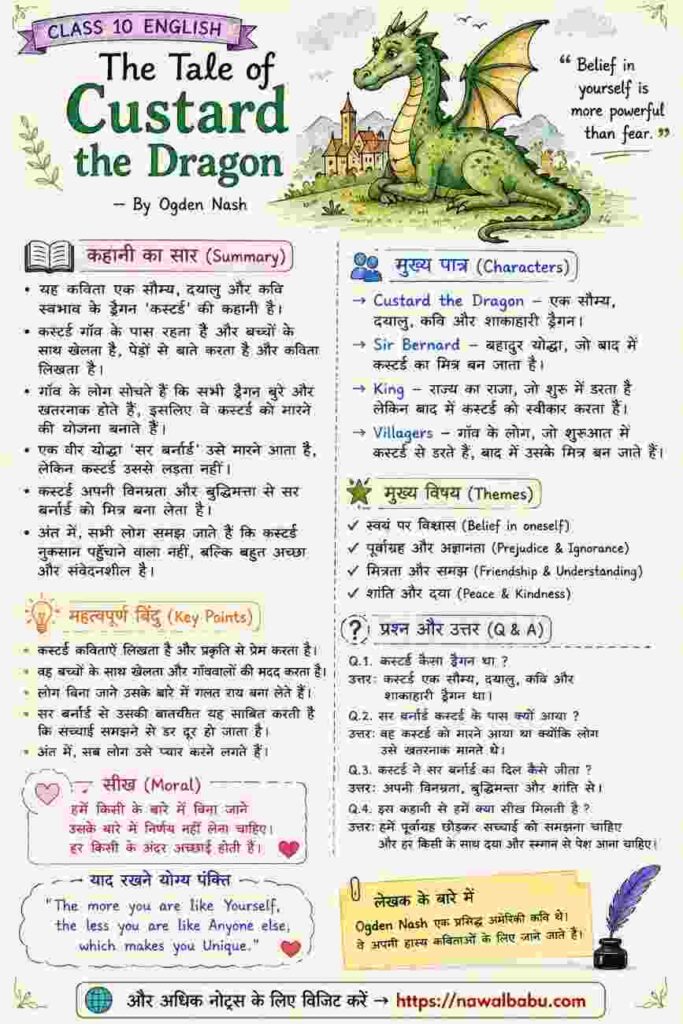
The poem describes Belinda, who lives in a small white house with her pets. She has a black kitten named Ink, a grey mouse named Blink, a yellow dog named Mustard and a dragon named Custard. Everyone except Custard claims to be extremely brave. Custard is considered a coward because he always wants a safe cage. One day, a dangerous pirate enters the house. Everyone becomes frightened and hides, but Custard bravely fights the pirate and eats him.
Stanza-wise Explanation / पद्यांशवार व्याख्या
Stanza 1 – Belinda and Her Pets
Belinda lives in a little white house with her pets. The house contains Ink, Blink, Mustard and Custard. The poet introduces the characters in a playful and humorous manner. Belinda has a cat, a mouse, a dog and a dragon. Custard looks frightening because of his physical features, but he is considered cowardly by everyone. The beginning establishes the humorous contrast between Custard’s frightening appearance and his apparently timid behaviour.
Stanza 2 – Custard’s Appearance
Custard is described as a frightening dragon. He has big sharp teeth, strong claws and spikes on his back. His mouth looks dangerous and his body appears powerful. However, despite all these frightening qualities, Custard behaves timidly and asks for a safe cage. Belinda and her pets laugh at him because they believe he is a coward. The poet creates humour by showing that a person’s appearance does not always reveal his true personality.
Stanza 3 – Others Boast About Courage
Belinda and her pets regularly boast about their bravery. They believe they are much braver than Custard. Ink, Blink and Mustard behave confidently and laugh at Custard for being afraid. Custard does not argue with them or try to prove himself. He simply remains quiet. This part of the poem shows the difference between boasting and genuine courage. The other characters are confident only because they have never faced a truly dangerous situation.
Stanza 4 – Arrival of the Pirate
Suddenly, a pirate enters Belinda’s house. He is carrying a pistol and appears dangerous. His arrival changes the entire situation. The characters who had previously boasted about their bravery become terrified. Belinda cries for help, while Ink, Blink and Mustard run away and hide. Their reactions expose their false courage. The pirate’s arrival is therefore the turning point of the poem because it provides a real test of everyone’s bravery.
Stanza 5 – Custard Fights the Pirate
While everyone else is frightened, Custard faces the pirate without hesitation. He moves towards the pirate and attacks him. The dragon catches the pirate and eventually eats him. This is the most important event in the poem. Custard, who had always been called a coward, becomes the true hero. His action proves that courage is not about talking loudly; it is about facing danger when necessary.
Stanza 6 – Everyone Becomes Brave Again
After Custard defeats the pirate, Belinda and the other animals return. They start claiming that they could have defeated the pirate themselves. However, their earlier behaviour clearly proves otherwise. They had hidden when danger appeared. Custard does not boast about his victory. Instead, he remains humble. The poet humorously shows that people often take credit after someone else has solved the problem. This makes the poem entertaining as well as meaningful.
Central Idea / मुख्य भाव
The central idea of the poem is that true courage is demonstrated through actions rather than words. Belinda, Ink, Blink and Mustard constantly claim to be brave, but they run away when the pirate arrives. Custard, who is always called a coward, courageously fights the pirate and saves everyone. The poem teaches students not to judge people by their appearance or by what they say. A quiet and humble person may possess greater courage than someone who constantly boasts about being brave.
Theme of the Poem / कविता की Themes
- True Courage: Real bravery appears during difficult situations.
- Appearance vs Reality: Custard looks frightening but behaves timidly, while the apparently brave characters prove cowardly.
- Humility: Custard does not boast after defeating the pirate.
- Boasting vs Action: Talking about courage is easy; demonstrating it is difficult.
- Humour: The poet uses funny characters, exaggeration and playful rhymes.
- Judging Others: The poem warns us not to judge someone only by appearance or reputation.
Why is Custard Called a Coward?
Custard is called a coward because he always wants a safe cage and appears frightened of danger. Belinda and her pets make fun of him and consider themselves braver than him. However, this judgment is proved wrong when the pirate enters the house. Custard alone faces the pirate and defeats him. Thus, Custard is called a coward only because of his behaviour and appearance before the danger. His actual action proves that he is the bravest character in the poem.
Read Also: How do Organisms Reproduce Class 10 Notes in Hindi & English | जीव कैसे प्रजनन करते हैं पूर्ण नोट्स
Why Does Custard Want a Safe Cage?
Custard wants a safe cage because he appears to be naturally cautious and afraid of danger. The other characters consider this a sign of cowardice and laugh at him. However, the poem later shows that being cautious does not necessarily mean being incapable of courage. When a real threat appears, Custard does not hide. He fights the pirate and saves everyone. Therefore, his desire for safety should not be confused with a complete lack of courage.
How Did Custard Prove His Bravery?
Custard proves his bravery when the pirate enters Belinda’s house. While Belinda, Ink, Blink and Mustard become frightened and hide, Custard faces the pirate directly. He attacks the dangerous man and eats him. This act saves everyone from the threat. Custard does not merely talk about bravery; he demonstrates it through action. His courage becomes clear at the exact moment when it is needed. Therefore, Custard becomes the real hero of the poem.
Why Did the Other Characters Run Away?
The other characters ran away because they were genuinely frightened by the pirate. Before his arrival, they repeatedly claimed to be brave and mocked Custard. However, when they faced actual danger, their confidence disappeared. Belinda cried for help, while Ink, Blink and Mustard hid themselves. Their behaviour reveals that their bravery was mostly based on words. The poet uses this situation humorously to show that a person’s true character becomes visible when he or she faces a difficult or dangerous situation.
Why Is the Poem Humorous?
The poem is humorous because the characters behave in unexpected and exaggerated ways. A powerful-looking dragon is called a coward, while a small mouse and other animals claim to be fearless. When a real pirate arrives, the so-called brave characters run away, whereas the supposed coward fights him. The repeated boasting after Custard’s victory also creates comedy. Ogden Nash uses funny descriptions, playful rhymes and exaggerated situations to make an important moral lesson entertaining and easy to remember.
Appearance vs Reality
One of the most important ideas in the poem is the contrast between appearance and reality. Custard looks like a dangerous dragon, yet everyone calls him a coward. On the other hand, Belinda and her pets appear confident and brave, but they become frightened when the pirate arrives. Custard’s actions reveal his real personality. Therefore, the poem teaches us that we should not judge a person only by appearance, words or reputation. True character becomes clear through actions and behaviour.
Importance of the Pirate
The pirate acts as a test of courage for all the characters. Before he appears, everyone claims to be brave and makes fun of Custard. His arrival creates a real emergency and forces everyone to reveal their true nature. Belinda and the other animals hide, while Custard fights. Thus, the pirate is important not because he is the main character, but because his presence exposes the difference between false bravery and genuine courage.
Moral of the Poem / शिक्षा
The poem gives a simple but valuable moral lesson:
- Actions speak louder than words.
- Never judge a person only by appearance.
- Do not laugh at someone who appears weak or fearful.
- Real courage is shown during difficult situations.
- Boasting about bravery is not the same as being brave.
- A humble person can be the greatest hero.
- We should respect people for their actions rather than their claims.
Title – “The Tale of Custard the Dragon”
The title is appropriate because the entire poem revolves around Custard and his unusual story. At first, Custard is presented as a cowardly dragon who wants a safe cage. Later, a pirate enters the house, and Custard becomes the only character brave enough to fight him. His unexpected heroic action forms the central event of the poem. Therefore, “The Tale of Custard the Dragon” is an appropriate title because it highlights the character whose actions reveal the main message of the poem.
Know More: Carbon and Its Compounds – Complete Notes (Class 10)
Poetic Devices / Literary Devices
Simile
A comparison using “like” or “as” is used to create vivid pictures.
Alliteration
Repetition of the same consonant sound makes the poem musical and memorable.
Onomatopoeia
Words suggesting sounds make the action more lively and humorous.
Hyperbole
The poet uses exaggeration to create humour and emphasize the characters’ qualities.
Repetition
Certain ideas and descriptions are repeated to create rhythm and comic effect.
Imagery
Descriptions of Custard, the pirate and the house help readers form clear mental pictures.
Irony
The character considered a coward becomes the only genuinely brave character.
Rhyme Scheme
The poem uses a regular and playful rhyme pattern. Ogden Nash uses humorous rhymes and unusual word combinations to create a light-hearted tone. The rhyming style makes the poem enjoyable to read and easier to remember. The poet does not use rhyme merely for decoration; it also supports the comic nature of the story. Students should focus on the rhyming words and sound patterns while reading each stanza.
Tone of the Poem
The tone of The Tale of Custard the Dragon is mainly humorous, playful and comic. Although the poem contains a dangerous situation involving a pirate, the poet presents it in a funny manner. The exaggerated descriptions of the characters, their boasting and their sudden fear create comedy. At the same time, the poem has a serious message about courage, humility and judging others. Thus, the poem combines entertainment with an important moral lesson.
Important Word Meanings
| Word | Meaning |
|---|---|
| Belinda | Name of the girl |
| Custard | Name of the dragon |
| Mustard | Name of the dog |
| Ink | Name of the cat |
| Blink | Name of the mouse |
| Coward | A person who lacks courage |
| Pirate | A person who attacks or robs ships/people |
| Clatter | A loud repeated sound |
| Scared | Frightened |
| Brave | Courageous |
| Cage | A structure used to keep an animal enclosed |
| Dungeon | A dark prison or underground room |
| Dagger | A short pointed weapon |
| Gobble | To eat quickly |
| Nasty | Very unpleasant or dangerous |
Character Sketch of Custard
Custard initially appears timid, cautious and fearful. He asks for a safe cage and becomes the subject of jokes among the other characters. However, his true personality is revealed when the pirate enters the house. Custard immediately faces the danger and defeats the pirate. He is therefore brave, courageous, dependable and humble. Most importantly, he does not boast about his heroic act afterwards. His character teaches us that true courage may remain hidden until a difficult situation demands it.
Character Sketch of Belinda
Belinda is confident and believes that she and her pets are very brave. She repeatedly laughs at Custard because he appears fearful. However, when the pirate arrives, she becomes frightened and calls for help. This shows that her confidence is greater in words than in action. After Custard defeats the pirate, Belinda again behaves proudly. Her character is mainly used by the poet to show the difference between self-confidence, boasting and genuine courage.
Important Questions and Answers
Q1. Who was Custard?
Answer: Custard was Belinda’s pet dragon. He looked frightening because of his teeth, claws and spikes, but everyone considered him a coward because he wanted a safe cage. However, when the pirate entered the house, Custard proved his real courage by fighting and eating him.
Q2. Why did everyone laugh at Custard?
Answer: Everyone laughed at Custard because he appeared timid and always wanted a safe cage. Belinda and her other pets believed that they were much braver than him. They considered his cautious behaviour proof of cowardice. However, their opinion changed indirectly when Custard defeated the pirate.
Q3. What happened when the pirate entered the house?
Answer: The pirate entered Belinda’s house carrying a pistol. Belinda became frightened, and Ink, Blink and Mustard ran away and hid. Custard, however, did not run away. He faced the pirate courageously, attacked him and eventually ate him. Thus, Custard saved everyone.
Q4. Who was the bravest character in the poem?
Answer: Custard was the bravest character. Although everyone called him a coward, he was the only one who faced the pirate when real danger appeared. Belinda and the other animals ran away. Custard’s action proves that genuine courage is demonstrated through deeds rather than through words or boasting.
Q5. What is the main message of the poem?
Answer: The main message is that true courage is shown through actions, not words. We should not judge people by their appearance or by what they say about themselves. Custard appears cowardly but becomes the hero when danger arrives. The poem also teaches humility and warns against unnecessary boasting.
Q6. Why is Custard a true hero?
Answer: Custard is a true hero because he faces the pirate when everyone else runs away. He risks his own safety to protect Belinda and the other animals. After defeating the pirate, he does not boast about his achievement. His courage, selflessness and humility make him the real hero of the poem.
Q7. How does the poem distinguish between real and false courage?
Answer: The poem distinguishes between real and false courage through the characters’ actions during the pirate’s attack. Belinda, Ink, Blink and Mustard constantly boast about being brave but hide when danger arrives. Custard, who is considered a coward, faces the pirate. Thus, the poem shows that real courage is proved by action during difficult circumstances.
Q8. Why is Custard’s victory surprising?
Answer: Custard’s victory is surprising because everyone expects him to be the least courageous character. He is repeatedly mocked for wanting a safe cage. However, when the pirate enters the house, Custard becomes the only character who fights. His unexpected victory creates humour and also proves that people should not be judged by their appearance or reputation.
Exam-Oriented Short Answers
- Poet: Ogden Nash
- Main character: Custard the Dragon
- Owner of the pets: Belinda
- Cat’s name: Ink
- Mouse’s name: Blink
- Dog’s name: Mustard
- Dangerous visitor: A pirate
- True hero: Custard
- Main theme: True courage vs. false bravery
- Poem type: Humorous narrative poem
- Important lesson: Actions prove character.
- Custard’s special quality: Courage with humility
- Central contrast: Boasting vs. actual bravery
- Major literary effect: Humour and irony
Quick Revision Notes
- The Tale of Custard the Dragon is written by Ogden Nash.
- Belinda lives with Ink, Blink, Mustard and Custard.
- Ink is a cat.
- Blink is a mouse.
- Mustard is a dog.
- Custard is a dragon.
- Everyone calls Custard a coward.
- Custard asks for a safe cage.
- A pirate suddenly enters Belinda’s house.
- Belinda and the other animals become frightened.
- Custard fights the pirate.
- Custard eats the pirate.
- Custard proves to be the real hero.
- The poem teaches us not to judge people by appearance.
- True courage is shown through actions, not boasting.
One-Line Revision Formula
Belinda + Ink + Blink + Mustard + Custard → Everyone boasts → Pirate enters → Everyone hides → Custard fights → Pirate defeated → True courage revealed.
Final Takeaway / निष्कर्ष
The Tale of Custard the Dragon is a funny but meaningful poem about real courage, humility and appearance versus reality. Custard is repeatedly mocked because he appears timid, while the other characters boast about their bravery. When the pirate creates a real danger, however, their claims prove false. Custard alone faces the threat and saves everyone. The poem teaches students a valuable lesson: “Bravery is not what we say; bravery is what we do when the situation demands it.”
याद रखने की सबसे आसान बात
“जो सबसे ज्यादा बहादुरी की बात करे, जरूरी नहीं कि वही सबसे बहादुर हो; असली बहादुरी मुश्किल समय में किए गए काम से साबित होती है।”