
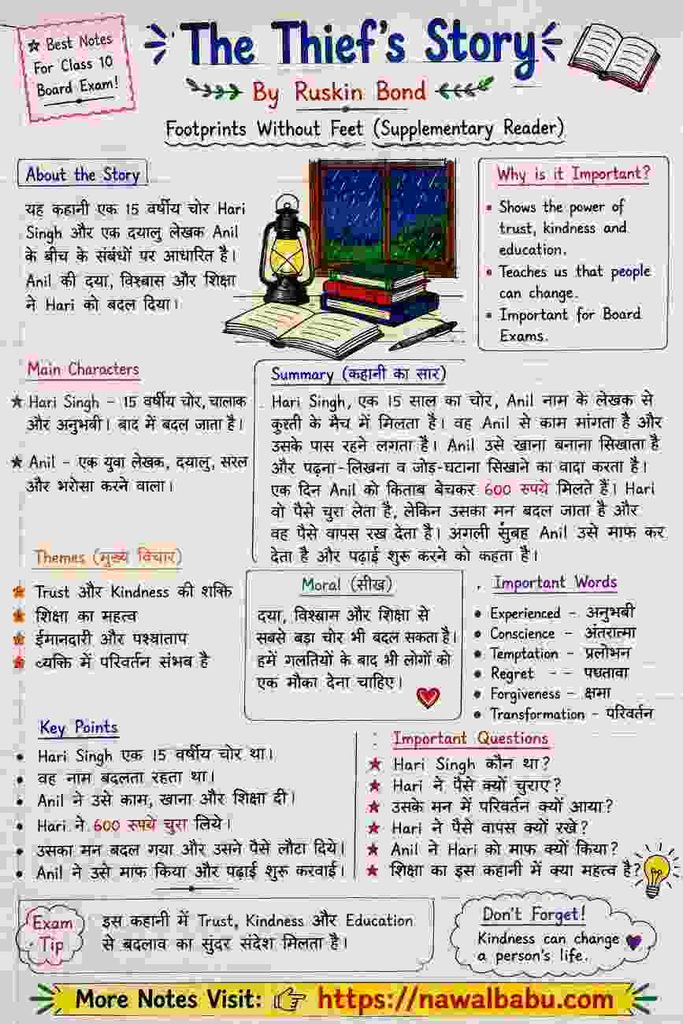
अगर आप The Thief’s Story Class 10 English Notes in Hindi खोज रहे हैं, तो यह पोस्ट आपके लिए बहुत उपयोगी है। The Thief’s Story Ruskin Bond द्वारा लिखी गई एक महत्वपूर्ण कहानी है, जो Class 10 English Supplementary Reader – Footprints Without Feet में शामिल है। इस कहानी में Hari Singh नाम का एक 15 वर्षीय चोर और Anil नाम का एक दयालु लेखक मुख्य पात्र हैं। कहानी के माध्यम से trust, kindness, education, honesty और transformation जैसे महत्वपूर्ण themes को समझाया गया है।
इस पोस्ट में आपको The Thief’s Story Summary in Hindi, Hindi + English Explanation, Character Sketch, Theme, Moral, Important Questions & Answers, Important Vocabulary और Exam-Oriented Points आसान भाषा में मिलेंगे। ये notes CBSE Class 10 English Board Exam की तैयारी और quick revision के लिए विशेष रूप से तैयार किए गए हैं। विद्यार्थियों को कहानी का सार और उसके महत्वपूर्ण प्रश्न आसानी से याद करने में मदद मिलेगी। Download PDF Of this Story.
The Thief’s Story Class 10 English Notes: Summary, Explanation
Author: Ruskin Bond
Book: Footprints Without Feet
Class: 10th
Genre: Short Story
Main Characters: Hari Singh and Anil
About the Story
“The Thief’s Story” is a simple but meaningful story written by Ruskin Bond. It tells us about a fifteen-year-old thief named Hari Singh, who meets a kind and trusting young writer named Anil. Hari initially joins Anil with the intention of stealing from him. However, Anil’s kindness, trust and willingness to educate him gradually change Hari’s thinking. The story beautifully shows that love, trust, education and kindness can reform a person better than punishment.
Main Characters
Hari Singh
Hari Singh is a fifteen-year-old experienced thief who changes his name frequently to escape identification. He is clever, observant and good at stealing. Initially, he approaches Anil only because he wants to rob him. However, Hari is not completely dishonest at heart. Anil’s trust and kindness create a conflict within him. Eventually, Hari realizes the importance of education and decides to return the stolen money. His decision shows the possibility of moral transformation.
Anil
Anil is a young, simple and kind-hearted writer. He earns money irregularly by writing and has a trusting nature. He gives Hari food, shelter and an opportunity to learn. Although Anil knows that Hari may be dishonest, he does not punish or insult him. Instead, his silent understanding influences Hari deeply. Anil represents trust, kindness, education and forgiveness. His character proves that positive treatment can encourage a wrongdoer to change.
Summary of the Story
Hari Singh, a fifteen-year-old thief, meets Anil at a wrestling match. Hari introduces himself and asks Anil for work. Anil agrees to employ him as a servant. Hari starts cooking for Anil, although his first meal is terrible. Anil teaches him to cook and promises to teach him how to read, write and do simple arithmetic. One day, Anil receives six hundred rupees. Hari steals the money and runs away, but his conscience stops him. He returns and places the money under the mattress.
Meeting Between Hari Singh and Anil
Hari Singh meets Anil at a wrestling match and notices that Anil looks friendly and careless. Hari introduces himself as an experienced wrestler, although he has no real interest in wrestling. He wants to gain Anil’s trust so that he can steal from him later. Hari asks for a job. Anil says that he cannot pay him regularly but offers food and shelter. Hari accepts the offer because he sees Anil as an easy target.
Why Did Hari Singh Change His Name Frequently?
Hari Singh changed his name frequently because he was a professional thief and wanted to avoid being caught. He understood that using different names would make it difficult for people and the police to identify him. The changing names also show that Hari had lived a dishonest and unstable life. His habit reflects his criminal background. However, after meeting Anil, Hari gradually begins to understand that he can create a better life through education and honest work.
Hari Singh Starts Working for Anil
Anil allows Hari to stay with him and work as a servant. Hari’s first task is cooking food. Unfortunately, he does not know how to cook properly, and Anil does not throw him out. Instead, Anil teaches him how to cook. This kindness surprises Hari because most people would have punished or dismissed him. Anil also promises to teach Hari reading, writing and arithmetic. For Hari, this opportunity becomes more valuable than he initially realizes.
Importance of Education in the Story
Education plays a major role in changing Hari Singh. Anil promises to teach him how to read, write and add numbers. Hari understands that education can help him earn money honestly and live a respectable life. He realizes that stealing can provide temporary money but cannot provide a secure future. The possibility of becoming educated creates hope in his mind. Thus, the story presents education as a powerful means of transforming a person’s character and future.
The Six Hundred Rupees
One day, Anil returns home with a bundle of notes. He has earned six hundred rupees from selling a book. He keeps the money under his mattress. Hari notices this opportunity and decides to steal it. He waits until Anil goes to sleep. Hari quietly takes the notes and leaves the room. At first, he feels happy because he has succeeded in stealing the money. However, while walking towards the railway station, his conscience begins to trouble him.
Why Did Hari Steal the Money?
Hari stole the six hundred rupees because stealing was his usual way of earning money. He believed that Anil was an easy person to rob because he trusted others and did not keep careful watch over his money. Hari also wanted to buy expensive clothes and enjoy himself. However, after stealing the money, he begins to think about Anil’s promise to educate him. He realizes that education could give him a much better future than the stolen money.
Hari’s Conflict After the Theft
After stealing the money, Hari goes towards the railway station to catch a train. Initially, he feels satisfied because he has the money. But gradually, his happiness disappears. He remembers Anil’s kindness and the promise of education. Hari realizes that if he leaves Anil, he will lose the opportunity to become educated. He also feels ashamed of betraying someone who trusted him. His internal conflict becomes the turning point of the story and leads him back to Anil.
Why Did Hari Not Catch the Train?
Hari reached the railway station but did not board the train. He thought about the education Anil had promised him. He understood that the six hundred rupees would only give him temporary pleasure, whereas education could provide him with a better and more respectable future. He also felt guilty about betraying Anil’s trust. Therefore, Hari returned to Anil’s house. His decision shows that his conscience had become stronger than his desire for money.
Hari Returns the Stolen Money
Hari returns to Anil’s room and carefully puts the stolen money back under the mattress. By this action, he proves that he has started changing. He understands that Anil’s trust and kindness are more valuable than six hundred rupees. Hari does not simply return the money because he is afraid of punishment. He returns it because he feels genuinely sorry for his action and wants to continue learning. This moment represents his moral awakening.
The Importance of Rain
Rain plays an important role when Hari returns to Anil’s house. It is raining heavily, and Hari becomes completely wet while walking back. The rain creates a gloomy and uncomfortable atmosphere, matching Hari’s emotional condition. At the same time, the rain can symbolically represent cleansing and renewal. Hari has committed a wrong act but now regrets it. Returning through the rain suggests that he is leaving his old dishonest life behind and moving towards a new beginning.
Anil’s Reaction the Next Morning
The next morning, Anil gives Hari a fifty-rupee note and tells him that he will now be paid regularly. He also tells Hari that they will start writing sentences. Anil does not openly accuse Hari of stealing the money. His reaction suggests that he understands what happened but chooses forgiveness instead of punishment. This silent response deeply affects Hari. Anil’s trust gives Hari another chance to become a good and educated person.
Why Did Anil Not Hand Hari Over to the Police?
Anil does not hand Hari over to the police because he understands that punishment alone may not reform him. Instead, Anil chooses kindness, trust and education. He realizes that Hari has already understood his mistake by returning the money. By giving him another chance, Anil encourages Hari to improve himself. His behaviour shows maturity and compassion. Anil’s decision proves that forgiveness and positive guidance can sometimes change a person more effectively than harsh punishment.
Theme of the Story
The central theme of “The Thief’s Story” is the power of trust, kindness and education. Hari begins as a thief but gradually changes because Anil treats him with kindness. The story also highlights the difference between temporary material gain and permanent personal development. Six hundred rupees could provide Hari short-term pleasure, but education could change his entire life. The story teaches that people should sometimes be given an opportunity to correct their mistakes and rebuild their lives.
Moral of the Story
The story teaches several valuable lessons. First, education can transform a person’s life. Second, kindness and trust can bring positive changes in someone’s character. Third, dishonest gains cannot provide lasting happiness or respect. Finally, everyone deserves an opportunity to improve after making a mistake. Hari’s decision to return the stolen money proves that a person who has made mistakes can still change. The story encourages us to choose honesty, education and self-respect instead of easy but dishonest methods.
Title – “The Thief’s Story”
The title “The Thief’s Story” is appropriate because the entire narrative revolves around Hari Singh, a young thief. The story begins with his intention to steal and ends with his decision to stop stealing and learn. The title focuses on his transformation from a dishonest boy into someone who wants a better life. It also creates curiosity because readers want to know what happens to the thief. Thus, the title is simple, direct and meaningful.
Character Sketch of Hari Singh
Hari Singh is clever, observant and experienced in stealing despite being only fifteen years old. He is also manipulative because he approaches Anil with the intention of robbing him. However, he has a sensitive conscience. Anil’s kindness, trust and promise of education awaken his better nature. Hari eventually returns the stolen money and chooses education over theft. Therefore, his character represents change and redemption. He proves that a person’s past does not necessarily determine his future.
Character Sketch of Anil
Anil is a young writer who lives a simple and uncertain life. He is generous, kind and trusting. He gives Hari food, shelter and education without demanding much in return. Even after Hari steals from him, Anil does not punish or insult him. Instead, he gives Hari another chance. Anil’s greatest strength is his ability to understand human nature. He believes in reform rather than revenge. His character represents kindness, trust, forgiveness and education.
Important Symbols
The Train
The train represents an opportunity to escape from Anil and return to Hari’s old life of stealing. Hari could have boarded it with the stolen money, but he chooses not to. Therefore, the train symbolizes a choice between his old dishonest life and a new educated life.
The Rain
The rain represents Hari’s emotional struggle and can also symbolize purification and a fresh beginning. Hari walks through the rain after deciding to return the money. His wet journey reflects his movement away from his old life.
Six Hundred Rupees
The six hundred rupees represent temporary material temptation. Hari initially values the money, but later understands that education and trust are much more valuable.
The Thief’s Story Class 10 English: Important Vocabulary
- Appealing – attractive or interesting
- Deserted – empty or without people
- Cheat – to deceive someone
- Unlined – without lines or marks
- Grunting – making a low sound
- Squatted – sat with knees bent close to the body
- Trusting – believing that someone is honest
- Prosperous – successful and wealthy
- Temptation – strong desire to do something
- Regret – feeling sorry for a wrong action
- Conscience – inner sense of right and wrong
- Appeared – seemed or became visible
- Desperately – with great need or urgency
- Transformation – complete change
- Forgiveness – pardoning someone for a mistake
Important Events in Sequence
- Hari Singh meets Anil at a wrestling match.
- Hari introduces himself and asks for a job.
- Anil agrees to keep him as a servant.
- Hari prepares a poor meal.
- Anil teaches him cooking and promises education.
- Hari notices Anil’s six hundred rupees.
- Hari steals the money.
- He goes towards the railway station.
- His conscience makes him stop.
- He returns to Anil’s room.
- He places the money back under the mattress.
- Anil gives him fifty rupees and promises regular payment.
- Hari begins a new life through education.
What Does Hari’s Transformation Show?
Hari’s transformation shows that people are capable of changing when they receive proper guidance. At the beginning, Hari believes that stealing is the easiest way to earn money. After living with Anil, he discovers the value of trust and education. His conscience eventually becomes stronger than his greed. Returning the money is his first major step towards honesty. Therefore, Hari’s transformation proves that love, trust, education and a second chance can bring out the goodness hidden within a person.
The Thief’s Story Class 10 English: Exam-Oriented Key Points
- Author: Ruskin Bond
- Main character: Hari Singh
- Age of Hari: Fifteen years
- Other main character: Anil
- Hari’s profession: Thief
- Anil’s profession: Writer
- Amount stolen: Six hundred rupees
- Reason for returning: Conscience and desire for education
- Main themes: Trust, kindness, education, honesty and transformation
- Major message: A person can change through love, trust and education.
- Ending: Hari returns the money and chooses education.
Short Answer Questions
Q1. Who was Hari Singh?
Hari Singh was a fifteen-year-old boy and an experienced thief. He frequently changed his name to avoid being recognized. He met Anil at a wrestling match and asked him for work. Hari initially joined Anil with the intention of stealing from him. However, Anil’s kindness, trust and promise to educate him gradually changed Hari. By the end of the story, Hari develops a conscience and returns the stolen money.
Q2. Why did Hari Singh approach Anil?
Hari approached Anil because he wanted to find an easy target for theft. He observed that Anil looked simple, friendly and careless with money. Hari introduced himself and asked for work. He believed that by staying with Anil, he could gain his confidence and later steal from him. However, his plan changed because Anil treated him kindly and promised to teach him reading, writing and arithmetic.
Q3. Why did Anil employ Hari?
Anil employed Hari because Hari asked him for work and Anil was kind enough to give him an opportunity. Although Anil could not promise a regular salary, he offered him food and shelter. He also taught Hari how to cook and promised to educate him. Anil did not judge Hari harshly. His generosity provided Hari with a safe environment in which he could gradually change his dishonest habits.
Q4. Why did Hari steal six hundred rupees?
Hari stole six hundred rupees because stealing was his usual method of earning money. When he saw the notes under Anil’s mattress, he became tempted. He thought that he could escape with the money and enjoy himself. However, after leaving Anil’s house, Hari began thinking about education and Anil’s kindness. His conscience made him realize that the stolen money was less valuable than the opportunity to learn and build a better future.
Q5. Why did Hari return the stolen money?
Hari returned the stolen money because his conscience troubled him. He realized that stealing from Anil meant losing the chance to receive education. He also remembered Anil’s kindness and trust. Although the six hundred rupees could provide temporary pleasure, education could give him a better and respectable future. Hari therefore returned to Anil’s house and placed the money under the mattress. This decision marks the beginning of his transformation into an honest person.
Q6. What did Anil promise to teach Hari?
Anil promised to teach Hari how to read and write sentences and how to add numbers. For Hari, this was extremely important because he understood that education could help him earn money honestly. Anil’s promise became one of the strongest reasons why Hari reconsidered his decision to run away with the stolen money. Through education, Hari saw the possibility of changing his life and becoming a respectable person.
Q7. How did Anil help Hari change?
Anil helped Hari change through kindness, trust and education. He gave Hari food and shelter even though he had no formal employment arrangement. He taught him cooking and promised to teach him reading, writing and arithmetic. When Hari stole money, Anil did not punish or humiliate him. Instead, he quietly gave him another opportunity. Anil’s behaviour awakened Hari’s conscience and encouraged him to choose education and honesty over theft.
Long Answer Question
Q. “Education can transform a person.” Explain with reference to “The Thief’s Story.”
Education is one of the most important forces behind Hari Singh’s transformation. Initially, Hari is a young thief who believes that stealing is the easiest way to earn money. When Anil promises to teach him reading, writing and arithmetic, Hari begins to see another possibility for his future. After stealing six hundred rupees, he realizes that leaving Anil would also mean losing his chance to become educated. Therefore, he returns the money. The story proves that education can replace dishonesty with hope, confidence and self-respect.
The Thief’s Story Class 10 English: One-Minute Revision
Hari Singh → Thief → Meets Anil → Gets Work → Learns Cooking → Anil Promises Education → ₹600 Stolen → Goes to Railway Station → Conscience Awakens → Returns Money → Anil Forgives → Education Begins
Remember:
“Trust + Kindness + Education = Transformation”
Central Message in One Line
The story teaches that kindness, trust and education can reform even a person who has chosen the wrong path.
The Thief’s Story Class 10 English: Conclusion
“The Thief’s Story” is more than a story about stealing. It is a story about change, conscience and second chances. Hari Singh begins as a thief but slowly understands that education and trust can provide a better future than stolen money. Anil’s kindness plays a major role in bringing out Hari’s goodness. The story gives students an important lesson: never underestimate the power of education, forgiveness and genuine trust to transform a person’s life.