Class 10 English Modals Questions with Answers: अगर आप Class 10 English Grammar में Modals की तैयारी कर रहे हैं, तो यह chapter आपके लिए बहुत महत्वपूर्ण है। इस लेख में Can, Could, May, Might, Must, Should, Ought to, Need, Have to, Has to, Had to, Will, Would, Shall आदि Modals के rules को आसान भाषा में समझाया गया है।
यहाँ आपको Modals Rules in Hindi, Examples, Exercise, MCQs, Fill in the Blanks, Error Correction और Practice Set with Answers मिलेंगे। Modals का सही उपयोग समझने के लिए केवल उनके meanings याद करना पर्याप्त नहीं है; यह समझना भी जरूरी है कि किस situation में कौन-सा modal इस्तेमाल किया जाता है।
Class 10 English Modals क्या हैं?
Modals ऐसे helping verbs हैं जो किसी कार्य की ability, possibility, permission, necessity, obligation, advice, request, इच्छा या probability आदि को व्यक्त करते हैं।
Common Modals
| Modal | मुख्य अर्थ / उपयोग |
|---|---|
| Can | सकता है, क्षमता, अनुमति |
| Could | सकता था, विनम्र request, possibility |
| May | सकता है, अनुमति, संभावना |
| Might | शायद, कम संभावना |
| Must | अवश्य, अनिवार्यता |
| Should | चाहिए, सलाह |
| Ought to | चाहिए, नैतिक कर्तव्य |
| Need | आवश्यकता |
| Have to | करना पड़ता है |
| Had to | करना पड़ा |
| Will | भविष्य, इच्छा |
| Would | विनम्र request, past habit |
| Shall | प्रस्ताव, भविष्य |
| Used to | पहले किया करता था |
ध्यान दें: सभी grammar books में modal auxiliaries और semi-modals की classification बिल्कुल एक जैसी नहीं होती। Exam में अपने prescribed syllabus और question pattern को प्राथमिकता दें।
Modals के Basic Rules
Modals को समझने का सबसे महत्वपूर्ण rule है:
Rule 1: Modal के बाद Verb की First Form आती है
Modal + V1
Examples:
- He can swim.
- She may come tomorrow.
- You should study regularly.
- We must obey the rules.
- They will attend the meeting.
❌ He can swims.
✅ He can swim.
❌ She should goes there.
✅ She should go there.
Rule 2: Modal के बाद सामान्यतः “to” नहीं आता
- I can do it.
- You should work hard.
- He must leave now.
लेकिन कुछ expressions जैसे ought to, have to, need to, used to में to आता है।
Examples:
- You ought to respect your parents.
- I have to complete my homework.
- We need to study this chapter.
Can – का प्रयोग
Can का प्रयोग मुख्य रूप से ability, permission और possibility के लिए किया जाता है।
(A) Ability – क्षमता
- I can swim.
- Riya can speak English.
- He can solve this problem.
Hindi:
I can swim. = मैं तैर सकता हूँ।
(B) Permission – अनुमति
- Can I come in, Sir?
- Can I use your pen?
(C) General possibility
- It can be dangerous.
Negative
cannot / can’t
- I cannot swim.
- You cannot enter this room.
Could – का प्रयोग
Could का प्रयोग past ability, polite request और possibility के लिए किया जाता है।
(A) Past Ability
- When I was young, I could run very fast.
- She could speak English when she was ten.
(B) Polite Request
- Could you help me?
- Could you open the door, please?
(C) Possibility
- It could rain tonight.
May – का प्रयोग
May का प्रयोग permission और possibility के लिए किया जाता है।
Permission
- May I come in, Sir?
- May I borrow your book?
Possibility
- It may rain today.
- He may come tomorrow.
Difference:
- May = संभावना अपेक्षाकृत अधिक हो सकती है।
- Might = संभावना कम/अनिश्चित हो सकती है।
यह distinction context पर निर्भर करता है; इसे हर situation में fixed percentage की तरह याद नहीं करना चाहिए।
Might – का प्रयोग
Might का प्रयोग कम निश्चित possibility के लिए किया जाता है।
Examples:
- He might come today.
- It might rain tonight.
- She might win the competition.
Negative
- He might not come today.
Must – का प्रयोग
Must का प्रयोग strong necessity, obligation और strong conclusion के लिए किया जाता है।
(A) Necessity / Obligation
- You must obey your parents.
- Students must follow the school rules.
- We must protect the environment.
(B) Strong conclusion
- He has been studying all night. He must be tired.
Negative
must not / mustn’t = नहीं करना चाहिए / सख्त मनाही
- You must not waste water.
- Students must not use mobile phones during the examination.
Must और Have to
दोनों necessity दिखा सकते हैं।
- You must wear a helmet.
- You have to wear a helmet.
लेकिन context के अनुसार इनके अर्थ में अंतर हो सकता है। Must अक्सर speaker की strong instruction या requirement दिखाता है, जबकि have to बाहरी rule, situation या obligation को दिखा सकता है।
Should – का प्रयोग
Should का प्रयोग advice, duty और अपेक्षा के लिए किया जाता है।
Advice
- You should work hard.
- You should respect your teachers.
- We should help the poor.
Expectation
- The train should arrive soon.
Negative
should not / shouldn’t
- You should not waste your time.
- We shouldn’t ignore our responsibilities.
Ought to – का प्रयोग
Ought to का अर्थ सामान्यतः चाहिए होता है। इसका प्रयोग duty, moral obligation और advice के लिए किया जाता है।
Examples:
- We ought to respect our parents.
- You ought to help the needy.
- Students ought to obey their teachers.
Negative
- You ought not to waste your time.
Important:
Ought के बाद to + V1 आता है।
✅ You ought to study.
❌ You ought study.
Need – का प्रयोग
Need का प्रयोग आवश्यकता बताने के लिए किया जाता है। इसका प्रयोग modal sense और ordinary verb दोनों तरह से हो सकता है।
Modal-like use
- You need not worry.
- You need not come tomorrow.
Ordinary verb
- You need to study hard.
- She needs to complete her homework.
यहाँ needs to ordinary verb construction है, इसलिए subject के अनुसार need/needs बदल सकता है।
Have to – का प्रयोग
Have to का प्रयोग necessity या obligation के लिए किया जाता है।
Examples:
- I have to go to school.
- We have to complete our homework.
- They have to follow the rules.
Has to
He/She/It के साथ:
- He has to study hard.
- She has to leave early.
Had to
Past में:
- I had to work hard.
- He had to leave early.
Will – का प्रयोग
Will का प्रयोग future, willingness और promise आदि के लिए किया जाता है।
Examples:
- I will help you.
- She will come tomorrow.
- We will finish the work.
Promise
- I will never forget you.
Would – का प्रयोग
Would का प्रयोग polite request, preference और कुछ contexts में past habit के लिए किया जाता है।
Polite Request
- Would you help me?
- Would you open the window?
Preference
- I would like to have some tea.
Past Habit
- When we were children, we would play in the park.
Shall – का प्रयोग
Shall का प्रयोग विशेष रूप से suggestion, offer और future expression के कुछ contexts में होता है।
Examples:
- Shall we start the class?
- Shall I open the window?
- We shall discuss this later.
Suggestion
- Shall we go for a walk?
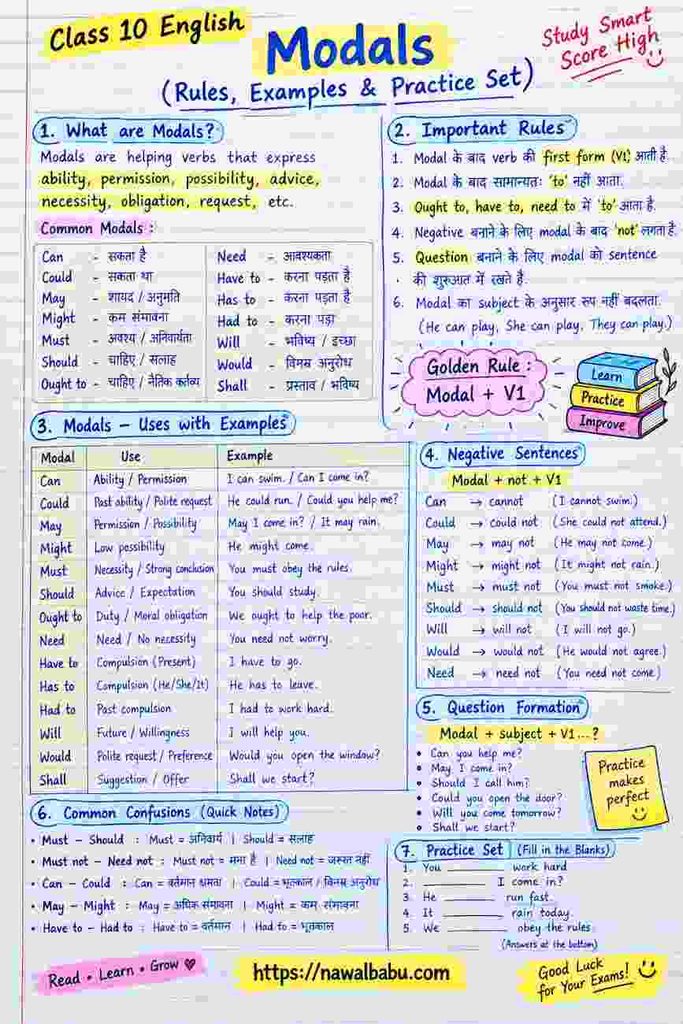
Modals की सबसे महत्वपूर्ण Table
| Modal | Use | Example |
|---|---|---|
| Can | Ability | I can swim. |
| Can | Permission | Can I come in? |
| Could | Past ability | He could run fast. |
| Could | Polite request | Could you help me? |
| May | Permission | May I come in? |
| May | Possibility | It may rain. |
| Might | Possibility | He might come. |
| Must | Necessity | You must obey rules. |
| Must not | Prohibition | You must not smoke. |
| Should | Advice | You should study. |
| Ought to | Duty | We ought to help him. |
| Need | Necessity | You need not worry. |
| Have to | Compulsion | I have to work. |
| Had to | Past compulsion | He had to leave. |
| Will | Future | I will help you. |
| Would | Polite request | Would you help me? |
| Shall | Suggestion | Shall we start? |
Modals में Negative Sentences
Negative बनाने के लिए सामान्यतः modal के बाद not लगाया जाता है।
Examples
Can → cannot
- He cannot swim.
Could → could not
- She could not attend the class.
May → may not
- He may not come today.
Might → might not
- It might not rain.
Must → must not
- You must not cheat.
Should → should not
- You should not waste time.
Will → will not
- I will not go there.
Would → would not
- He would not agree.
Read More: Class 10 English Tenses Questions with Answers | Rules, Examples & Exercises
Modals में Questions कैसे बनाते हैं?
Modal को sentence के beginning में रखकर question बनाया जा सकता है।
Examples
Can + subject + V1…?
- Can you swim?
May + subject + V1…?
- May I come in?
Should + subject + V1…?
- Should I call him?
Could + subject + V1…?
- Could you help me?
Will + subject + V1…?
- Will you come tomorrow?
Modals और Main Verb Agreement
Modal के बाद verb subject के अनुसार नहीं बदलती।
Correct:
- He can play.
- She can play.
- They can play.
Incorrect:
- He can plays.
- She can plays.
- They can plays.
Golden Rule:
Modal + V1
Class 10 Modals Questions with Answers
अब परीक्षा की तैयारी के लिए महत्वपूर्ण questions और उनके answers देखते हैं।
Question 1
You ______ respect your parents.
Answer: should
Complete sentence:
You should respect your parents.
Reason: Advice/Duty के लिए should का प्रयोग होता है।
Question 2
______ I come in, Sir?
Answer: May
Complete sentence:
May I come in, Sir?
Reason: Formal permission के लिए may का प्रयोग किया जाता है।
Question 3
We ______ obey the traffic rules.
Answer: must
Complete sentence:
We must obey the traffic rules.
Reason: Strong obligation के लिए must।
Question 4
When I was young, I ______ run very fast.
Answer: could
Complete sentence:
When I was young, I could run very fast.
Reason: Past ability के लिए could।
Question 5
It ______ rain tonight.
Answer: might
Complete sentence:
It might rain tonight.
Reason: Possibility के लिए might।
Question 6
You ______ not worry about the result.
Answer: need
Complete sentence:
You need not worry about the result.
Reason: Lack of necessity बताने के लिए need not।
Question 7
Students ______ follow the school rules.
Answer: must
Complete sentence:
Students must follow the school rules.
Question 8
I ______ complete this work before tomorrow.
Answer: have to
Complete sentence:
I have to complete this work before tomorrow.
Question 9
She ______ speak English when she was five.
Answer: could
Complete sentence:
She could speak English when she was five.
Question 10
You ______ not waste your valuable time.
Answer: should
Complete sentence:
You should not waste your valuable time.
Class 10 Modals MCQs
1. You ______ obey your teachers.
A. can
B. should
C. might
D. could
Answer: B. should
2. ______ I borrow your pen?
A. Must
B. May
C. Should
D. Would
Answer: B. May
3. He ______ swim when he was six.
A. can
B. may
C. could
D. must
Answer: C. could
4. You ______ not enter this room.
A. can
B. must
C. must
D. would
Answer: C. must
5. It ______ rain tomorrow.
A. might
B. must
C. ought
D. need
Answer: A. might
6. We ______ respect our elders.
A. ought to
B. can
C. might
D. would
Answer: A. ought to
7. I ______ finish my homework today.
A. have to
B. may
C. could
D. might
Answer: A. have to
8. ______ you please help me?
A. Must
B. Could
C. Need
D. Shall
Answer: B. Could
9. You ______ not worry about it.
A. need
B. can
C. must
D. would
Answer: A. need
10. ______ we start the meeting?
A. Shall
B. Must
C. Might
D. Could
Answer: A. Shall
Read Also: Active and Passive Voice Class 10 | Questions, Rules, Examples & Exercises
Modals Fill in the Blanks Practice Set
Fill in the blanks with suitable modals.
- You ______ work hard to succeed.
- ______ I use your mobile phone?
- He ______ swim when he was a child.
- It ______ rain this evening.
- Students ______ obey the school rules.
- We ______ help the poor.
- You ______ not tell a lie.
- I ______ complete this work today.
- ______ you please lend me your book?
- She ______ speak French when she lived in Paris.
- We ______ respect our national symbols.
- You ______ not worry about the problem.
- He ______ come to school tomorrow.
- ______ I open the window?
- They ______ follow the instructions.
Answers
- should
- May
- could
- might/may
- must
- should/ought to
- should
- have to
- could/would
- could
- should/must
- need
- may/might
- Shall/May
- must/have to
Note: कुछ sentences में context के अनुसार एक से अधिक modals grammatically possible हो सकते हैं। ऐसे questions में पूरा sentence और intended meaning देखकर answer चुनें।
Modals Error Correction Questions
नीचे दिए गए sentences में errors पहचानकर correct करें।
1. He can speaks English.
❌ Incorrect
✅ He can speak English.
2. You should to study hard.
❌ Incorrect
✅ You should study hard.
3. She may comes tomorrow.
❌ Incorrect
✅ She may come tomorrow.
4. He must obeys the rules.
❌ Incorrect
✅ He must obey the rules.
5. You ought respect your parents.
❌ Incorrect
✅ You ought to respect your parents.
Modals Sentence Transformation
Example 1
It is necessary for you to work hard.
Using must:
You must work hard.
Example 2
It is advisable for you to help the poor.
Using should:
You should help the poor.
Example 3
Perhaps he will come today.
Using might:
He might come today.
Example 4
I request you to help me.
Using could:
Could you help me?
Can और Could में अंतर
| Can | Could |
|---|---|
| Present ability | Past ability |
| Informal permission | Polite request |
| Possibility | Possibility |
| I can swim. | I could swim when I was five. |
Examples
Can:
I can drive a car.
Could:
I could drive a car when I was eighteen.
Polite request:
Could you please help me?
May और Might में अंतर
दोनों possibility व्यक्त करते हैं।
May
- He may come today.
Might
- He might come today.
Exam Tip:
जब possibility कम निश्चित हो या sentence में uncertainty अधिक हो, might contextually appropriate हो सकता है।
Must और Should में अंतर
Must
Strong necessity / obligation:
- You must obey the law.
Should
Advice / recommendation:
- You should exercise regularly.
याद रखने की आसान trick:
Must = जरूरी / अनिवार्य
Should = सलाह / करना चाहिए
Must Not और Need Not में अंतर
यह Class 10 students के लिए बहुत important distinction है।
Must not = सख्त मनाही
- You must not smoke here.
अर्थ: यहाँ smoking करना मना है।
Need not = आवश्यकता नहीं
- You need not come tomorrow.
अर्थ: तुम्हें कल आने की आवश्यकता नहीं है।
याद रखें:
Mustn’t = नहीं करना है
Needn’t = करने की जरूरत नहीं है
Should और Ought to में अंतर
दोनों का प्रयोग advice और duty के लिए किया जा सकता है।
Should
- You should respect your parents.
Ought to
- You ought to respect your parents.
दोनों का अर्थ लगभग समान हो सकता है, लेकिन ought to में “to” का प्रयोग आवश्यक है।
Have to, Has to और Had to
Present
I/We/You/They have to work.
He/She/It has to work.
Past
All subjects के साथ:
had to
Examples:
- I had to leave early.
- She had to work hard.
- They had to wait for an hour.
Modals से जुड़े 10 Golden Rules
- Modal के बाद सामान्यतः V1 आती है।
- Modal के बाद main verb में s/es नहीं लगता।
- Modal के बाद सामान्यतः to नहीं आता।
- Ought to के बाद V1 आती है।
- Have to/has to/had to में to का प्रयोग होता है।
- Negative modal बनाने के लिए सामान्यतः not लगाया जाता है।
- Modal को sentence की शुरुआत में रखकर questions बनाए जा सकते हैं।
- Can ability के लिए बहुत common है।
- Could past ability और polite request के लिए common है।
- Must, should, ought to के meanings को context के अनुसार समझें।
Board Exam में Modals की तैयारी कैसे करें?
Modals के questions हल करने के लिए सबसे पहले sentence का meaning समझें। केवल शब्द देखकर answer न चुनें।
Step 1: Sentence पढ़ें
पहले पूरे sentence को ध्यान से पढ़ें।
Step 2: Meaning पहचानें
देखें कि sentence में क्या बताया गया है:
- Ability?
- Permission?
- Possibility?
- Advice?
- Necessity?
- Obligation?
- Request?
- Prohibition?
Step 3: Suitable Modal चुनें
Meaning के अनुसार modal चुनें।
Step 4: Verb Check करें
Modal के बाद V1 है या नहीं, जरूर देखें।
Step 5: पूरा Sentence पढ़ें
Answer लगाने के बाद पूरे sentence को फिर से पढ़ें। देखें कि उसका meaning natural और grammatically correct है या नहीं।
Class 10 Modals Practice Set – 20 Questions
Choose the correct option.
1. You ______ respect your elders.
a) can
b) should
c) might
d) could
2. ______ I come in?
a) May
b) Must
c) Should
d) Need
3. He ______ run fast when he was young.
a) can
b) may
c) could
d) must
4. We ______ obey the law.
a) must
b) might
c) could
d) would
5. She ______ come tomorrow.
a) might
b) must
c) need
d) ought
6. You ______ not waste water.
a) should
b) could
c) might
d) would
7. ______ you help me, please?
a) Must
b) Could
c) Need
d) Shall
8. Students ______ wear the prescribed uniform.
a) must
b) might
c) could
d) would
9. You ______ not worry about the result.
a) need
b) must
c) should
d) could
10. We ______ help people in need.
a) ought to
b) may
c) might
d) can
11. I ______ complete this work today.
a) have to
b) may
c) could
d) might
12. She ______ speak English when she was ten.
a) can
b) could
c) must
d) should
13. It ______ rain tonight.
a) might
b) must
c) need
d) ought
14. You ______ obey your parents.
a) should
b) might
c) could
d) may
15. ______ we go for a walk?
a) Shall
b) Must
c) Need
d) Might
16. He ______ finish the work before leaving.
a) must
b) might
c) could
d) would
17. You ______ smoke in the hospital.
a) must not
b) need not
c) could
d) would
18. I ______ help you tomorrow.
a) will
b) might
c) need
d) ought
19. We ______ respect our national symbols.
a) ought to
b) might
c) could
d) would
20. When I was a child, I ______ play cricket every evening.
a) can
b) could
c) must
d) may
Answer Key
| Q. | Answer | Q. | Answer |
|---|---|---|---|
| 1 | should | 11 | have to |
| 2 | May | 12 | could |
| 3 | could | 13 | might |
| 4 | must | 14 | should |
| 5 | might | 15 | Shall |
| 6 | should | 16 | must |
| 7 | Could | 17 | must not |
| 8 | must | 18 | will |
| 9 | need | 19 | ought to |
| 10 | ought to | 20 | could |
For More Practice Visit: Modal Exercises with Answers
Frequently Asked Questions – Class 10 English Modals
1. What are Modals in English Grammar?
Modals are helping verbs used to express ability, possibility, permission, advice, necessity, obligation, request and other meanings.
2. Which verb form is used after a modal?
Generally, the first form of the verb (V1) is used after a modal.
Example:
She can dance.
3. What is the difference between Must and Should?
Must generally expresses strong necessity or obligation, while should generally expresses advice or recommendation.
4. What is the difference between Mustn’t and Needn’t?
Mustn’t means something is prohibited, whereas needn’t means something is not necessary.
5. Can “to” be used after a modal?
Generally, no. We say can go, should study, must work. However, expressions such as ought to, have to and need to contain “to”.
6. Which modal is used for past ability?
Could is commonly used for general past ability.
Example:
He could swim when he was six.
7. Which modal is commonly used for advice?
Should is commonly used for advice.
Example:
You should study regularly.
8. Which modal can be used for polite requests?
Could and would are commonly used for polite requests.
Example:
Could you help me?
Know More: A Question of Trust Class 10 English Notes in Hindi | Summary, Explanation, Questions & Answers
Quick Revision Notes
Ability
Can / Could
Permission
Can / May / Could
Possibility
May / Might / Could
Advice
Should / Ought to
Strong Necessity
Must
No Necessity
Need not
Obligation
Must / Have to
Past Obligation
Had to
Polite Request
Could / Would
Suggestion
Shall
Future
Will / Shall
Important Exam Tip
Modals के questions में केवल modal का Hindi meaning याद करना पर्याप्त नहीं है। एक ही modal अलग-अलग contexts में अलग function दे सकता है। इसलिए sentence का पूरा meaning पढ़कर answer चुनना सबसे सुरक्षित तरीका है।
विशेष रूप से इन pairs को अच्छी तरह revise करें:
Can – Could
May – Might
Must – Should
Must not – Need not
Should – Ought to
Have to – Had to
Conclusion
Class 10 English Grammar में Modals एक महत्वपूर्ण topic है। अच्छे marks के लिए आपको केवल definitions याद करने के बजाय उनके rules, uses और examples को समझना चाहिए। सबसे महत्वपूर्ण rule है कि सामान्यतः modal के बाद verb की first form (V1) आती है।
अगर आप रोजाना 10–15 modal sentences की practice करते हैं, तो fill in the blanks, MCQs, sentence correction और transformation जैसे questions को आसानी से हल कर सकते हैं। Board examination की तैयारी करते समय Can, Could, May, Might, Must, Should, Ought to, Need, Have to, Had to, Will, Would और Shall के uses को बार-बार revise करें।
CBSE की official academic resources में Class X English curriculum और grammar-related materials उपलब्ध हैं; नवीनतम syllabus/pattern के लिए विद्यार्थियों को अपने session के official CBSE curriculum को भी अवश्य देखना चाहिए।
Practice + Rules + Context = Modals में बेहतर पकड़।