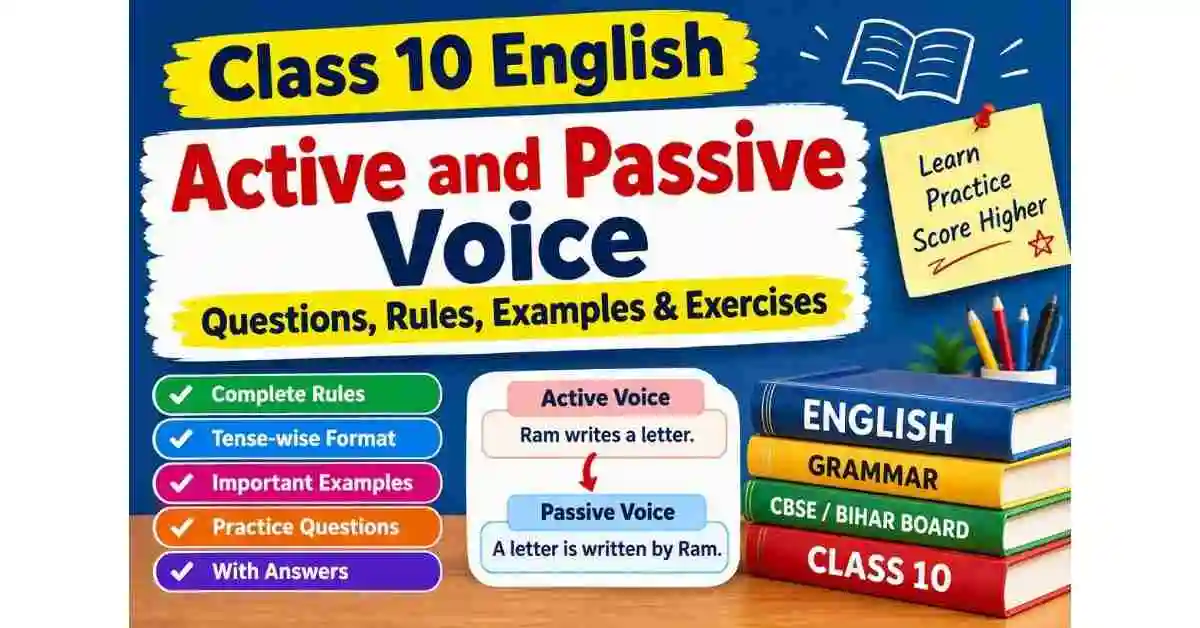
Active and Passive Voice Class 10 English Grammar का एक बहुत महत्वपूर्ण topic है। Board exams में Voice से questions अक्सर sentence transformation, grammar exercises और error-based questions के रूप में पूछे जाते हैं। इस chapter में students को केवल rules याद करने के बजाय Tense, helping verb, V3 (past participle), object और subject की भूमिका समझना जरूरी है।
इस लेख में Active Voice और Passive Voice की परिभाषा, सभी महत्वपूर्ण Rules, Tense-wise structures, Examples, Negative और Interrogative sentences, Modal verbs, Imperative sentences तथा Practice Exercises with Answers को सरल Hindi + English में समझाया गया है। यह सामग्री Class 10 CBSE और Bihar Board के विद्यार्थियों के लिए revision और board exam preparation में उपयोगी है।
Active and Passive Voice: Rules, Examples & Exercises
Active Voice और Passive Voice क्या है?
English sentence में यह देखा जाता है कि काम कौन कर रहा है और काम किस पर हो रहा है।
Active Voice
जब sentence में Subject स्वयं action करता है, तो उसे Active Voice कहते हैं।
Example: Ram writes a letter.
यहाँ Ram काम कर रहा है, इसलिए sentence Active Voice में है।
Structure:
Subject + Verb + Object
Ram + writes + a letter.
Passive Voice
जब sentence में Object पर action होने पर emphasis होता है, तो उसे Passive Voice कहते हैं।
Example: A letter is written by Ram.
यहाँ focus letter पर है।
Structure: Object + Helping Verb + V3 + by + Subject
Active और Passive Voice में मुख्य अंतर
| Active Voice | Passive Voice |
|---|---|
| Subject पर emphasis | Object/action पर emphasis |
| Subject पहले आता है | Object पहले आता है |
| Main verb tense के अनुसार बदलता है | V3 का प्रयोग होता है |
| Object बाद में आता है | Subject अक्सर by के बाद आता है |
| Ram writes a letter. | A letter is written by Ram. |
Active से Passive Voice बनाने के Basic Rules
Active Voice को Passive Voice में बदलते समय इन steps को follow करें:
Rule 1: Object को पहचानें
Active sentence में object को पहचानें।
Ram writes a letter.
- Subject = Ram
- Verb = writes
- Object = a letter
Object a letter passive sentence का subject बन जाएगा।
Rule 2: Object को शुरुआत में रखें
A letter …
Rule 3: Tense पहचानें
यहाँ writes Simple Present Tense है।
Simple Present में passive structure होता है:
is/am/are + V3
इसलिए:
A letter is written…
Rule 4: Main Verb को V3 में बदलें
write → written
Rule 5: Subject को by के बाद रखें
Ram → by Ram
Final sentence:
A letter is written by Ram.
Subject और Object का परिवर्तन
Passive Voice बनाते समय pronoun भी बदल सकते हैं।
| Active Subject | Passive में |
|---|---|
| I | me |
| We | us |
| You | you |
| He | him |
| She | her |
| It | it |
| They | them |
Example:
Active: She helps me.
Passive: I am helped by her.
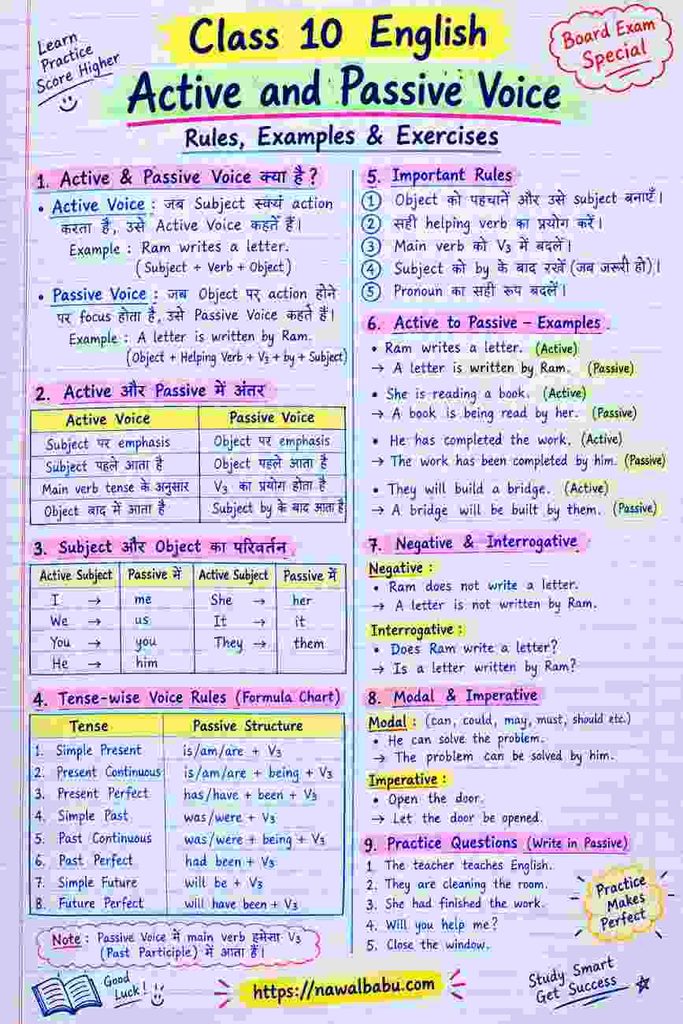
Tense-wise Active and Passive Voice Rules
यह section Class 10 students के लिए सबसे important है।
1. Simple Present Tense
Active Structure
Subject + V1/V5 + Object
Passive Structure
Object + is/am/are + V3 + by + Subject
Example
Active: Ram writes a letter.
Passive: A letter is written by Ram.
More Examples
Active: She teaches English.
Passive: English is taught by her.
Active: They clean the room.
Passive: The room is cleaned by them.
2. Present Continuous Tense
Active Structure
Subject + is/am/are + V-ing + Object
Passive Structure
Object + is/am/are + being + V3 + by + Subject
Example
Active: Ram is writing a letter.
Passive: A letter is being written by Ram.
More Examples
Active: She is reading a book.
Passive: A book is being read by her.
Active: They are repairing the road.
Passive: The road is being repaired by them.
3. Present Perfect Tense
Active Structure
Subject + has/have + V3 + Object
Passive Structure
Object + has/have + been + V3 + by + Subject
Example
Active: Ram has written a letter.
Passive: A letter has been written by Ram.
More Examples
Active: She has completed the work.
Passive: The work has been completed by her.
Active: They have cleaned the room.
Passive: The room has been cleaned by them.
4. Simple Past Tense
Active Structure
Subject + V2 + Object
Passive Structure
Object + was/were + V3 + by + Subject
Example
Active: Ram wrote a letter.
Passive: A letter was written by Ram.
More Examples
Active: She bought a book.
Passive: A book was bought by her.
Active: They cleaned the room.
Passive: The room was cleaned by them.
5. Past Continuous Tense
Active Structure
Subject + was/were + V-ing + Object
Passive Structure
Object + was/were + being + V3 + by + Subject
Example
Active: Ram was writing a letter.
Passive: A letter was being written by Ram.
More Examples
Active: She was reading a book.
Passive: A book was being read by her.
Active: They were repairing the road.
Passive: The road was being repaired by them.
6. Past Perfect Tense
Active Structure
Subject + had + V3 + Object
Passive Structure
Object + had been + V3 + by + Subject
Example
Active: Ram had written a letter.
Passive: A letter had been written by Ram.
More Examples
Active: She had completed the work.
Passive: The work had been completed by her.
Active: They had cleaned the room.
Passive: The room had been cleaned by them.
7. Simple Future Tense
Active Structure
Subject + will + V1 + Object
Passive Structure
Object + will + be + V3 + by + Subject
Example
Active: Ram will write a letter.
Passive: A letter will be written by Ram.
More Examples
Active: She will complete the work.
Passive: The work will be completed by her.
Active: They will build a bridge.
Passive: A bridge will be built by them.
8. Future Perfect Tense
Active Structure
Subject + will have + V3 + Object
Passive Structure
Object + will have been + V3 + by + Subject
Example
Active: Ram will have written a letter.
Passive: A letter will have been written by Ram.
Read More: Class 10 English Narration Questions with Answers | Direct and Indirect Speech
Tenses जिनका Passive सामान्यतः नहीं बनाया जाता
Class 10 में एक important exam point है कि हर tense का passive सामान्य रूप से प्रयोग नहीं किया जाता।
विशेष रूप से:
- Present Perfect Continuous
- Past Perfect Continuous
- Future Continuous
- Future Perfect Continuous
इनके passive forms सामान्य English usage में बहुत uncommon होते हैं और school-level grammar में सामान्यतः avoid किए जाते हैं।
Active and Passive Voice Formula Chart
| Tense | Passive Structure |
|---|---|
| Simple Present | is/am/are + V3 |
| Present Continuous | is/am/are + being + V3 |
| Present Perfect | has/have + been + V3 |
| Simple Past | was/were + V3 |
| Past Continuous | was/were + being + V3 |
| Past Perfect | had been + V3 |
| Simple Future | will be + V3 |
| Future Perfect | will have been + V3 |
Exam Trick: Passive Voice में सबसे महत्वपूर्ण बात है कि main verb हमेशा V3 (Past Participle) में होना चाहिए।
Negative Sentences का Passive Voice
Negative sentence में not को appropriate helping verb के बाद रखा जाता है।
Simple Present
Active: Ram does not write a letter.
Passive: A letter is not written by Ram.
Simple Past
Active: Ram did not write a letter.
Passive: A letter was not written by Ram.
ध्यान रखें कि Active में did + V1 होता है, लेकिन Passive में was/were + V3 आएगा।
Interrogative Sentences का Passive Voice
Question sentence को Passive में बदलते समय helping verb को sentence की शुरुआत में रखा जाता है।
Example 1
Active: Does Ram write a letter?
Passive: Is a letter written by Ram?
Example 2
Active: Did Ram write a letter?
Passive: Was a letter written by Ram?
Example 3
Active: Has Ram written a letter?
Passive: Has a letter been written by Ram?
Wh-Questions का Passive Voice
Wh-word को सामान्यतः sentence की शुरुआत में ही रखा जाता है।
Example
Active: Who wrote this letter?
Passive: By whom was this letter written?
Another Example
Active: When did Ram write the letter?
Passive: When was the letter written by Ram?
Modal Verbs का Passive Voice
Modal verbs जैसे:
- can
- could
- may
- might
- must
- should
- ought to
- would
के साथ passive बनाने का formula:
Object + Modal + be + V3 + by + Subject
Examples
Active: Ram can solve the problem.
Passive: The problem can be solved by Ram.
Active: You should obey your parents.
Passive: Your parents should be obeyed by you.
Active: We must follow the rules.
Passive: The rules must be followed by us.
Imperative Sentences का Passive Voice
Imperative sentences में order, request, advice या instruction होता है।
Active: Open the door.
Passive: Let the door be opened.
More Examples
Active: Close the window.
Passive: Let the window be closed.
Active: Help the poor.
Passive: Let the poor be helped.
Request वाले Sentences
Active: Please help me.
Passive: You are requested to help me.
Advice
Active: Work hard.
Passive: You are advised to work hard.
Two Objects वाले Sentences
कुछ sentences में दो objects होते हैं।
Example:
She gave me a book. इसका passive दो तरीकों से बनाया जा सकता है:
I was given a book by her. या A book was given to me by her.
दोनों structures context के अनुसार सही हो सकते हैं।
Preposition वाले Passive Sentences
कुछ verbs के साथ preposition भी होता है। Passive बनाते समय preposition को हटाना नहीं चाहिए।
Example
Active: They laughed at him.
Passive: He was laughed at by them.
Example
Active: Someone has looked after the child.
Passive: The child has been looked after.
जब Subject Unknown हो
अगर Active sentence में subject someone, people, they, somebody आदि है और passive में उसे बताना जरूरी नहीं है, तो उसे छोड़ा जा सकता है।
Active: Someone stole my bag.
Passive: My bag was stolen.
यह sentence अधिक natural है।
इसी तरह:
Active: People speak English all over the world.
Passive: English is spoken all over the world.
यहाँ by people की आवश्यकता नहीं है।
Passive Voice में “by” कब हटाया जा सकता है?
जब doer यानी काम करने वाला व्यक्ति महत्वपूर्ण या ज्ञात न हो, तो by + subject हटाया जा सकता है।
Example
Active: Someone opened the door.
Passive: The door was opened.
Active: People speak Hindi in India.
Passive: Hindi is spoken in India.
Active and Passive Voice के Important Examples
Example 1
Active: The teacher teaches English.
Passive: English is taught by the teacher.
Example 2
Active: Ravi is writing an essay.
Passive: An essay is being written by Ravi.
Example 3
Active: She has completed her homework.
Passive: Her homework has been completed by her.
Example 4
Active: The police arrested the thief.
Passive: The thief was arrested by the police.
Example 5
Active: They were playing cricket.
Passive: Cricket was being played by them.
Example 6
Active: He had finished the work.
Passive: The work had been finished by him.
Example 7
Active: They will build a new school.
Passive: A new school will be built by them.
Example 8
Active: You must follow the rules.
Passive: The rules must be followed by you.
Active and Passive Voice Questions for Class 10
अब नीचे board-exam practice के लिए important questions दिए गए हैं।
Exercise 1: Change into Passive Voice
- Ram writes a letter.
- She reads a newspaper.
- They clean the room.
- The teacher teaches English.
- Ravi is playing cricket.
- She is cooking food.
- They have completed the work.
- He has opened the door.
- Ram wrote a letter.
- The police arrested the thief.
- She was reading a book.
- They were repairing the road.
- He had finished the work.
- They will build a bridge.
- She will complete the project.
Answers
- A letter is written by Ram.
- A newspaper is read by her.
- The room is cleaned by them.
- English is taught by the teacher.
- Cricket is being played by Ravi.
- Food is being cooked by her.
- The work has been completed by them.
- The door has been opened by him.
- A letter was written by Ram.
- The thief was arrested by the police.
- A book was being read by her.
- The road was being repaired by them.
- The work had been finished by him.
- A bridge will be built by them.
- The project will be completed by her.
Exercise 2: Negative Sentences
Change into Passive Voice:
- Ram does not write a letter.
- She did not complete the work.
- They do not clean the room.
- He did not open the door.
- She will not buy the book.
Answers
- A letter is not written by Ram.
- The work was not completed by her.
- The room is not cleaned by them.
- The door was not opened by him.
- The book will not be bought by her.
Exercise 3: Interrogative Sentences
Change into Passive Voice:
- Does Ram write a letter?
- Did she complete the work?
- Is he reading a book?
- Has she finished the work?
- Will they build a house?
Answers
- Is a letter written by Ram?
- Was the work completed by her?
- Is a book being read by him?
- Has the work been finished by her?
- Will a house be built by them?
Exercise 4: Modal Verbs
Change into Passive Voice:
- You should obey your parents.
- We must follow the rules.
- He can solve the problem.
- They may cancel the match.
- She should complete the work.
Answers
- Your parents should be obeyed by you.
- The rules must be followed by us.
- The problem can be solved by him.
- The match may be cancelled by them.
- The work should be completed by her.
Exercise 5: Imperative Sentences
Change into Passive Voice:
- Open the door.
- Close the window.
- Clean the room.
- Help the poor.
- Do not waste water.
Answers
- Let the door be opened.
- Let the window be closed.
- Let the room be cleaned.
- Let the poor be helped.
- Let water not be wasted.
Common Errors in Active and Passive Voice
Class 10 students अक्सर इन mistakes को करते हैं।
1. V3 का प्रयोग भूल जाना
❌ A letter is write by Ram.
✅ A letter is written by Ram.
2. Tense बदल देना
Active: Ram wrote a letter.
गलत: A letter is written by Ram.
सही: A letter was written by Ram.
3. “being” भूल जाना
Active: Ram is writing a letter.
गलत: A letter is written by Ram.
सही: A letter is being written by Ram.
4. “been” भूल जाना
Active: She has completed the work.
गलत: The work has completed by her.
सही: The work has been completed by her.
5. Pronoun गलत लगाना
Active: She helped me.
गलत: Me was helped by she.
सही: I was helped by her.
Active और Passive Voice याद करने की आसान Trick
Passive Voice बनाते समय केवल यह sequence याद रखें:
O → HV → V3 → by → S
जहाँ:
- O = Object
- HV = Helping Verb
- V3 = Past Participle
- S = Subject
उदाहरण:
Ram writes a letter.
Object = letter
→ A letter
Helping verb = is
→ A letter is
V3 = written
→ A letter is written
Subject = Ram
→ A letter is written by Ram.
Board Exam के लिए Quick Revision Notes
- Active Voice में subject action करता है।
- Passive Voice में object को subject position मिलती है।
- Passive Voice में main verb की V3 form आती है।
- Tense के अनुसार helping verb बदलती है।
- Continuous Tense के passive में being आता है।
- Perfect Tense के passive में been आता है।
- Modal के बाद passive में be + V3 आता है।
- Simple Future में will be + V3 होता है।
- जरूरत न होने पर by + subject हटाया जा सकता है।
- हर Active sentence का Passive बनाना संभव नहीं होता; सामान्यतः transitive verbs, जिनका object होता है, passive में बदले जा सकते हैं।
For More Practice Visit: Active and Passive Voice Exercise with Answers
Frequently Asked Questions (FAQs)
Active Voice क्या है?
जब sentence का subject स्वयं action करता है, तो sentence Active Voice कहलाता है। उदाहरण: Ram writes a letter.
Passive Voice क्या है?
जब sentence में action या object पर अधिक emphasis होता है और object को subject position में रखा जाता है, तो उसे Passive Voice कहते हैं। उदाहरण: A letter is written by Ram.
Passive Voice में verb की कौन-सी form आती है?
Passive Voice में main verb की third form (V3/Past Participle) आती है।
क्या सभी sentences का Passive Voice बनाया जा सकता है?
नहीं। सामान्यतः ऐसे sentences जिनमें object होता है यानी transitive verbs का प्रयोग होता है, उनका passive बनाया जा सकता है।
Modal verbs के Passive Voice का formula क्या है?
Object + Modal + be + V3 + by + Subject
Example:
Active: He can solve the problem.
Passive: The problem can be solved by him.
Passive Voice में “being” कब आता है?
Continuous Tenses के passive में सामान्यतः being + V3 का प्रयोग होता है।
Example: The room is being cleaned.
You Must Read:Class 10 History Chapter 4 Notes in Hindi & English | The Age of Industrialisation Notes PDF | NCERT Solutions & Summary
Conclusion
Active and Passive Voice Class 10 English Grammar का महत्वपूर्ण topic है। इसे अच्छे से सीखने के लिए केवल formulas याद करना पर्याप्त नहीं है। पहले Subject, Verb, Object और Tense को पहचानें, फिर Object को शुरुआत में लाकर appropriate helping verb लगाएँ और main verb को V3 में बदलें।
Board exam में विशेष ध्यान Simple Present, Present Continuous, Present Perfect, Simple Past, Past Continuous, Past Perfect, Simple Future, Modal Verbs, Negative, Interrogative और Imperative Sentences पर देना चाहिए। ऊपर दिए गए examples और exercises को लिखकर practice करने से Voice transformation में accuracy बेहतर की जा सकती है।