Class 10 English Narration यानी Direct and Indirect Speech English Grammar का एक बहुत महत्वपूर्ण topic है। Board examinations में Narration से questions अक्सर sentence transformation के रूप में पूछे जाते हैं। यदि आपको Direct Speech को Indirect Speech में बदलने के Rules अच्छी तरह पता हैं, तो आप ऐसे questions आसानी से solve कर सकते हैं।
इस chapter में हम Direct Speech and Indirect Speech, Reporting Verb, Reported Speech, Tense Change, Pronoun Change, Time and Place Words के परिवर्तन तथा Assertive, Interrogative, Imperative और Exclamatory Sentences की Narration सीखेंगे।
यह article Class 10 CBSE और Bihar Board English Grammar के विद्यार्थियों के लिए सरल भाषा में तैयार किया गया है। इसमें आपको Narration Rules with Examples, Important Questions with Answers और Practice Questions भी मिलेंगे।
Class 10 English Narration: Direct & Indirect Speech
What is Narration?
किसी व्यक्ति द्वारा कही गई बात को किसी दूसरे व्यक्ति तक पहुँचाने के तरीके को Narration कहते हैं।
Narration मुख्य रूप से दो प्रकार की होती है:
- Direct Speech
- Indirect Speech
Example:
Direct Speech:
Ram said, “I am happy.”
Indirect Speech:
Ram said that he was happy.
यहाँ Ram के exact words को Direct Speech कहा गया है, जबकि उन्हीं words को अपने शब्दों में report करने पर Indirect Speech कहलाती है।
Direct Speech क्या है?
जब किसी व्यक्ति के द्वारा बोले गए exact words को बिना किसी परिवर्तन के quotation marks (” “) के अंदर लिखा जाता है, तो उसे Direct Speech कहते हैं।
Example: Rahul said, “I am busy.”
इस sentence में:
- Rahul said → Reporting Speech
- I am busy → Reported Speech
- said → Reporting Verb
- ” “ → Inverted Commas
More Examples
- He said, “I am tired.”
- Riya said, “I like English.”
- The teacher said, “Work hard.”
- Mohan said, “I will help you.”
Indirect Speech क्या है?
जब किसी व्यक्ति की कही हुई बात को बिना उसके exact words दोहराए, अपने शब्दों में बताया जाता है, तो उसे Indirect Speech कहते हैं।
Example:
Direct:
He said, “I am tired.”
Indirect:
He said that he was tired.
यहाँ quotation marks हटा दिए गए हैं और sentence के अनुसार pronoun तथा tense में आवश्यक परिवर्तन किया गया है।
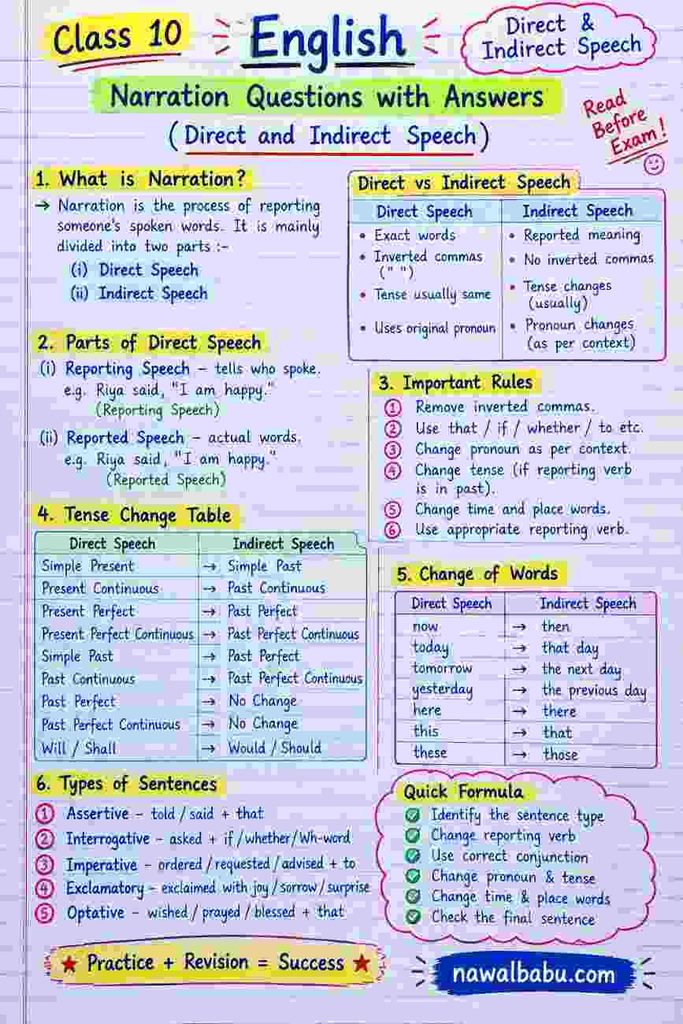
Direct और Indirect Speech में अंतर
| Direct Speech | Indirect Speech |
|---|---|
| Exact words लिखे जाते हैं | Meaning को report किया जाता है |
| Inverted commas का प्रयोग होता है | Inverted commas नहीं होते |
| Reporting और Reported Speech अलग रहते हैं | दोनों clauses जुड़ जाते हैं |
| Tense सामान्यतः original रहता है | कई मामलों में tense बदलता है |
| Pronoun original speaker के अनुसार होता है | Pronoun context के अनुसार बदलता है |
Example:
Direct:
Sita said, “I am reading a book.”
Indirect:
Sita said that she was reading a book.
Parts of Direct Speech
Direct Speech में मुख्यतः दो parts होते हैं:
1. Reporting Speech
जो part यह बताता है कि कौन बोल रहा है, उसे Reporting Speech कहते हैं।
Example:
Ravi said, “I am ready.”
यहाँ Ravi said Reporting Speech है।
2. Reported Speech
जो actual words बोले गए हैं, उन्हें Reported Speech कहते हैं।
Example:
Ravi said, “I am ready.”
यहाँ I am ready Reported Speech है।
Narration के Basic Rules
Direct Speech को Indirect Speech में बदलते समय निम्न बातों का ध्यान रखना चाहिए:
Rule 1: Inverted Commas हटाएँ
Direct Speech में लगे quotation marks (” “) को Indirect Speech में हटा दिया जाता है।
Direct:
He said, “I am happy.”
Indirect:
He said that he was happy.
Rule 2: Conjunction का प्रयोग
Sentence के प्रकार के अनुसार that, if, whether, to आदि का प्रयोग किया जाता है।
Examples:
Assertive:
He said, “I am ill.”
→ He said that he was ill.
Interrogative:
He said to me, “Are you ready?”
→ He asked me if I was ready.
Imperative:
The teacher said to me, “Work hard.”
→ The teacher advised me to work hard.
Rule 3: Pronoun में परिवर्तन
Pronoun को speaker, listener और reported person के अनुसार बदलना पड़ता है।
एक आसान नियम:
First Person → Reporting Verb के Subject के अनुसार
Direct:
Ram said, “I am busy.”
Indirect:
Ram said that he was busy.
यहाँ I → he हुआ क्योंकि Reporting Verb का subject Ram है।
Second Person → Reporting Verb के Object के अनुसार
Direct:
Ram said to me, “You are honest.”
Indirect:
Ram told me that I was honest.
यहाँ you → I हुआ क्योंकि object “me” है।
Third Person → सामान्यतः परिवर्तन नहीं
Direct:
Ram said, “He is honest.”
Indirect:
Ram said that he was honest.
Third person pronoun context के अनुसार रहता है।
Read More: Class 10 English Tenses Questions with Answers | Rules, Examples & Exercises
Tense Change in Narration
यदि Reporting Verb Past Tense में हो, तो सामान्यतः Reported Speech का tense बदल जाता है।
Tense Change Table
| Direct Speech | Indirect Speech |
|---|---|
| Simple Present | Simple Past |
| Present Continuous | Past Continuous |
| Present Perfect | Past Perfect |
| Present Perfect Continuous | Past Perfect Continuous |
| Simple Past | Past Perfect |
| Past Continuous | Past Perfect Continuous |
| Past Perfect | No Change |
| Past Perfect Continuous | No Change |
| Will/Shall | Would/Should |
1. Simple Present → Simple Past
Direct:
He said, “I play cricket.”
Indirect:
He said that he played cricket.
More Examples:
Direct: She said, “I like tea.”
Indirect: She said that she liked tea.
2. Present Continuous → Past Continuous
Direct:
He said, “I am reading a book.”
Indirect:
He said that he was reading a book.
Example:
Direct: Riya said, “I am studying English.”
Indirect: Riya said that she was studying English.
3. Present Perfect → Past Perfect
Direct:
He said, “I have completed my work.”
Indirect:
He said that he had completed his work.
4. Present Perfect Continuous → Past Perfect Continuous
Direct:
He said, “I have been working for two hours.”
Indirect:
He said that he had been working for two hours.
5. Simple Past → Past Perfect
Direct:
He said, “I bought a new book.”
Indirect:
He said that he had bought a new book.
6. Past Continuous → Past Perfect Continuous
Direct:
He said, “I was watching television.”
Indirect:
He said that he had been watching television.
7. Past Perfect → No Change
Direct:
He said, “I had finished my work.”
Indirect:
He said that he had finished his work.
8. Will → Would
Direct:
He said, “I will help you.”
Indirect:
He said that he would help me.
When Tense Does Not Change
हर sentence में tense change नहीं होता।
Rule 1: Reporting Verb Present/Future में हो
यदि Reporting Verb Present या Future Tense में है, तो Reported Speech का tense सामान्यतः नहीं बदलता।
Direct:
He says, “I am busy.”
Indirect:
He says that he is busy.
Rule 2: Universal Truth
यदि Reported Speech में Universal Truth या scientific fact हो, तो tense नहीं बदलता।
Direct:
The teacher said, “The Earth moves around the Sun.”
Indirect:
The teacher said that the Earth moves around the Sun.
गलत: The teacher said that the Earth moved around the Sun.
Change of Words in Narration
Direct से Indirect Speech में केवल tense और pronoun ही नहीं बदलते, बल्कि time और place से संबंधित कुछ words भी बदल सकते हैं।
| Direct Speech | Indirect Speech |
|---|---|
| now | then |
| today | that day |
| tonight | that night |
| yesterday | the previous day / the day before |
| tomorrow | the next day / the following day |
| ago | before |
| last night | the previous night |
| last week | the previous week |
| next week | the following week |
| here | there |
| this | that |
| these | those |
| thus | so |
| hence | therefore |
| come | go |
Example:
Direct:
He said, “I will come here tomorrow.”
Indirect:
He said that he would go there the next day.
Narration of Assertive Sentences
ऐसे sentences जिनमें कोई statement, fact या information दी जाती है, उन्हें Assertive Sentences कहते हैं।
इनमें सामान्यतः said, told आदि Reporting Verbs का प्रयोग होता है और conjunction that लगाया जाता है।
Formula:
Subject + said/told + object + that + statement
Example 1
Direct:
Ram said, “I am ill.”
Indirect:
Ram said that he was ill.
Example 2
Direct:
She said to me, “I am happy.”
Indirect:
She told me that she was happy.
Important Rule
said to + object → told + object
Example:
Direct: He said to me, “I am busy.”
Indirect: He told me that he was busy.
Narration of Interrogative Sentences
जिस sentence में question पूछा जाता है, उसे Interrogative Sentence कहते हैं।
Interrogative sentence को Indirect Speech में बदलते समय:
- said/say to → asked
- Question mark हट जाता है।
- Yes/No question में if/whether का प्रयोग होता है।
- Wh-question में वही Wh-word रखा जाता है।
- Sentence को statement order में लिखा जाता है।
Yes/No Questions
यदि question का answer Yes या No में दिया जा सकता है, तो if या whether का प्रयोग किया जाता है।
Example:
Direct:
He said to me, “Are you happy?”
Indirect:
He asked me if I was happy.
Example:
Direct:
She said to him, “Do you know me?”
Indirect:
She asked him whether he knew her.
Wh-Questions
यदि question what, why, where, when, who, how, which आदि से शुरू हो, तो वही Wh-word Indirect Speech में रखा जाता है।
Example:
Direct:
He said to me, “Where do you live?”
Indirect:
He asked me where I lived.
Example:
Direct:
She said to him, “Why are you crying?”
Indirect:
She asked him why he was crying.
Important Point
Indirect Speech में question की तरह word order नहीं रहता।
❌ He asked me where did I live.
✅ He asked me where I lived.
Narration of Imperative Sentences
जिस sentence में order, command, request, advice, suggestion, prohibition आदि व्यक्त किए जाते हैं, उसे Imperative Sentence कहते हैं।
ऐसे sentences में Reporting Verb sentence के meaning के अनुसार बदलता है।
Common Reporting Verbs
| Meaning | Reporting Verb |
|---|---|
| Order | ordered |
| Request | requested |
| Advice | advised |
| Command | commanded |
| Warning | warned |
| Begging | begged |
| Prohibition | forbade |
Indirect Speech में अक्सर to + V1 का प्रयोग किया जाता है।
Order
Direct:
The teacher said to the boy, “Stand up.”
Indirect:
The teacher ordered the boy to stand up.
Request
Direct:
He said to me, “Please help me.”
Indirect:
He requested me to help him.
Advice
Direct:
The doctor said to me, “Take rest.”
Indirect:
The doctor advised me to take rest.
Negative Imperative
Negative command में not to का प्रयोग किया जाता है।
Direct:
The teacher said to the students, “Do not make a noise.”
Indirect:
The teacher ordered the students not to make a noise.
Narration of Exclamatory Sentences
जिस sentence में strong feeling जैसे:
- joy
- sorrow
- surprise
- anger
- wonder
व्यक्त हो, उसे Exclamatory Sentence कहते हैं।
Direct Speech में अक्सर Hurrah!, Alas!, Oh!, Wow!, What!, How! आदि का प्रयोग होता है।
Indirect Speech में reporting verb meaning के अनुसार बदलता है।
| Expression | Reporting Verb |
|---|---|
| Hurrah! | exclaimed with joy |
| Alas! | exclaimed with sorrow |
| Wow!/What a surprise! | exclaimed with surprise |
| Oh! | exclaimed with surprise/sorrow depending on context |
Exclamation of Joy
Direct:
He said, “Hurrah! We have won the match.”
Indirect:
He exclaimed with joy that they had won the match.
Exclamation of Sorrow
Direct:
He said, “Alas! My friend is dead.”
Indirect:
He exclaimed with sorrow that his friend was dead.
Exclamation of Surprise
Direct:
She said, “What a beautiful flower!”
Indirect:
She exclaimed with surprise that it was a very beautiful flower.
Narration of Optative Sentences
जिस sentence में wish, prayer, blessing या curse व्यक्त किया जाता है, उसे Optative Sentence कहते हैं।
Reporting verbs:
- wished
- prayed
- blessed
- cursed
Example:
Direct:
He said, “May you succeed!”
Indirect:
He wished that I might succeed.
Another Example:
Direct:
The old man said, “May God bless you!”
Indirect:
The old man prayed that God might bless me.
Important Narration Questions with Answers
Question 1
Direct: Ram said, “I am busy.”
Answer:
Ram said that he was busy.
Question 2
Direct: Sita said, “I have completed my homework.”
Answer:
Sita said that she had completed her homework.
Question 3
Direct: Mohan said to me, “I will help you.”
Answer:
Mohan told me that he would help me.
Question 4
Direct: Riya said, “I bought a new dress.”
Answer:
Riya said that she had bought a new dress.
Question 5
Direct: He said to me, “Are you ready?”
Answer:
He asked me if I was ready.
Question 6
Direct: She said to me, “Where do you live?”
Answer:
She asked me where I lived.
Question 7
Direct: The teacher said to the students, “Work hard.”
Answer:
The teacher advised the students to work hard.
Question 8
Direct: Father said to me, “Do not waste your time.”
Answer:
Father advised me not to waste my time.
Question 9
Direct: He said, “Hurrah! We have won the match.”
Answer:
He exclaimed with joy that they had won the match.
Question 10
Direct: She said, “Alas! I have lost my purse.”
Answer:
She exclaimed with sorrow that she had lost her purse.
Class 10 Narration Questions for Board Exam
नीचे कुछ important questions दिए गए हैं जिनका अभ्यास Class 10 students को अवश्य करना चाहिए।
1. Change into Indirect Speech:
He said, “I am reading a book.”
Answer:
He said that he was reading a book.
2. Change into Indirect Speech:
Ravi said, “I have done my work.”
Answer:
Ravi said that he had done his work.
3. Change into Indirect Speech:
She said to me, “Do you like English?”
Answer:
She asked me if I liked English.
4. Change into Indirect Speech:
The teacher said to the boy, “Why are you late?”
Answer:
The teacher asked the boy why he was late.
5. Change into Indirect Speech:
Mother said to me, “Study hard.”
Answer:
Mother advised me to study hard.
6. Change into Indirect Speech:
The officer said to the soldiers, “March forward.”
Answer:
The officer ordered the soldiers to march forward.
7. Change into Indirect Speech:
He said, “Alas! My dog is dead.”
Answer:
He exclaimed with sorrow that his dog was dead.
8. Change into Indirect Speech:
She said, “What a beautiful place!”
Answer:
She exclaimed with wonder that it was a very beautiful place.
9. Change into Indirect Speech:
He said to me, “Please give me some water.”
Answer:
He requested me to give him some water.
10. Change into Indirect Speech:
The teacher said, “The Earth is round.”
Answer:
The teacher said that the Earth is round.
Direct and Indirect Speech Practice Set
अब नीचे दिए गए questions को स्वयं solve करने का प्रयास करें।
Convert into Indirect Speech:
- He said, “I am happy.”
- Ram said, “I have finished my work.”
- She said, “I will visit Delhi tomorrow.”
- Mohan said to me, “Are you busy?”
- The teacher said to me, “Why are you late?”
- Father said to me, “Work hard.”
- The doctor said to the patient, “Take rest.”
- The teacher said to the boys, “Do not make a noise.”
- He said, “Hurrah! We have won the match.”
- She said, “Alas! My friend has died.”
Answers to Practice Set
- He said that he was happy.
2. Ram said that he had finished his work.
3. She said that she would visit Delhi the next day.
4. Mohan asked me if I was busy.
5. The teacher asked me why I was late.
6. Father advised me to work hard.
7. The doctor advised the patient to take rest.
8. The teacher ordered the boys not to make a noise.
9. He exclaimed with joy that they had won the match.
10. She exclaimed with sorrow that her friend had died.
For More Practice Visit: 10th Class English Direct and Indirect Speech Question Bank
Common Mistakes in Narration
Class 10 students Direct and Indirect Speech करते समय अक्सर कुछ common mistakes करते हैं।
Mistake 1: Question Mark रखना
❌ He asked me if I was ready?
✅ He asked me if I was ready.
Indirect Speech में reported question के अंत में सामान्यतः full stop लगाया जाता है।
Mistake 2: Question Word Order रखना
❌ He asked me where did I live.
✅ He asked me where I lived.
Mistake 3: Said to को हमेशा told करना
said to का conversion context पर निर्भर करता है।
Example:
He said to me, “I am busy.”
→ He told me that he was busy.
लेकिन question में:
He said to me, “Are you ready?”
→ He asked me if I was ready.
Mistake 4: Universal Truth का Tense बदलना
❌ The teacher said that the Sun rose in the east.
✅ The teacher said that the Sun rises in the east.
Universal truth का tense सामान्यतः नहीं बदलता।
Quick Revision Chart
| Direct Speech | Indirect Speech |
|---|---|
| said to | told |
| said to + question | asked |
| said to + order | ordered |
| said to + advice | advised |
| said to + request | requested |
| said to + negative order | ordered not to |
| ” “ | removed |
| ? | . |
| ! | removed |
| this | that |
| these | those |
| here | there |
| now | then |
| today | that day |
| tomorrow | the next day |
| yesterday | the previous day |
Narration याद करने की आसान Trick
Direct से Indirect Speech बनाते समय इस क्रम को याद रखें:
1. Inverted commas हटाओ
↓
2. Sentence का type पहचानो
↓
3. Reporting Verb बदलो
↓
4. Appropriate conjunction लगाओ
↓
5. Pronoun बदलो
↓
6. Tense बदलो, यदि आवश्यक हो
↓
7. Time/Place words बदलो
↓
8. Sentence structure check करो
इस क्रम का पालन करने से Narration के अधिकांश questions आसानी से solve किए जा सकते हैं।
Frequently Asked Questions (FAQs)
What is Narration in Class 10 English?
Narration is the process of reporting someone’s spoken words. It is mainly divided into Direct Speech and Indirect Speech.
What is Direct Speech?
Direct Speech reports the exact words of a speaker within quotation marks.
Example: He said, “I am happy.”
What is Indirect Speech?
Indirect Speech reports the meaning of someone’s words without using the exact words or quotation marks.
Example: He said that he was happy.
What is the main rule of Direct and Indirect Speech?
The main changes generally involve reporting verb, conjunction, pronoun, tense, and words indicating time or place.
What happens to “said to” in Indirect Speech?
It can change according to the sentence type.
- Statement → told
- Question → asked
- Order → ordered
- Advice → advised
- Request → requested
Does the tense always change in Indirect Speech?
No. Tense does not normally change when the reporting verb is in the present/future tense, and universal truths generally retain their tense.
How are Yes/No questions changed?
Use if or whether.
Direct: He said, “Are you ready?”
Indirect: He asked if I was ready.
How are Wh-questions changed?
The Wh-word is retained and the sentence changes to statement word order.
Direct: He said, “Where do you live?”
Indirect: He asked where I lived.
Board Exam Tips for Narration
Class 10 English Board Exam में Narration के questions solve करते समय इन points को याद रखें:
- सबसे पहले sentence का type पहचानें।
- Reporting Verb को ध्यान से देखें।
- Pronoun change carefully करें।
- Past Reporting Verb होने पर tense change check करें।
- Universal Truth का tense न बदलें।
- Yes/No question में if/whether लगाएँ।
- Wh-question में Wh-word को बनाए रखें।
- Indirect question में question word order का प्रयोग न करें।
- Imperative sentence में meaning के अनुसार ordered, requested, advised, warned आदि लगाएँ।
- Negative command में not to का प्रयोग करें।
- Exclamatory sentence में feeling के अनुसार reporting verb चुनें।
- अंत में पूरा sentence पढ़कर grammar check करें।
Conclusion
Direct and Indirect Speech या Narration Class 10 English Grammar का एक scoring topic है। इसे केवल rules याद करके नहीं बल्कि examples और practice questions के साथ समझना अधिक आसान होता है। सबसे महत्वपूर्ण बातें हैं—Pronoun Change, Tense Change, Reporting Verb, Conjunction और Time/Place Words का परिवर्तन।
यदि आप रोजाना 10–15 Narration questions का अभ्यास करते हैं और sentence का type पहचानकर rule apply करते हैं, तो Direct and Indirect Speech के questions को बहुत आसानी से solve किया जा सकता है। Board examination की तैयारी के लिए ऊपर दिए गए rules, examples, important questions और practice set को बार-बार revise करें।
यह chapter CBSE और Bihar Board Class 10 English Grammar की तैयारी के लिए विशेष रूप से उपयोगी है।