Class 10 English Determiners Questions with Answers – Determiners English Grammar का एक महत्वपूर्ण topic है, जिससे CBSE और Bihar Board Class 10 English Exam में अक्सर questions पूछे जाते हैं। इस chapter में A, An, The, Some, Any, Much, Many, Few, A Few, Little, A Little, Each, Every, Either, Neither, Both, All, Enough, Several आदि Determiners के rules और उनके सही प्रयोग को समझना जरूरी है।
इस लेख में आपको Determiners के Rules, Examples, Important Questions, Fill in the Blanks, Error Correction और Practice Exercises with Answers आसान भाषा में मिलेंगे। अगर आप Class 10 Board Exam की तैयारी कर रहे हैं, तो यह article आपके लिए quick revision notes की तरह भी काम करेगा।
Class 10 English Determiners Questions with Answers
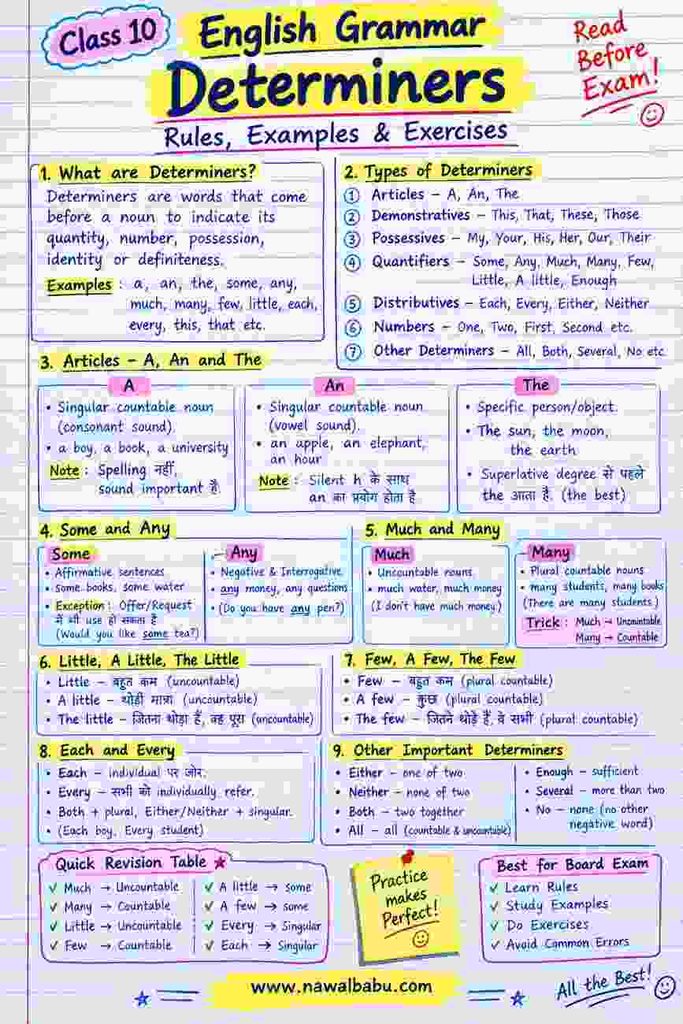
Determiners क्या हैं? | What are Determiners?
Determiners वे words हैं जो किसी noun से पहले लगकर उस noun की संख्या, मात्रा, निश्चितता या पहचान के बारे में जानकारी देते हैं।
Examples:
- a boy
- an apple
- the sun
- some water
- many students
- little milk
- every student
- these books
यहाँ a, an, the, some, many, little, every, these Determiners हैं।
सरल परिभाषा
A determiner is a word placed before a noun to clarify its meaning, quantity, number or identity.
Types of Determiners
Class 10 के लिए मुख्य Determiners इस प्रकार हैं:
- Articles – A, An, The
- Demonstratives – This, That, These, Those
- Possessives – My, Your, His, Her, Our, Their
- Quantifiers – Some, Any, Much, Many, Little, Few, Enough
- Distributives – Each, Every, Either, Neither
- Numbers – One, Two, First, Second आदि
- Other Determiners – All, Both, Several, No, Either, Neither
Articles – A, An and The
Articles Determiners के सबसे महत्वपूर्ण प्रकारों में से हैं।
A का प्रयोग
A का प्रयोग किसी singular countable noun से पहले किया जाता है, जब शब्द की शुरुआत consonant sound से होती है।
Examples:
- He is a teacher.
- I saw a dog.
- She bought a book.
- Ram is a good boy.
Important Rule
यह जरूरी नहीं है कि word का पहला letter consonant हो; sound महत्वपूर्ण है।
- a university – क्योंकि university की sound “yu” है।
- a European – “yu” sound
- a useful book – “yu” sound
An का प्रयोग
An का प्रयोग singular countable noun से पहले vowel sound होने पर किया जाता है।
Examples:
- an apple
- an orange
- an elephant
- an umbrella
- an honest man
Silent H के साथ
यदि h silent हो और vowel sound आए तो an का प्रयोग होगा।
- an honest man
- an hour
- an heir
- an honourable person
ध्यान रखें
An spelling नहीं बल्कि pronunciation के आधार पर लगाया जाता है।
The का प्रयोग
The का प्रयोग किसी specific या निश्चित व्यक्ति, वस्तु या स्थान के लिए किया जाता है।
Examples:
- The sun rises in the east.
- The moon shines at night.
- I saw a dog. The dog was black.
- Please close the door.
Unique things
- the sun
- the moon
- the earth
- the sky
Superlative Degree
Superlative degree से पहले सामान्यतः the आता है।
- the best
- the tallest
- the most beautiful
- the fastest
Example:
He is the best player in the team.
Some और Any
Some
Some का प्रयोग सामान्यतः affirmative sentences में किया जाता है।
Examples:
- I have some books.
- She bought some fruits.
- There is some milk in the glass.
Any
Any का प्रयोग सामान्यतः negative और interrogative sentences में किया जाता है।
Examples:
- I don’t have any money.
- Is there any water?
- Do you have any questions?
Important Exception
Offer या request में some का प्रयोग हो सकता है।
- Would you like some tea?
- Please give me some water.
Much और Many
Much
Much का प्रयोग uncountable nouns के साथ होता है।
Examples:
- much water
- much milk
- much money
- much time
Example:
I don’t have much money.
Many
Many का प्रयोग plural countable nouns के साथ होता है।
Examples:
- many students
- many books
- many questions
- many houses
Example:
There are many students in the classroom.
याद रखने की Trick
Much → Uncountable
Many → Countable Plural
Little, A Little और The Little
इन तीनों का प्रयोग uncountable nouns के साथ होता है।
Little
Little का अर्थ है – बहुत कम, लगभग नहीं के बराबर।
Example:
There is little water in the tank.
अर्थ: टंकी में पानी बहुत कम है।
A Little
A little का अर्थ है – थोड़ी मात्रा, लेकिन कुछ है।
Example:
There is a little water in the bottle.
The Little
The little का अर्थ है – जितना थोड़ा है, वह पूरा।
Example:
The little money he had was spent on books.
Few, A Few और The Few
इनका प्रयोग plural countable nouns के साथ होता है।
Few
Few = बहुत कम, लगभग नहीं के बराबर।
- Few students passed the test.
A Few
A few = कुछ, हालांकि संख्या कम है।
- A few students came to the class.
The Few
The few = जितने थोड़े हैं, वे सभी।
- The few friends he has are very loyal.
Exam Trick
| Determiner | Meaning | Noun |
|---|---|---|
| Little | बहुत कम | Uncountable |
| A little | थोड़ा | Uncountable |
| The little | जितना थोड़ा है वह पूरा | Uncountable |
| Few | बहुत कम | Plural Countable |
| A few | कुछ | Plural Countable |
| The few | जितने थोड़े हैं वे सभी | Plural Countable |
Each और Every
Each और Every दोनों का अर्थ “प्रत्येक/हर” होता है, लेकिन इनके प्रयोग में अंतर है।
Each
Each का प्रयोग individual members पर जोर देने के लिए किया जाता है।
- Each student received a book.
- Each boy was given a prize.
Every
Every का प्रयोग group के सभी members को individually refer करने के लिए किया जाता है।
- Every student must attend the class.
- I go to school every day.
Important Rule
Each और Every के बाद सामान्यतः singular countable noun आता है।
❌ Every students
✅ Every student
❌ Each boys
✅ Each boy
Read More: Active and Passive Voice Class 10 | Questions, Rules, Examples & Exercises
Either और Neither
Either
Either का अर्थ है – दोनों में से कोई एक।
- You can take either book.
- Either answer is correct.
Neither
Neither का अर्थ है – दोनों में से कोई भी नहीं।
- Neither answer is correct.
- Neither boy was present.
Important Rule
Either और Neither के बाद सामान्यतः singular countable noun आता है।
Both
Both का अर्थ है – दोनों।
यह plural countable nouns के साथ प्रयोग होता है।
Examples:
- Both boys are intelligent.
- Both books are useful.
- Both students passed the examination.
Both + of
- Both of the boys are present.
- Both of them are good players.
All
All का अर्थ है – सभी/पूरा।
इसका प्रयोग countable और uncountable दोनों nouns के साथ हो सकता है।
Examples:
- All students are present.
- All the books are new.
- All the water was dirty.
Enough
Enough का अर्थ है – पर्याप्त।
यह countable और uncountable दोनों nouns के साथ प्रयोग हो सकता है।
Examples:
- We have enough money.
- There are enough chairs.
- He has enough time.
Several
Several का अर्थ है – कई।
इसका प्रयोग plural countable nouns के साथ किया जाता है।
Examples:
- Several students were absent.
- I have read several books.
- She visited several places.
No
No का अर्थ है – कोई नहीं/एक भी नहीं।
Examples:
- There is no water in the bottle.
- I have no money.
- There are no students in the classroom.
Important Rule
“No” के साथ sentence में सामान्यतः दूसरा negative word नहीं लगाया जाता।
❌ I have no money not.
✅ I have no money.
Demonstrative Determiners
Demonstrative Determiners किसी व्यक्ति या वस्तु की ओर संकेत करते हैं।
This
पास की singular वस्तु के लिए।
- This book is interesting.
That
दूर की singular वस्तु के लिए।
- That house is beautiful.
These
पास की plural वस्तुओं के लिए।
- These books are new.
Those
दूर की plural वस्तुओं के लिए।
- Those boys are playing.
Quick Table
| Singular | Plural |
|---|---|
| This | These |
| That | Those |
Possessive Determiners
Possessive Determiners किसी व्यक्ति या वस्तु के साथ संबंध बताते हैं।
मुख्य Possessive Determiners
- My
- Your
- His
- Her
- Its
- Our
- Their
Examples:
- This is my book.
- He lost his pen.
- She completed her homework.
- We love our country.
- They cleaned their room.
Important Rules of Determiners
Rule 1: Singular Countable Noun
Singular countable noun के पहले सामान्यतः determiner आवश्यक होता है।
❌ I saw boy.
✅ I saw a boy.
Rule 2: Much + Uncountable Noun
❌ Much books
✅ Much water
Rule 3: Many + Plural Countable Noun
❌ Many water
✅ Many students
Rule 4: Little + Uncountable Noun
❌ Little books
✅ Little money
Rule 5: Few + Plural Countable Noun
❌ Few money
✅ Few students
Rule 6: Every + Singular Noun
❌ Every students
✅ Every student
Rule 7: Each + Singular Noun
❌ Each boys
✅ Each boy
Read Also: The Necklace Class 10 Notes in Hindi | Summary, Explanation & Question Answers
Class 10 Determiners Questions with Answers
अब नीचे Board Exam के लिए महत्वपूर्ण questions दिए गए हैं।
Question 1
Fill in the blank:
There is ___ milk in the glass.
Answer: some
Complete sentence:
There is some milk in the glass.
Question 2
He does not have ___ money.
Answer: any
Complete sentence:
He does not have any money.
Question 3
There are ___ students in the classroom.
Answer: many
Complete sentence:
There are many students in the classroom.
Question 4
I have ___ friends in Delhi.
Answer: a few
Complete sentence:
I have a few friends in Delhi.
Question 5
There is ___ water in the bottle.
Answer: a little
Complete sentence:
There is a little water in the bottle.
Question 6
___ student must obey the rules.
Answer: Every
Complete sentence:
Every student must obey the rules.
Question 7
He is ___ honest man.
Answer: an
Complete sentence:
He is an honest man.
Question 8
She is ___ university student.
Answer: a
Complete sentence:
She is a university student.
Question 9
___ sun rises in the east.
Answer: The
Complete sentence:
The sun rises in the east.
Question 10
___ boys are playing cricket.
Answer: Some
Complete sentence:
Some boys are playing cricket.
Determiners Exercise – Set 1
Fill in the blanks with suitable Determiners.
- I have ___ books on English grammar.
- There isn’t ___ water in the bottle.
- He bought ___ apple.
- She is ___ honest girl.
- ___ students were absent today.
- There are ___ chairs in the room.
- I have ___ money left.
- ___ student has a different opinion.
- ___ boys were selected for the team.
- There is ___ milk in the glass.
Answers
- some
- any
- an
- an
- Some
- many
- little
- Every
- a few
- some
Determiners Exercise – Set 2
Choose the correct option.
1. There are ___ students in the class.
A. much
B. many
C. little
D. any
Answer: B. many
2. I have ___ money.
A. many
B. few
C. a little
D. several
Answer: C. a little
3. He is ___ European.
A. an
B. a
C. the
D. some
Answer: B. a
4. ___ of the two answers is correct.
A. Neither
B. Many
C. Much
D. Several
Answer: A. Neither
5. ___ students have completed their homework.
A. Much
B. A little
C. Several
D. Little
Answer: C. Several
Determiners Error Correction
नीचे दिए गए sentences में Determiner की गलतियाँ पहचानकर सही sentence लिखिए।
1. Every students should work hard.
❌ Incorrect
✅ Every student should work hard.
2. I have much books.
❌ Incorrect
✅ I have many books.
3. There are little students in the class.
❌ Incorrect
✅ There are few students in the class.
4. He is an university student.
❌ Incorrect
✅ He is a university student.
5. She has a few water.
❌ Incorrect
✅ She has a little water.
Determiners – Most Important Exam Tricks
Trick 1
Much → Uncountable
Many → Countable Plural
Trick 2
Little → Uncountable
Few → Countable Plural
Trick 3
A little = कुछ मात्रा
Little = बहुत कम
Trick 4
A few = कुछ
Few = बहुत कम
Trick 5
Every + Singular Noun
Trick 6
Each + Singular Noun
Trick 7
Both + Plural Noun
Trick 8
Either/Neither + Singular Noun
Trick 9
This/That + Singular
These/Those + Plural
Trick 10
A/An का चुनाव spelling नहीं बल्कि sound के आधार पर करें।
Determiners Practice Set for Class 10
अब बिना answers देखे इन questions को हल करें।
- There is ___ sugar in the bowl.
- I don’t have ___ money.
- ___ boy was given a prize.
- She bought ___ umbrella.
- He is ___ university student.
- ___ students are playing football.
- There are ___ books on the table.
- I have ___ friends in Patna.
- There is ___ hope of his recovery.
- ___ of the two boys is guilty.
- ___ students were present in the class.
- ___ student must bring his notebook.
- He has ___ knowledge of English.
- We need ___ chairs for the guests.
- ___ books are mine.
Answers
- some
- any
- Each
- an
- a
- Some
- many
- a few
- little
- Neither
- All
- Every
- little
- some
- These
For More Practice Visit: Determiners Exercises for Class 10 with Practice Questions
Frequently Asked Questions – FAQs
What are Determiners in Class 10 English?
Determiners are words placed before nouns to indicate quantity, number, possession, identity or definiteness. Examples include a, an, the, some, any, many, much, few, little, each and every.
Which Determiners are important for Class 10?
For Class 10 Board Exams, students should particularly prepare A, An, The, Some, Any, Much, Many, Few, A Few, Little, A Little, Each, Every, Either, Neither, Both, All and Enough.
What is the difference between Few and A Few?
Few means very few or almost none, while A Few means some. Both are used with plural countable nouns.
What is the difference between Little and A Little?
Little means very little or almost none, while A Little means some quantity. Both are used with uncountable nouns.
Is Every followed by singular or plural noun?
Every is generally followed by a singular countable noun.
Example: Every student must attend the class.
Is Much used with countable nouns?
No. Much is generally used with uncountable nouns, whereas Many is used with plural countable nouns.
Quick Revision Table
| Determiner | Main Use | Example |
|---|---|---|
| A | Singular countable | a boy |
| An | Vowel sound | an apple |
| The | Specific noun | the book |
| Some | Positive quantity | some water |
| Any | Negative/Question | any money |
| Much | Uncountable | much water |
| Many | Plural countable | many books |
| Little | Very little quantity | little money |
| A little | Some quantity | a little milk |
| Few | Very few | few students |
| A few | Some | a few students |
| Each | Individual | each student |
| Every | All individually | every child |
| Either | One of two | either book |
| Neither | None of two | neither answer |
| Both | Two together | both boys |
| All | Entire quantity/group | all students |
| Several | More than two | several books |
| Enough | Sufficient | enough food |
Conclusion
Determiners Class 10 English Grammar का एक scoring topic है। Board Exam में अच्छे marks प्राप्त करने के लिए केवल definitions याद करना पर्याप्त नहीं है; आपको A, An, The, Some, Any, Much, Many, Little, Few, Each, Every, Either, Neither और Both के सही प्रयोग को examples के साथ समझना चाहिए।
सबसे पहले Much–Many, Little–Few, A Little–A Few और Each–Every का अंतर अच्छी तरह याद करें। इसके बाद ऊपर दिए गए exercises को बिना answers देखे solve करें। नियमित practice करने से Determiners के questions को आसानी से हल किया जा सकता है।
CBSE और Bihar Board Class 10 English Exam की तैयारी कर रहे विद्यार्थियों के लिए यह topic grammar section में quick revision के लिए विशेष रूप से उपयोगी है।