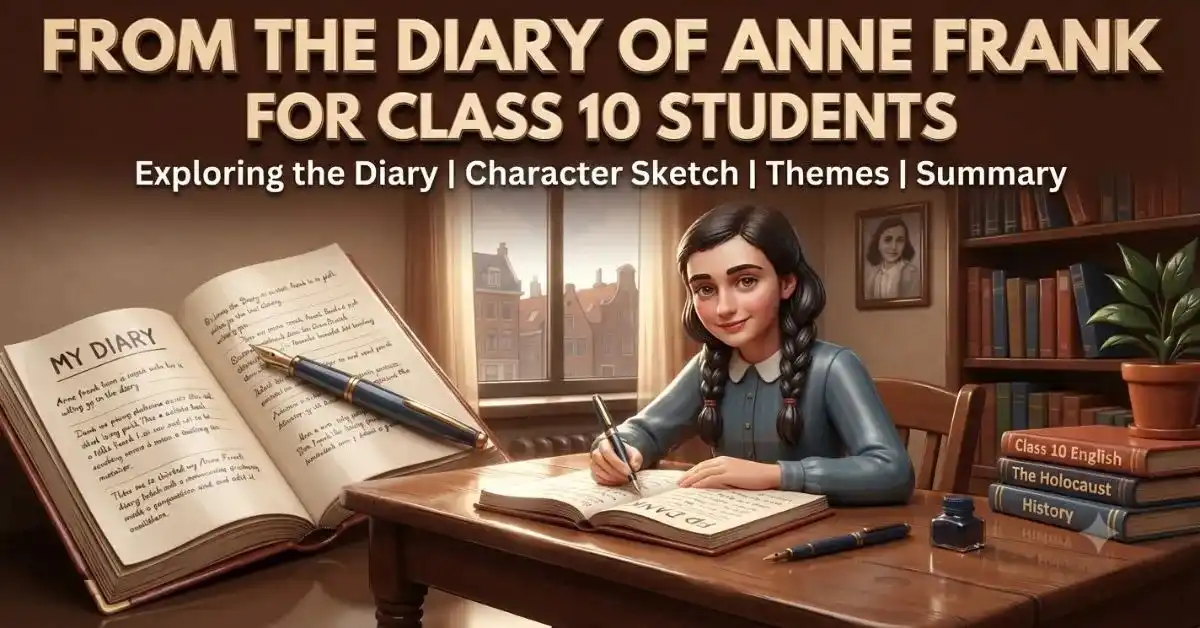
From the Diary of Anne Frank Class 10 is an important chapter from the Class 10 English textbook. The chapter introduces students to the personal thoughts, feelings and experiences of a young girl named Anne Frank. Through her diary, Anne shares her loneliness, school life, family relationships and her desire to have a true friend.
This chapter is not only about a schoolgirl writing a diary. It also gives us a glimpse into the emotional world of a teenager. Anne’s writing is honest, intelligent, humorous and full of self-reflection.
In this complete guide, you will find From the Diary of Anne Frank Class 10 summary, Hindi explanation, important question answers, textbook questions, MCQs, extra questions, difficult words, character sketches and exam preparation tips. Download NCERT BOOK PDF.
From the Diary of Anne Frank Class 10 – Chapter Overview
| Topic | Details |
|---|---|
| Chapter Name | From the Diary of Anne Frank |
| Author | Anne Frank |
| Genre | Diary / Autobiographical Writing |
| Main Character | Anne Frank |
| Important Person | Mr Keesing |
| Diary Name | Kitty |
| Main Theme | Loneliness, Friendship and Self-Expression |
| Class | 10 |
| Subject | English |
About Anne Frank
Who Was Anne Frank?
Anne Frank was a young Jewish girl whose diary became famous around the world. She wrote about her everyday life, thoughts, fears, hopes and feelings during a difficult period in history.
Anne was a sensitive and intelligent girl. She had family members and several friends, but she still felt that she did not have one person with whom she could freely share her deepest thoughts.
For this reason, Anne decided to write a diary. She treated her diary almost like a close friend and gave it the name Kitty.
Her diary allows readers to understand the thoughts and emotions of a young girl. Her writing is simple but powerful because she expresses herself honestly.
Why Did Anne Frank Write a Diary?
Anne started writing a diary because she felt that she did not have a true friend with whom she could share everything.
Although she had loving parents, a sister and many people around her, she believed that ordinary friendship was not enough for sharing her deepest feelings.
She wanted someone who would listen to her without judging her. Since she could not find such a person, she decided to make her diary her friend.
She named this imaginary friend Kitty and began writing letters to her in the diary.
From the Diary of Anne Frank Class 10 Summary
Anne Frank received a diary as a birthday present. She was excited about it and decided to use it to record her thoughts and experiences.
At the beginning of her diary, Anne explained why she wanted to write. She said that writing in a diary was a strange experience for someone like her. She had a family, loving parents and friends, but she still felt lonely inside.
Anne believed that people might not understand her deepest thoughts. Therefore, she decided to treat her diary as a close friend. She named the diary Kitty and began writing letters to it.
Anne also wrote about her family. She mentioned her parents and her elder sister. She described her school life and the people around her.
One of the interesting parts of the chapter is Anne’s relationship with her mathematics teacher, Mr Keesing. He was annoyed because Anne talked too much in class. He considered her a chatterbox and wanted her to control her habit.
As punishment, Mr Keesing asked Anne to write an essay on the topic “A Chatterbox.”
Anne completed the essay and explained that talking was a natural habit. She also tried to give a reasonable explanation for her behaviour.
However, Anne continued talking in the class. Mr Keesing then gave her another essay to write. This time, the topic was related to her habit of talking.
Anne did not become discouraged. Instead, she used her intelligence and sense of humour to deal with the situation.
Finally, Mr Keesing asked her to write an essay about a mother duck and her ducklings. Anne created a humorous story in which the ducklings were punished because they talked too much.
Mr Keesing found the essay funny. He understood Anne’s clever way of responding to his punishment. After that, he stopped punishing her for talking.
The chapter shows that Anne was not only talkative but also intelligent, creative and confident. She had the ability to express her thoughts clearly and use humour in difficult situations.
The chapter also gives us an important lesson about loneliness. Anne’s diary became her closest companion because she wanted someone who could understand her completely.
From the Diary of Anne Frank Summary in Hindi
यह अध्याय Anne Frank की diary पर आधारित है। Anne Frank एक intelligent और sensitive लड़की थी। उसके पास परिवार और दोस्त थे, फिर भी उसे लगता था कि उसके पास ऐसा कोई सच्चा दोस्त नहीं है जिससे वह अपने मन की सभी बातें खुलकर कह सके।
Anne को अपने जन्मदिन पर एक diary मिली। उसने इस diary में अपने विचार और भावनाएँ लिखना शुरू किया। उसने अपनी diary को एक imaginary friend माना और उसका नाम Kitty रखा।
Anne ने बताया कि वह अपने परिवार और दोस्तों से प्यार करती थी, लेकिन वह अपने मन की गहरी बातें उनसे share नहीं कर पाती थी। इसी कारण वह अपनी diary से बातें करने लगी।
Anne ने अपने school life के बारे में भी लिखा। उसके teacher Mr Keesing उसकी अधिक बातें करने की आदत से परेशान थे। उन्होंने Anne को punishment के रूप में “A Chatterbox” विषय पर essay लिखने को कहा।
Anne ने essay में अपनी बातों को सही ठहराने की कोशिश की। उसने बताया कि talking एक natural habit हो सकती है और यह आसानी से बदली नहीं जा सकती।
जब Anne ने class में बात करना जारी रखा, तो Mr Keesing ने उसे फिर से essay लिखने को कहा। Anne ने अपनी intelligence और humour का इस्तेमाल करते हुए ऐसे essays लिखे जिन्हें पढ़कर Mr Keesing भी प्रभावित हुए।
अंत में Mr Keesing ने Anne को mother duck और ducklings से संबंधित एक essay लिखने को कहा। Anne ने इसमें भी humour का प्रयोग किया। उसकी रचनात्मकता देखकर Mr Keesing हँस पड़े और इसके बाद उन्होंने Anne को अधिक बात करने के लिए punishment देना बंद कर दिया।
इस chapter से हमें Anne के व्यक्तित्व के बारे में पता चलता है। वह intelligent, creative, honest, humorous और self-reflective लड़की थी।
From the Diary of Anne Frank Hindi Translation and Explanation
नीचे chapter के महत्वपूर्ण विचारों का सरल Hindi explanation दिया गया है।
1. Anne और उसकी Diary
Anne को अपनी diary बहुत प्रिय थी। वह अपनी diary को एक सामान्य notebook की तरह नहीं देखती थी। उसके लिए diary एक ऐसी friend थी जिससे वह अपने मन की बातें कर सकती थी।
सरल अर्थ:
Anne को लगता था कि उसके पास ऐसा कोई दोस्त नहीं है जो उसकी भावनाओं को पूरी तरह समझ सके। इसलिए उसने diary को अपना close friend बना लिया।
2. Anne का अकेलापन
Anne के पास family और friends थे, फिर भी वह emotionally lonely महसूस करती थी।
सरल अर्थ:
कई बार किसी व्यक्ति के आसपास बहुत सारे लोग होते हैं, लेकिन फिर भी उसे लगता है कि उसे समझने वाला कोई नहीं है। Anne की स्थिति भी कुछ ऐसी ही थी।
3. Kitty के रूप में Diary
Anne ने अपनी diary को Kitty नाम दिया। वह diary को letters लिखती थी और उसमें अपने विचार share करती थी।
सरल अर्थ:
Kitty Anne की imaginary friend थी। Diary के माध्यम से Anne अपने emotions को खुलकर व्यक्त करती थी।
4. Mr Keesing और Anne
Mr Keesing Anne के teacher थे। उन्हें Anne की बात करने की आदत पसंद नहीं थी। उन्होंने उसे सुधारने के लिए essays लिखने की punishment दी।
सरल अर्थ:
Anne ने punishment को डरकर स्वीकार करने के बजाय अपनी creativity का इस्तेमाल किया। उसने humour के साथ essays लिखे और अंत में teacher को भी प्रभावित कर दिया।
Character Sketch of Anne Frank
Anne Frank इस chapter की मुख्य character है। उसके व्यक्तित्व की कई विशेषताएँ हमें diary के माध्यम से पता चलती हैं।
1. Intelligent
Anne बहुत intelligent और समझदार लड़की थी। वह किसी भी situation का creative solution खोज लेती थी।
2. Sensitive
वह अपनी feelings को गहराई से महसूस करती थी। उसकी loneliness और emotional needs उसके writing में दिखाई देती हैं।
3. Creative
Mr Keesing के essays के जवाब में Anne ने अपनी creativity का अच्छा उदाहरण दिया।
4. Honest
Anne अपनी diary में अपने विचारों और emotions को ईमानदारी से लिखती थी।
5. Humorous
Anne में humour की अच्छी sense थी। उसने difficult situations को भी मजेदार तरीके से handle किया।
6. Self-Reflective
Anne अपने व्यवहार और personality के बारे में सोचती थी। वह खुद को समझने की कोशिश करती थी।
Character Sketch of Mr Keesing
Mr Keesing Anne के mathematics teacher थे। शुरुआत में वह Anne की अधिक बात करने की आदत से परेशान थे।
वह discipline बनाए रखना चाहते थे और इसलिए Anne को essays लिखने की punishment देते थे।
हालाँकि, Mr Keesing पूरी तरह कठोर व्यक्ति नहीं थे। Anne की creativity और humour देखकर उनका attitude बदल गया। उन्होंने Anne के essays का आनंद लिया और अंत में उसे बात करने के लिए punishment देना बंद कर दिया।
इससे पता चलता है कि Mr Keesing एक strict teacher होने के साथ-साथ समझदार और humour को appreciate करने वाले व्यक्ति भी थे।
Theme and Central Idea of From the Diary of Anne Frank
1. Loneliness
Chapter का सबसे महत्वपूर्ण theme loneliness है। Anne के पास family और friends होने के बावजूद उसे एक true friend की कमी महसूस होती थी।
2. Importance of Friendship
Anne चाहती थी कि कोई ऐसा व्यक्ति हो जिसके सामने वह अपने मन की हर बात कह सके। इससे true friendship की importance समझ में आती है।
3. Self-Expression Through Writing
Anne के लिए writing अपनी feelings express करने का माध्यम थी। Diary ने उसे अपनी emotions को समझने और व्यक्त करने में मदद की।
4. School Life and Discipline
Chapter में teacher और student के relationship को भी दिखाया गया है। Anne की talking habit और Mr Keesing की प्रतिक्रिया school discipline का हिस्सा है।
5. Humour and Creativity
Anne ने punishment को भी creativity और humour के अवसर में बदल दिया। यह उसके intelligent personality को दर्शाता है।
From the Diary of Anne Frank Class 10 Difficult Words and Meanings
| Word | Meaning | Hindi Meaning |
|---|---|---|
| Diary | Personal record | व्यक्तिगत डायरी |
| Chatterbox | A person who talks a lot | बहुत अधिक बोलने वाला |
| Incorrigible | Difficult to correct | जिसे सुधारना कठिन हो |
| Convincing | Believable | विश्वास योग्य |
| Inherited | Received from parents | विरासत में मिला |
| Quack | Sound of a duck | बत्तख की आवाज |
| Cried | Shouted or wept | चिल्लाया / रोया |
| Mature | Fully developed | परिपक्व |
| Remark | Comment | टिप्पणी |
| Punishment | Penalty for wrongdoing | सजा |
| Annoyed | Irritated | परेशान |
| Argument | Reason or discussion | तर्क |
| Habit | Regular behaviour | आदत |
| Affection | Love or fondness | स्नेह |
| Miserable | Very unhappy | बहुत दुखी |
| Confide | Share private thoughts | निजी बातें बताना |
| Peculiar | Strange or unusual | अजीब |
| Patient | Able to wait calmly | धैर्यवान |
| Humorous | Funny | मजेदार |
| Creative | Having new ideas | रचनात्मक |
From the Diary of Anne Frank Class 10 Textbook Question Answers
Oral Comprehension Check – Important Answers
Q1. Why does Anne need to give a brief sketch about her life?
Answer:
Anne feels that her diary will not understand her thoughts unless she first gives some information about her life. Therefore, she introduces her family, friends and school life before sharing her personal feelings.
Q2. Why did Anne decide to write a diary?
Answer:
Anne decided to write a diary because she felt lonely and wanted a true friend with whom she could share her deepest thoughts. She considered her diary a close companion.
Q3. Why did Anne name her diary Kitty?
Answer:
Anne gave her diary the name Kitty because she imagined it as a close friend. She wrote personal letters to Kitty and shared her feelings with her.
Q4. Why did Mr Keesing punish Anne?
Answer:
Mr Keesing punished Anne because she talked too much during class. He wanted her to control her habit of talking.
Q5. How did Anne respond to Mr Keesing’s punishment?
Answer:
Anne accepted the punishment but used her intelligence and creativity to write humorous essays. Her clever responses eventually changed Mr Keesing’s attitude towards her.
Know More: Outcomes of Democracy Class 10 Notes in Hindi | लोकतंत्र के परिणाम अध्याय 5 सम्पूर्ण नोट्स PDF
From the Diary of Anne Frank Class 10 Important Question Answers
Short Answer Questions
Q1. Why did Anne feel that she had no true friend?
Answer:
Anne had many people around her, including family members and friends. However, she felt that she could not share her deepest thoughts and feelings with them. She wanted a friend who would understand her completely. Therefore, she felt that she had no true friend.
Q2. What did Anne receive on her birthday?
Answer:
Anne received a diary as one of her birthday gifts. She was very happy with it and decided to use it to record her thoughts and experiences.
Q3. What was the name of Anne’s diary?
Answer:
Anne named her diary Kitty. She treated Kitty as an imaginary close friend and wrote letters to her.
Q4. Why was Anne’s diary important to her?
Answer:
Anne’s diary was important because it gave her a place to express her private thoughts and emotions. She could write freely without worrying about being judged.
Q5. Why was Mr Keesing annoyed with Anne?
Answer:
Mr Keesing was annoyed because Anne talked too much in class. He considered her a chatterbox and wanted her to become more disciplined.
Q6. What punishment did Mr Keesing give Anne?
Answer:
Mr Keesing asked Anne to write essays on her habit of talking. He wanted the writing assignments to make her understand that she should talk less in class.
Q7. How did Anne defend her habit of talking?
Answer:
Anne argued that talking was a natural habit and that she had inherited it from her mother. She explained her behaviour intelligently instead of simply accepting that she was wrong.
Q8. How did Anne use humour to deal with her punishment?
Answer:
Anne wrote creative and humorous essays. In her final essay, she created a funny situation involving a mother duck and her ducklings. Her humour made Mr Keesing laugh and changed his attitude.
Q9. What qualities of Anne are revealed in the chapter?
Answer:
Anne is shown as intelligent, sensitive, creative, honest, humorous and self-aware. She can express her thoughts clearly and deal with difficult situations using intelligence and humour.
Q10. What is the main message of the chapter?
Answer:
The chapter highlights the importance of having someone with whom we can honestly share our thoughts and feelings. It also shows how writing can become a powerful way of expressing emotions and understanding oneself.
Long Answer Questions
Q1. Describe Anne Frank’s personality.
Answer:
Anne Frank was an intelligent and sensitive young girl. She was thoughtful and often reflected on her own feelings and behaviour. Although she had a family and friends, she felt emotionally lonely and wanted a true friend.
Anne was also creative and humorous. When her teacher, Mr Keesing, punished her for talking too much, she did not become frightened or hopeless. Instead, she used her intelligence to write interesting essays. Her final essay was so humorous that Mr Keesing was amused.
Anne was also honest. She openly discussed her feelings in her diary. Overall, Anne’s personality was a combination of intelligence, sensitivity, creativity, honesty and humour.
Q2. Why did Anne consider her diary her best friend?
Answer:
Anne considered her diary her best friend because she felt that she did not have anyone with whom she could share her deepest emotions. Although she had family members and friends, she believed that they could not completely understand her inner feelings.
Her diary gave her a safe place to express herself freely. She could write about her happiness, loneliness, fears and thoughts without hesitation. She gave the diary the name Kitty and addressed it like a close friend.
Thus, the diary became an important companion in Anne’s life.
Q3. Describe the relationship between Anne and Mr Keesing.
Answer:
At first, Anne and Mr Keesing did not have a very comfortable relationship. Mr Keesing was annoyed by Anne’s habit of talking during class. He considered her a chatterbox and gave her essays as punishment.
Anne, however, did not react negatively. She used her creativity and humour to complete the assignments. Her final essay about a mother duck and her ducklings amused Mr Keesing.
After seeing Anne’s intelligence and sense of humour, Mr Keesing changed his attitude. He stopped punishing her for talking. Their relationship therefore changed from strict teacher-student interaction to one based on mutual understanding and humour.
Q4. Explain the importance of loneliness in the chapter.
Answer:
Loneliness is one of the central ideas of the chapter. Anne had a family, classmates and friends, but she still felt that she lacked a true friend.
Her loneliness was not because she had no people around her. Rather, she wanted someone who could understand her deepest thoughts and feelings. This emotional loneliness encouraged her to start writing a diary.
The diary became her trusted companion. Through Kitty, Anne could express everything that she could not easily share with others.
Q5. How did Anne’s intelligence help her deal with Mr Keesing?
Answer:
Anne’s intelligence and creativity helped her deal with Mr Keesing’s punishments. Instead of becoming upset, she used the writing assignments as an opportunity to express her ideas.
She gave logical explanations for her talking habit and later wrote humorous essays. Her final essay about the mother duck and ducklings was particularly funny.
Mr Keesing appreciated her creativity and realised that Anne was not simply a troublesome student. Eventually, he stopped giving her punishment for talking.
From the Diary of Anne Frank Class 10 MCQs
Q1. Who wrote the diary described in the chapter?
A. Helen Keller
B. Anne Frank
C. Jane Austen
D. Virginia Woolf
Answer: B. Anne Frank
Q2. What did Anne receive as a birthday gift?
A. A book
B. A diary
C. A pen
D. A watch
Answer: B. A diary
Q3. What name did Anne give to her diary?
A. Maria
B. Kitty
C. Margaret
D. Anna
Answer: B. Kitty
Q4. Why did Anne start writing a diary?
A. Her teacher asked her
B. She wanted to become famous
C. She wanted a true friend
D. She wanted to write a novel
Answer: C. She wanted a true friend
Q5. What was Anne’s main problem in class?
A. She slept in class
B. She talked too much
C. She did not do homework
D. She was always late
Answer: B. She talked too much
Q6. Who was Mr Keesing?
A. Anne’s father
B. Anne’s mathematics teacher
C. Anne’s neighbour
D. Anne’s brother
Answer: B. Anne’s mathematics teacher
Q7. Why did Mr Keesing punish Anne?
A. For being late
B. For not doing homework
C. For talking too much
D. For fighting
Answer: C. For talking too much
Q8. What did Mr Keesing first ask Anne to write about?
A. My Best Friend
B. A Chatterbox
C. My School
D. My Family
Answer: B. A Chatterbox
Q9. Which quality helped Anne deal with her punishment?
A. Anger
B. Fear
C. Creativity
D. Silence
Answer: C. Creativity
Q10. What was one of Anne’s important qualities?
A. Laziness
B. Creativity
C. Dishonesty
D. Carelessness
Answer: B. Creativity
Q11. What does Anne’s diary represent?
A. A textbook
B. A close friend
C. A school project
D. A storybook
Answer: B. A close friend
Q12. What is one major theme of the chapter?
A. Adventure
B. Loneliness
C. Sports
D. Travel
Answer: B. Loneliness
Q13. Anne used which quality in her essays?
A. Humour
B. Anger
C. Fear
D. Laziness
Answer: A. Humour
Q14. What kind of person was Anne?
A. Intelligent and creative
B. Careless and lazy
C. Cruel and dishonest
D. Unfriendly and rude
Answer: A. Intelligent and creative
Q15. What did Mr Keesing eventually do?
A. He expelled Anne
B. He stopped punishing her for talking
C. He changed her school
D. He stopped teaching mathematics
Answer: B. He stopped punishing her for talking
From the Diary of Anne Frank Class 10 One-Word and One-Line Questions
- Who is the author of the chapter?
Answer: Anne Frank. - What did Anne receive on her birthday?
Answer: A diary. - What did Anne name her diary?
Answer: Kitty. - Who was Anne’s teacher?
Answer: Mr Keesing. - What habit of Anne annoyed Mr Keesing?
Answer: Her habit of talking too much. - What did Anne want in a true friend?
Answer: Someone who could understand her deeply. - What was the first essay assigned to Anne?
Answer: “A Chatterbox.” - What did Anne use to deal with punishment?
Answer: Intelligence, creativity and humour. - What became Anne’s closest companion?
Answer: Her diary. - What is the main theme of the chapter?
Answer: Loneliness and the need for true friendship.
From the Diary of Anne Frank Class 10 Assertion and Reason Questions
Q1. Assertion (A): Anne considered her diary a close friend.
Reason (R): She felt that she could share her deepest thoughts with her diary.
Answer: Both A and R are true, and R correctly explains A.
Q2. Assertion (A): Mr Keesing was annoyed with Anne.
Reason (R): Anne talked too much during class.
Answer: Both A and R are true, and R correctly explains A.
Q3. Assertion (A): Anne was a creative girl.
Reason (R): She used humour and imagination in her essays.
Answer: Both A and R are true, and R correctly explains A.
Q4. Assertion (A): Anne felt emotionally lonely.
Reason (R): She did not have anyone with whom she could freely share her deepest feelings.
Answer: Both A and R are true, and R correctly explains A.
Q5. Assertion (A): Mr Keesing eventually stopped punishing Anne.
Reason (R): He appreciated Anne’s humorous and creative writing.
Answer: Both A and R are true, and R correctly explains A.
From the Diary of Anne Frank Class 10 Extra Questions
Very Short Answer Questions
Q1. What did Anne call her imaginary friend?
Answer: Kitty.
Q2. What kind of writing is this chapter based on?
Answer: Diary writing.
Q3. What was Anne’s major problem in class?
Answer: She talked too much.
Q4. Who gave Anne punishment?
Answer: Mr Keesing.
Q5. What did Anne want from a true friend?
Answer: Understanding and emotional support.
Short Answer Questions
Q1. Why did Anne find diary writing unusual?
Answer:
Anne found diary writing unusual because she had never written such personal thoughts before. She also felt that a diary could understand her only after she explained her life and feelings to it.
Q2. Why did Anne create the imaginary friend Kitty?
Answer:
Anne created Kitty because she wanted someone with whom she could share her private feelings. She used her diary as a way to communicate with this imaginary friend.
Q3. How was Anne different from an ordinary student?
Answer:
Anne was intelligent, creative and self-aware. She did not simply accept problems passively. She used her intelligence and humour to deal with situations such as Mr Keesing’s punishments.
Q4. What lesson do we learn from Anne’s relationship with Mr Keesing?
Answer:
We learn that understanding and humour can improve relationships. Mr Keesing initially became annoyed with Anne, but her creativity helped him understand her personality better.
Long Answer Questions
Q1. “Anne Frank was a creative and intelligent girl.” Explain.
Answer:
Anne Frank’s intelligence and creativity are clearly visible throughout the chapter. She had a habit of talking in class, which annoyed Mr Keesing. Instead of becoming afraid of punishment, Anne used her intelligence to respond to the writing assignments.
She gave logical explanations for her behaviour and wrote humorous essays. Her final essay about the duck family showed her imagination and sense of humour. Mr Keesing was so impressed that he eventually stopped punishing her.
Therefore, Anne’s actions clearly show that she was intelligent, creative and confident.
Q2. What does the chapter teach us about the importance of expressing feelings?
Answer:
The chapter teaches us that expressing feelings is important for emotional well-being. Anne often felt lonely because she could not share her deepest thoughts with others.
Her diary gave her a safe space to express herself. Writing helped her understand her own feelings and experiences. The chapter therefore shows that honest self-expression can help a person deal with loneliness and emotional pressure.
From the Diary of Anne Frank Class 10: Important Questions for Board Exam
Students should prepare the following questions carefully:
- Why did Anne Frank decide to write a diary?
- Why did Anne name her diary Kitty?
- Why did Anne feel lonely despite having friends and family?
- Describe Anne Frank’s character.
- Why was Mr Keesing annoyed with Anne?
- How did Anne defend her habit of talking?
- How did Anne’s humour help her deal with punishment?
- Describe the relationship between Anne and Mr Keesing.
- What is the central theme of the chapter?
- Why is Anne’s diary important to her?
These questions cover the most important ideas of the chapter and are useful for revision before examinations.
From the Diary of Anne Frank Exam Preparation Tips
1. Understand the Chapter
Do not try to memorise every sentence. First understand Anne’s personality and the main events.
2. Remember the Main Characters
Focus mainly on Anne Frank and Mr Keesing. Understand their behaviour and relationship.
3. Learn the Central Theme
Remember that loneliness, friendship and self-expression are major themes of the chapter.
4. Practise Textbook Questions
Textbook questions are important because they test your understanding of the chapter.
5. Revise MCQs
MCQs can help you remember important facts, characters and events.
6. Prepare Short and Long Answers
Practise writing answers in your own words. Avoid memorising answers word for word.
7. Learn Important Vocabulary
Knowing difficult words will help you understand the chapter and improve your English answers.
From the Diary of Anne Frank: (FAQs)
Who wrote From the Diary of Anne Frank?
Answer: The chapter is based on the diary writings of Anne Frank.
Why did Anne Frank write a diary?
Answer: Anne wrote a diary because she wanted a true friend with whom she could share her deepest thoughts and feelings.
What was Anne’s diary called?
Answer: Anne named her diary Kitty.
Why did Anne call her diary Kitty?
Answer: She imagined her diary as a close friend and addressed it as Kitty.
Why did Mr Keesing punish Anne?
Answer: Mr Keesing punished Anne because she talked too much during class.
What is the main theme of From the Diary of Anne Frank?
Answer: The major themes are loneliness, friendship, self-expression, creativity and understanding one’s feelings.
What is the summary of From the Diary of Anne Frank Class 10?
Answer: The chapter presents Anne Frank’s diary entries and her thoughts about loneliness, friendship, family and school life. It also describes her humorous interactions with her teacher, Mr Keesing.
What are the important questions from From the Diary of Anne Frank?
Answer: Important questions include why Anne started writing a diary, why she named it Kitty, why she felt lonely, why Mr Keesing punished her and how Anne used humour to change his attitude.
Conclusion
From the Diary of Anne Frank Class 10 is a meaningful chapter that introduces us to the thoughts and emotions of a young girl. Anne Frank’s diary shows that a person may feel lonely even when surrounded by family and friends. What matters is having someone who truly understands our inner feelings.
Anne’s relationship with her diary also teaches us the importance of self-expression. Her interactions with Mr Keesing show her intelligence, creativity and wonderful sense of humour.
For the Class 10 examination, students should focus on the chapter summary, Hindi explanation, character sketch, themes, textbook question answers, important questions and MCQs. A clear understanding of these topics will make revision easier and help students write better answers in the examination.