
Class 10 English में Subject-Verb Agreement Grammar का एक बहुत महत्वपूर्ण topic है। Board Examination में इससे जुड़े questions अक्सर Fill in the Blanks, Error Correction, Sentence Improvement, Multiple Choice Questions और Grammar Exercises के रूप में पूछे जाते हैं। सही Subject-Verb Agreement समझने के लिए यह जानना जरूरी है कि sentence में Subject singular है या plural और उसके अनुसार कौन-सी verb प्रयोग होगी।
इस chapter में आपको Subject-Verb Agreement के सभी महत्वपूर्ण Rules, Examples, Common Errors, Questions with Answers और Practice Set आसान भाषा में दिए गए हैं। ये notes CBSE तथा Bihar Board Class 10 English के विद्यार्थियों के लिए उपयोगी हैं।
Subject-Verb Agreement क्या है?
Subject-Verb Agreement का अर्थ है कि sentence में Subject और Verb का number तथा person के अनुसार सही मेल होना चाहिए।
अर्थात् यदि Subject singular है तो सामान्यतः singular verb और यदि Subject plural है तो plural verb का प्रयोग किया जाता है।
Examples:
- He plays cricket.
- They play cricket.
- She is happy.
- They are happy.
पहले sentence में He singular subject है, इसलिए plays का प्रयोग हुआ है। दूसरे sentence में They plural subject है, इसलिए play प्रयोग हुआ है।
Subject-Verb Agreement के Important Rules
Rule 1: Singular Subject के साथ Singular Verb
जब subject singular हो, तो Present Simple Tense में सामान्यतः verb में s/es लगाया जाता है।
Examples:
- Ram plays football.
- She reads a book.
- The boy goes to school.
- My brother works hard.
याद रखें:
Singular Subject → Singular Verb
Rule 2: Plural Subject के साथ Plural Verb
Plural subject के साथ Present Simple में verb का base form प्रयोग होता है।
Examples:
- The boys play football.
- They read books.
- We go to school.
- The students work hard.
ध्यान दें कि boys plural है, इसलिए play होगा, plays नहीं।
Rule 3: I और You के साथ सामान्यतः Base Verb
I और You के साथ Present Simple में verb का base form प्रयोग किया जाता है।
Examples:
- I play cricket.
- I read English.
- You work hard.
- You speak English.
लेकिन verb be के मामले में नियम अलग है:
- I am a student.
- You are a student.
Rule 4: Two Subjects Joined by “And”
जब दो singular subjects को and से जोड़ा जाता है, तो सामान्यतः plural verb का प्रयोग होता है।
Examples:
- Ram and Shyam are friends.
- Riya and Sita play together.
- The teacher and the student are present.
Important Exception
यदि दो words मिलकर एक ही व्यक्ति, वस्तु या एक ही idea को दर्शाते हैं, तो singular verb आ सकती है।
Example:
- Bread and butter is my favourite breakfast.
यहाँ bread और butter को एक combined item/meal के रूप में लिया गया है।
Rule 5: Either…Or / Neither…Nor
जब दो subjects को either…or या neither…nor से जोड़ा जाता है, तो verb सामान्यतः nearest subject के अनुसार होती है।
Examples:
- Either Ram or his friends are coming.
- Either his friends or Ram is coming.
- Neither the teacher nor the students are ready.
- Neither the students nor the teacher is ready.
Exam Trick:
Verb के ठीक पहले वाले subject को ध्यान से देखें।
Rule 6: Each और Every के साथ Singular Verb
Each और Every के बाद सामान्यतः singular noun और singular verb का प्रयोग होता है।
Examples:
- Each student has a book.
- Every boy is present.
- Each of the players is ready.
- Every student works hard.
गलत:
- Each student have a book. ❌
सही:
- Each student has a book. ✅
Rule 7: Everyone, Everybody, Someone, Somebody, Nobody
इन words का अर्थ कई लोगों से संबंधित हो सकता है, लेकिन grammatical रूप से इन्हें singular माना जाता है।
इसलिए इनके साथ singular verb का प्रयोग होता है।
Important Words:
- Everyone
- Everybody
- Someone
- Somebody
- Anyone
- Anybody
- Nobody
- No one
Examples:
- Everyone is happy.
- Everybody likes music.
- Someone has taken my pen.
- Nobody knows the answer.
- No one was absent.
Rule 8: Either और Neither
Either और Neither सामान्यतः singular होते हैं और इनके साथ singular verb का प्रयोग किया जाता है।
Examples:
- Either of the two boys is intelligent.
- Neither of the answers is correct.
- Neither of them was present.
Rule 9: Collective Noun
Collective nouns जैसे:
- team
- family
- committee
- jury
- class
- crowd
- army
का प्रयोग context के अनुसार singular या plural sense में हो सकता है।
जब group को एक unit के रूप में देखा जाता है, तो singular verb का प्रयोग किया जाता है।
Examples:
- The team is winning.
- The committee has decided the matter.
- The family is happy.
यदि members को अलग-अलग individuals के रूप में emphasize किया जाए, तो plural verb भी संभव हो सकती है, विशेषकर British English में।
Rule 10: Uncountable Nouns के साथ Singular Verb
कुछ nouns दिखने में अधिक मात्रा का अर्थ देते हैं लेकिन grammar में singular माने जाते हैं।
Examples:
- information
- advice
- furniture
- knowledge
- news
- luggage
- equipment
Examples:
- The news is true.
- The furniture is expensive.
- His knowledge is impressive.
- This information is useful.
गलत:
- The news are true. ❌
सही:
- The news is true. ✅
Rule 11: “A Number of” और “The Number of”
यह Board Exam के लिए बहुत महत्वपूर्ण rule है।
A number of + plural noun + plural verb
Example:
- A number of students are absent.
- A number of books are missing.
The number of + plural noun + singular verb
Example:
- The number of students is increasing.
- The number of books is small.
याद रखने की Trick:
A number of → Plural Verb
The number of → Singular Verb
Rule 12: “Along with”, “As well as”, “Together with”
यदि subject के बाद along with, as well as, together with, with आदि आएँ, तो verb पहले मुख्य subject के अनुसार होगी।
Examples:
- Ram, along with his friends, is coming.
- The teacher, as well as the students, is present.
- The captain, together with his players, was ready.
यहाँ friends/students/players को देखकर verb को plural नहीं करना चाहिए।
Rule 13: “There is” और “There are”
There subject नहीं है। Verb उसके बाद आने वाले वास्तविक subject के अनुसार होती है।
Examples:
- There is a book on the table.
- There are many books on the table.
- There is a student in the room.
- There are five students in the room.
Trick:
There के बाद आने वाले noun को देखें।
Rule 14: “One of” के साथ Singular Verb
One of + plural noun के साथ मुख्य verb singular होती है।
Examples:
- One of my friends is a doctor.
- One of the boys has won the race.
- One of the students was absent.
गलत:
- One of the boys are absent. ❌
सही:
- One of the boys is absent. ✅
Rule 15: “More than One” के साथ Singular Verb
More than one के बाद noun singular form में आता है और सामान्यतः singular verb का प्रयोग होता है।
Example:
- More than one student has answered the question.
- More than one person was injured.
Rule 16: Fractions और Percentages
Fraction या percentage के साथ verb उस noun के अनुसार होती है जिसके बारे में fraction या percentage बताया गया है।
Examples:
- Half of the water is wasted.
- Half of the students are absent.
- Fifty percent of the work is complete.
- Fifty percent of the students are present.
Rule 17: Time, Money और Distance
जब time, money या distance को एक single amount के रूप में माना जाता है, तो singular verb का प्रयोग किया जा सकता है।
Examples:
- Ten kilometres is a long distance.
- Five years is a long time.
- Ten thousand rupees is a large amount.
Rule 18: Titles of Books, Movies और Newspapers
किसी book, newspaper, movie या literary work का title grammatical रूप से singular माना जाता है।
Examples:
- “The Arabian Nights” is an interesting book.
- “Gulliver’s Travels” is a famous novel.
Subject-Verb Agreement में होने वाली Common Mistakes
विद्यार्थी अक्सर इन गलतियों को करते हैं:
Mistake 1
❌ He play cricket.
✅ He plays cricket.
Mistake 2
❌ They plays cricket.
✅ They play cricket.
Mistake 3
❌ Each student have a book.
✅ Each student has a book.
Mistake 4
❌ The news are true.
✅ The news is true.
Mistake 5
❌ One of my friends are a doctor.
✅ One of my friends is a doctor.
Mistake 6
❌ A number of students is absent.
✅ A number of students are absent.
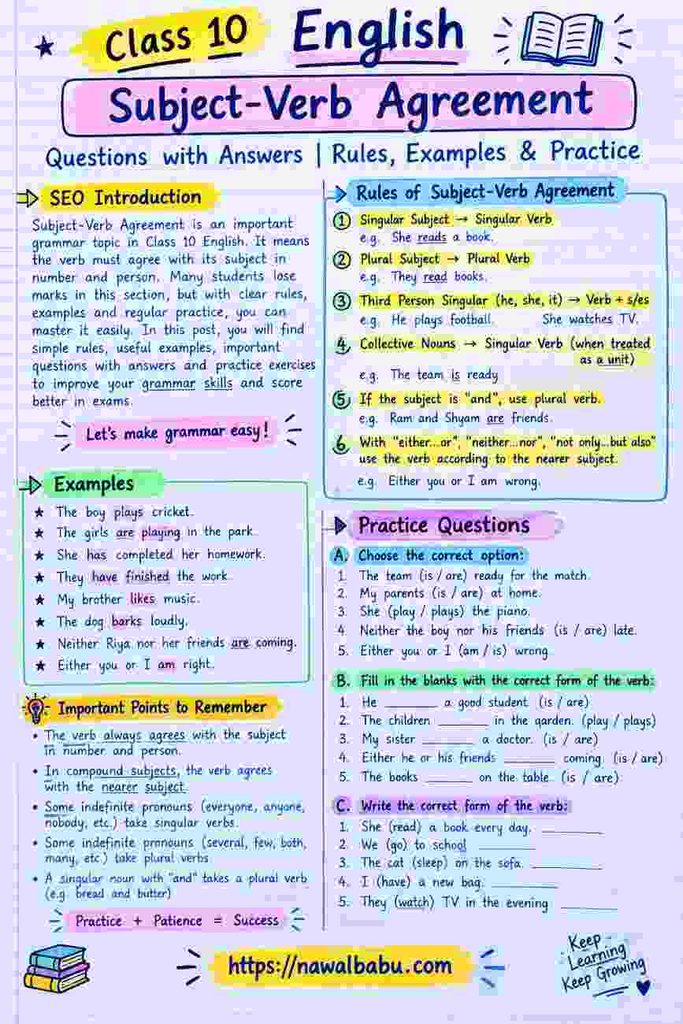
Subject-Verb Agreement Questions with Answers
नीचे Class 10 Board Examination के लिए important practice questions दिए गए हैं।
Question 1
He _______ to school every day.
A. go
B. goes
C. going
D. gone
Answer: B. goes
Question 2
The boys _______ football every evening.
A. plays
B. playing
C. play
D. played
Answer: C. play
Question 3
Each of the students _______ a notebook.
A. have
B. has
C. having
D. are having
Answer: B. has
Question 4
Everyone _______ ready for the examination.
A. are
B. were
C. is
D. have
Answer: C. is
Question 5
Neither of the answers _______ correct.
A. are
B. were
C. have
D. is
Answer: D. is
Question 6
A number of students _______ absent today.
A. is
B. are
C. was
D. has
Answer: B. are
Question 7
The number of students in this class _______ fifty.
A. are
B. were
C. is
D. have
Answer: C. is
Question 8
Ram, along with his friends, _______ going to the market.
A. are
B. were
C. is
D. have
Answer: C. is
Question 9
There _______ many books on the table.
A. is
B. are
C. was
D. has
Answer: B. are
Question 10
One of my friends _______ in Delhi.
A. live
B. living
C. lives
D. are living
Answer: C. lives
Subject-Verb Agreement Practice Set
Fill in the blanks with the correct verb.
- She _______ English very well. (speak/speaks)
- They _______ hard every day. (work/works)
- Everyone _______ to be successful. (want/wants)
- Each boy _______ a pen. (have/has)
- The students _______ ready for the test. (is/are)
- My father _______ to office every day. (go/goes)
- Neither of the boys _______ present. (is/are)
- A number of people _______ waiting outside. (is/are)
- The number of applicants _______ increasing. (is/are)
- There _______ a book on the table. (is/are)
- There _______ many students in the classroom. (is/are)
- One of my friends _______ a doctor. (is/are)
- The news _______ shocking. (is/are)
- Mathematics _______ my favourite subject. (is/are)
- Ram and Shyam _______ good friends. (is/are)
Answers
- speaks
- work
- wants
- has
- are
- goes
- is
- are
- is
- is
- are
- is
- is
- is
- are
Error Correction Questions
Question 1
Find and correct the error:
He go to school every day.
Correct sentence:
He goes to school every day.
Question 2
Each of the students have a book.
Correct sentence:
Each of the students has a book.
Question 3
The boys plays cricket.
Correct sentence:
The boys play cricket.
Question 4
Everyone are happy.
Correct sentence:
Everyone is happy.
Question 5
The news are true.
Correct sentence:
The news is true.
Subject-Verb Agreement: Quick Revision Table
| Subject | Correct Verb Pattern | Example |
|---|---|---|
| He/She/It | singular verb | She plays |
| I/You | base verb | You play |
| We/They | base verb | They play |
| Each | singular verb | Each has |
| Every | singular verb | Every student is |
| Everyone | singular verb | Everyone is |
| Nobody | singular verb | Nobody knows |
| One of | singular verb | One is |
| A number of | plural verb | A number are |
| The number of | singular verb | The number is |
| Either/Neither | generally singular | Neither is |
| There is | singular noun | There is a book |
| There are | plural noun | There are books |
Board Exam Tips for Subject-Verb Agreement
Class 10 Board Exam में Subject-Verb Agreement के questions solve करते समय इन points को याद रखें:
- सबसे पहले subject identify करें।
- देखें कि subject singular है या plural।
- Each, Every, Everyone, Everybody, Nobody को singular मानें।
- A number of के साथ plural verb रखें।
- The number of के साथ singular verb रखें।
- One of + plural noun के साथ singular verb रखें।
- Either…or / Neither…nor में nearest subject पर ध्यान दें।
- Along with / as well as / together with मुख्य subject को नहीं बदलते।
- There is/There are में बाद वाले वास्तविक subject को देखें।
- Sentence को पूरा पढ़कर verb चुनें; केवल noun के पास देखकर answer न करें।
For More Practice Visit: Grade 10 Subject-Verb Agreement Worksheet | PDF
Frequently Asked Questions (FAQs)
What is Subject-Verb Agreement in Class 10 English?
Subject-Verb Agreement का अर्थ है कि sentence में subject और verb का grammatical number तथा person के अनुसार सही मेल होना चाहिए। Singular subject के साथ सामान्यतः singular verb और plural subject के साथ plural verb का प्रयोग किया जाता है।
What is the most important rule of Subject-Verb Agreement?
सबसे basic rule यह है कि singular subject के साथ singular verb और plural subject के साथ plural verb का प्रयोग किया जाता है। लेकिन each, every, either, neither, collective nouns, a number of और the number of जैसे विशेष cases को भी समझना जरूरी है।
Is “Everyone” singular or plural?
Everyone grammatically singular माना जाता है। इसलिए इसके साथ singular verb आती है।
Example:
Everyone is ready.
Is “News” singular or plural?
News uncountable singular noun की तरह प्रयोग होता है। इसलिए इसके साथ singular verb आती है।
Example:
The news is true.
What is the difference between “A number of” and “The number of”?
A number of का अर्थ कई/बहुत से होता है और इसके साथ plural verb आती है।
Example: A number of students are absent.
The number of किसी संख्या को दर्शाता है और इसके साथ singular verb आती है।
Example: The number of students is increasing.
Is Subject-Verb Agreement important for Class 10 Board Exam?
हाँ। Subject-Verb Agreement English Grammar का महत्वपूर्ण topic है और इसके concepts को fill in the blanks, error correction, editing तथा अन्य grammar questions में लागू किया जा सकता है।
Conclusion
Subject-Verb Agreement Class 10 English Grammar का एक महत्वपूर्ण और scoring topic है। यदि आप singular और plural subjects, Each/Every, Everyone, Either/Neither, A number of/The number of, One of, There is/There are और as well as/along with जैसे rules को अच्छी तरह समझ लेते हैं, तो इस topic से जुड़े अधिकांश questions आसानी से हल किए जा सकते हैं।
Board Exam की तैयारी के लिए केवल rules याद करने के बजाय examples और practice questions को बार-बार solve करें। इससे sentence में सही verb पहचानने की आपकी speed और accuracy दोनों बेहतर होंगी।