Class 10 Geography Chapter 5 “Minerals and Energy Resources” विद्यार्थियों के लिए बेहद महत्वपूर्ण अध्याय है। इस अध्याय में खनिजों के प्रकार, उनके उपयोग, भारत में प्रमुख खनिज उत्पादक क्षेत्र, ऊर्जा संसाधनों के प्रकार तथा उनके संरक्षण के बारे में सरल भाषा में जानकारी दी गई है। आज के औद्योगिक और आर्थिक विकास में खनिज एवं ऊर्जा संसाधनों की महत्वपूर्ण भूमिका है। For Objective Questions, Visit Learneasily8.
इस नोट्स में लौह एवं अलौह खनिज, कोयला, पेट्रोलियम, प्राकृतिक गैस, जलविद्युत, सौर ऊर्जा और पवन ऊर्जा जैसे विषयों को आसान हिंदी + English भाषा में विस्तार से समझाया गया है। ये नोट्स NCERT आधारित हैं और बोर्ड परीक्षा की तैयारी के लिए अत्यंत उपयोगी हैं। साथ ही महत्वपूर्ण बिंदु, मानचित्र कार्य और त्वरित पुनरावृत्ति भी शामिल की गई है ताकि विद्यार्थी कम समय में पूरे अध्याय को आसानी से समझ और याद कर सकें।
Minerals and Energy Resources Notes: Class 10 Geography Chapter 5
Minerals and Energy Resources are very important for the economic development of a country. Minerals are naturally occurring substances found in the earth’s crust, while energy resources help in running industries, transport, electricity generation, and daily life activities. India is rich in many minerals like iron ore, coal, manganese, and mica. Different types of energy resources such as coal, petroleum, natural gas, solar energy, and wind energy are used to fulfill the growing energy demand. Proper use and conservation of these resources are necessary because many of them are exhaustible and may finish in the future.
What are Minerals? (खनिज क्या हैं?)
Minerals are naturally occurring substances having a definite chemical composition and physical properties. They are formed through geological processes over millions of years. Minerals are found in rocks, ores, and beneath the earth’s surface. They are essential for industrial development and manufacturing activities. Iron is used in industries, copper in electrical goods, and limestone in cement production. Minerals can be metallic or non-metallic. Some minerals are hard like diamonds, while others are soft like talc. Human civilization and industrial progress depend greatly on mineral resources.
Mode of Occurrence of Minerals (खनिजों की प्राप्ति के तरीके)
Minerals occur in different forms in nature. Some minerals are found in igneous and metamorphic rocks in cracks and joints called veins and lodes. Metallic minerals like tin, copper, zinc, and lead are usually found in this way. Minerals are also found in sedimentary rocks in layers or beds such as coal and limestone. Some minerals occur due to evaporation, like gypsum and potash. In ocean water, minerals like common salt and magnesium are found dissolved. Certain minerals are also found as alluvial deposits in river beds and valley floors.
Ferrous Minerals (लौह खनिज)
Ferrous minerals contain iron and are very important for metallurgical industries. India exports many ferrous minerals to other countries. These minerals provide a strong base for industrial development.
(a) Iron Ore (लौह अयस्क)
Iron ore is the basic mineral for the iron and steel industry. India has rich deposits of high-grade iron ore. Hematite and magnetite are the two main types of iron ore. Hematite is the best quality iron ore and contains about 70% iron. Major iron ore producing states are Odisha, Jharkhand, Chhattisgarh, Karnataka, and Goa. Iron ore is used in making machines, tools, railways, bridges, and buildings. The development of industries largely depends on iron ore availability.
(b) Manganese (मैंगनीज)
Manganese is mainly used in the manufacturing of steel and ferro-manganese alloy. It is also used in bleaching powder, insecticides, paints, and batteries. Odisha is the largest producer of manganese in India. Other producing states are Karnataka, Madhya Pradesh, Maharashtra, and Andhra Pradesh. Manganese improves the strength and hardness of steel. Therefore, it is considered an important industrial mineral.
Non-Ferrous Minerals (अलौह खनिज)
Non-ferrous minerals do not contain iron. They are important because they are resistant to rust and are good conductors of electricity.
(a) Copper (तांबा)
Copper is widely used in electrical industries due to its excellent conductivity. It is also used in electronics, chemicals, and alloy making. Major copper-producing states are Rajasthan, Madhya Pradesh, and Jharkhand. Copper reserves in India are limited, so the country imports copper to meet industrial needs.
(b) Bauxite (बॉक्साइट)
Bauxite is the ore from which aluminum is obtained. Aluminum is lightweight, strong, and resistant to corrosion. It is used in aircraft, utensils, electrical cables, and transport industries. Odisha is the largest producer of bauxite in India. Jharkhand, Maharashtra, Chhattisgarh, and Gujarat are also important producers.
Non-Metallic Minerals (अधात्विक खनिज)
Non-metallic minerals do not contain metals. They are widely used in industries and construction works.
(a) Mica (अभ्रक)
Mica is famous for its excellent insulating properties. It is used in electrical and electronic industries. India was once the largest producer of mica in the world. Jharkhand, Andhra Pradesh, Rajasthan, and Telangana are important mica-producing states.
(b) Limestone (चूना पत्थर)
Limestone is an important raw material for the cement industry. It is also used in iron and steel industries. Limestone is found in sedimentary rocks. Major producing states are Rajasthan, Madhya Pradesh, Andhra Pradesh, Gujarat, and Chhattisgarh.
Conservation of Minerals (खनिजों का संरक्षण)
Minerals are exhaustible resources because they take millions of years to form. Rapid industrialization and mining activities are reducing mineral reserves quickly. Therefore, conservation is very important. Minerals should be used carefully and scientifically. Recycling of metals can reduce wastage. Using substitutes and improving technology can also help conserve minerals. Sustainable development ensures that future generations can also use these resources.
Read Also: Class 10 Geography Chapter 3 Water Resources Notes in Hindi | जल संसाधन Class 10 Notes PDF
Energy Resources (ऊर्जा संसाधन)
Energy resources are essential for agriculture, industries, transportation, and domestic work. They are divided into conventional and non-conventional sources.
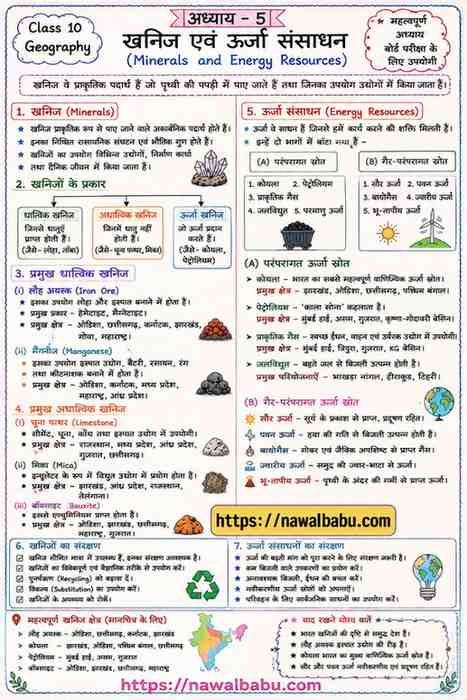
Conventional Sources of Energy (परंपरागत ऊर्जा स्रोत)
These are traditional sources of energy used for a long time.
(a) Coal (कोयला)
Coal is the most important source of commercial energy in India. It is mainly used for electricity generation and industries. Coal is formed from dead plants buried under the earth for millions of years. Different types of coal are peat, lignite, bituminous, and anthracite. Jharkhand, Odisha, Chhattisgarh, West Bengal, and Madhya Pradesh are major coal-producing states.
(b) Petroleum (पेट्रोलियम)
Petroleum is called “black gold” because of its great economic value. It is used in transport, industries, and manufacturing petrochemical products. Major petroleum-producing areas are Mumbai High, Gujarat, Assam, and Krishna-Godavari Basin. Petroleum is a non-renewable resource and should be used carefully.
(c) Natural Gas (प्राकृतिक गैस)
Natural gas is an environment-friendly fuel. It is used in power generation, fertilizer industries, and cooking fuel. Major natural gas reserves are found in Mumbai High, Tripura, Krishna-Godavari Basin, and Gujarat. Compressed Natural Gas (CNG) is widely used in vehicles because it causes less pollution.
(d) Electricity (विद्युत)
Electricity is generated mainly by thermal and hydel power plants. Thermal power is produced using coal, petroleum, and natural gas. Hydel power is generated from flowing water. Bhakra Nangal, Hirakud, and Tehri are important hydel projects in India.
Non-Conventional Sources of Energy (गैर-परंपरागत ऊर्जा स्रोत)
These are renewable and eco-friendly sources of energy.
(a) Solar Energy (सौर ऊर्जा)
Solar energy is obtained from the sun. India receives abundant sunlight throughout the year. Solar panels are used to generate electricity and heat. Rajasthan and Gujarat are leading states in solar energy production. Solar energy reduces pollution and saves conventional fuels.
(b) Wind Energy (पवन ऊर्जा)
Windmills are used to generate electricity from wind. Tamil Nadu, Gujarat, Maharashtra, Karnataka, and Rajasthan are important wind energy producing states. Wind energy is clean, renewable, and pollution-free.
(c) Biogas (बायोगैस)
Biogas is produced from animal dung, plant waste, and organic materials. It is mainly used in rural areas for cooking and lighting. Biogas plants help in waste management and reduce dependence on firewood.
(d) Tidal and Geothermal Energy (ज्वारीय एवं भू-तापीय ऊर्जा)
Tidal energy is produced from ocean tides, while geothermal energy is obtained from heat inside the earth. These sources are renewable and environmentally friendly but are still used on a limited scale in India.
Conservation of Energy Resources (ऊर्जा संसाधनों का संरक्षण)
Energy conservation is necessary because conventional resources are limited. People should avoid unnecessary use of electricity and fuel. Using public transport, energy-efficient appliances, and renewable energy sources can save energy. Awareness and proper planning are important for sustainable energy use.
Important Points for Revision (त्वरित पुनरावृत्ति)
- Minerals are naturally occurring substances found in the earth’s crust.
- Iron ore is the backbone of modern industry.
- Odisha is rich in iron ore and manganese.
- Bauxite is used for making aluminum.
- Coal is the main source of commercial energy in India.
- Petroleum is called black gold.
- Solar and wind energy are renewable resources.
- Conservation of minerals and energy is essential for future generations.
Map Work Important Areas (मानचित्र कार्य)
Mineral Producing Areas
- Iron Ore – Odisha, Chhattisgarh, Karnataka
- Coal – Jharkhand, Odisha, West Bengal
- Petroleum – Mumbai High, Assam, Gujarat
- Bauxite – Odisha, Jharkhand
Power Plants
- Thermal Power Plants – Singrauli, Korba
- Hydel Power Projects – Bhakra Nangal, Tehri, Hirakud
Conclusion (निष्कर्ष)
Minerals and energy resources are the backbone of industrial and economic development. India has rich reserves of minerals and diverse energy resources. However, many resources are exhaustible and unevenly distributed. Proper conservation, scientific management, and increased use of renewable energy can ensure sustainable development. Every citizen should use these resources wisely to protect the environment and secure the future needs of coming generations.