अगर आप कक्षा 10 भूगोल के अध्याय “Manufacturing Industries (विनिर्माण उद्योग)” के आसान, स्पष्ट और परीक्षा उपयोगी नोट्स खोज रहे हैं, तो यह पोस्ट आपके लिए बेहद महत्वपूर्ण है। इस अध्याय में उद्योगों का महत्व, उद्योगों के प्रकार, सूती वस्त्र उद्योग, लौह एवं इस्पात उद्योग, चीनी उद्योग, सीमेंट उद्योग, औद्योगिक प्रदूषण तथा पर्यावरण संरक्षण जैसे सभी महत्वपूर्ण विषयों को सरल हिंदी + English भाषा में समझाया गया है।
ये नोट्स NCERT आधारित हैं और बोर्ड परीक्षा की तैयारी के लिए विशेष रूप से तैयार किए गए हैं। प्रत्येक टॉपिक को छोटे पैराग्राफ और बुलेट पॉइंट्स में समझाया गया है ताकि विद्यार्थी आसानी से याद कर सकें। साथ ही महत्वपूर्ण तथ्य, उदाहरण और मुख्य बिंदु भी दिए गए हैं जो परीक्षा में अच्छे अंक लाने में मदद करेंगे। Download Ncert Book.
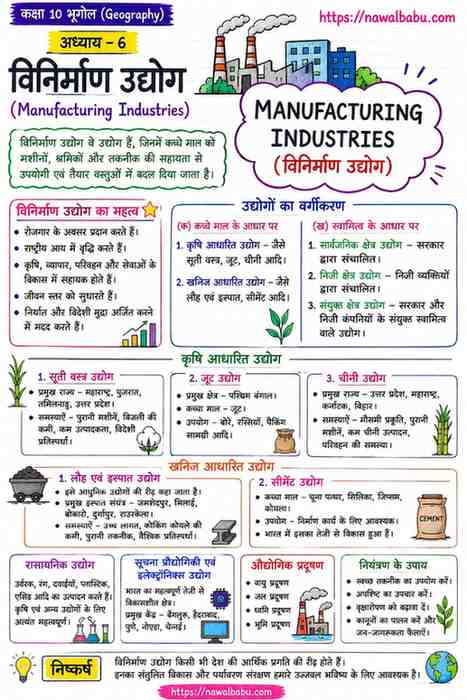
Manufacturing Industries (विनिर्माण उद्योग)
Manufacturing industries are those industries that convert raw materials into useful finished goods with the help of machines, labour, and technology. These industries play an important role in the economic development of a country. They provide employment, increase production, reduce dependence on agriculture, and improve the standard of living of people. India has many types of manufacturing industries such as textile, iron and steel, automobile, chemical, and information technology industries.
विनिर्माण उद्योग वे उद्योग हैं जो कच्चे माल को मशीनों, श्रमिकों और तकनीक की सहायता से उपयोगी तैयार वस्तुओं में बदलते हैं। ये उद्योग देश के आर्थिक विकास में महत्वपूर्ण भूमिका निभाते हैं। ये रोजगार प्रदान करते हैं, उत्पादन बढ़ाते हैं, कृषि पर निर्भरता कम करते हैं तथा लोगों के जीवन स्तर को सुधारते हैं।
Importance of Manufacturing Industries (विनिर्माण उद्योगों का महत्व)
1. Economic Growth (आर्थिक विकास)
Manufacturing industries increase the national income of a country. Industrial development strengthens the economy and helps in modernization. Countries with strong industries are generally economically developed and powerful.
विनिर्माण उद्योग देश की राष्ट्रीय आय बढ़ाते हैं। औद्योगिक विकास अर्थव्यवस्था को मजबूत बनाता है और आधुनिकीकरण में सहायता करता है। जिन देशों के उद्योग मजबूत होते हैं वे आर्थिक रूप से विकसित और शक्तिशाली होते हैं।
Important Points:
- Increase GDP and national income
- Promote industrialization
- Strengthen the economy
- Improve export earnings
2. Employment Generation (रोजगार के अवसर)
Industries provide jobs to millions of people directly and indirectly. Workers are employed in factories, transport, trade, banking, and other services related to industries.
उद्योग लाखों लोगों को प्रत्यक्ष और अप्रत्यक्ष रूप से रोजगार देते हैं। फैक्ट्रियों, परिवहन, व्यापार, बैंकिंग तथा अन्य सेवाओं में रोजगार मिलता है।
Important Points:
- Reduce unemployment
- Support rural and urban workers
- Increase income of families
- Improve living standards
3. Agricultural Development (कृषि का विकास)
Industries help agriculture by producing fertilizers, tractors, irrigation pumps, and other agricultural equipment. Agro-based industries also use agricultural products as raw materials.
उद्योग कृषि के विकास में सहायता करते हैं। वे उर्वरक, ट्रैक्टर, सिंचाई पंप तथा कृषि उपकरण बनाते हैं। कृषि आधारित उद्योग कृषि उत्पादों को कच्चे माल के रूप में उपयोग करते हैं।
Important Points:
- Supply modern farming tools
- Increase agricultural productivity
- Support farmers financially
- Promote agro-based industries
Contribution of Industry to National Economy
(राष्ट्रीय अर्थव्यवस्था में उद्योगों का योगदान)
The industrial sector contributes significantly to India’s GDP. It helps in exports and foreign exchange earnings. However, India still faces challenges like low productivity and competition from foreign industries.
औद्योगिक क्षेत्र भारत की GDP में महत्वपूर्ण योगदान देता है। यह निर्यात और विदेशी मुद्रा अर्जित करने में मदद करता है। फिर भी भारत को कम उत्पादकता और विदेशी उद्योगों से प्रतिस्पर्धा जैसी चुनौतियों का सामना करना पड़ता है।
Key Points
- Industrial growth supports the economy
- Increases foreign exchange
- Encourages infrastructure development
- Faces global competition
Industrial Location (उद्योगों की अवस्थिति)
Factors Affecting Industrial Location
(उद्योगों की अवस्थिति को प्रभावित करने वाले कारक)
Industries are located where raw materials, labour, transport, power, and markets are easily available. Government policies and availability of water also affect industrial location.
उद्योग वहां स्थापित किए जाते हैं जहाँ कच्चा माल, श्रमिक, परिवहन, बिजली और बाजार आसानी से उपलब्ध हों। सरकारी नीतियाँ और जल की उपलब्धता भी उद्योगों की अवस्थिति को प्रभावित करती हैं।
Main Factors
- Availability of raw materials
- Availability of labour
- Transport facilities
- Market availability
- Power supply
- Government policies
Read Also: Class 10 History Chapter 2 Notes in Hindi | Nationalism in India Easy Explanation (NCERT 2026-27)
Classification of Industries (उद्योगों का वर्गीकरण)
1. Based on Raw Material
(कच्चे माल के आधार पर)
Agro-Based Industries (कृषि आधारित उद्योग)
These industries use agricultural products as raw materials. Example: cotton textile, sugar, and jute industries.
ये उद्योग कृषि उत्पादों को कच्चे माल के रूप में उपयोग करते हैं। उदाहरण: सूती वस्त्र, चीनी और जूट उद्योग।
Mineral-Based Industries (खनिज आधारित उद्योग)
These industries use minerals as raw materials. Example: iron and steel, cement industries.
ये उद्योग खनिजों को कच्चे माल के रूप में उपयोग करते हैं। उदाहरण: लौह एवं इस्पात तथा सीमेंट उद्योग।
2. Based on Ownership
(स्वामित्व के आधार पर)
Public Sector Industries (सार्वजनिक क्षेत्र उद्योग)
Owned and managed by the government. Example: BHEL and SAIL.
सरकार द्वारा संचालित उद्योग सार्वजनिक क्षेत्र उद्योग कहलाते हैं।
Private Sector Industries (निजी क्षेत्र उद्योग)
Owned by private individuals or companies. Example: TISCO.
निजी व्यक्तियों या कंपनियों द्वारा संचालित उद्योग निजी क्षेत्र उद्योग कहलाते हैं।
Joint Sector Industries (संयुक्त क्षेत्र उद्योग)
Owned jointly by the government and private companies.
सरकार और निजी कंपनियों के संयुक्त स्वामित्व वाले उद्योग संयुक्त क्षेत्र उद्योग कहलाते हैं।
Agro-Based Industries (कृषि आधारित उद्योग)
Cotton Textile Industry (सूती वस्त्र उद्योग)
The cotton textile industry is one of the oldest industries in India. Maharashtra, Gujarat, Tamil Nadu, and Uttar Pradesh are major cotton textile producing states.
सूती वस्त्र उद्योग भारत का सबसे पुराना उद्योग है। महाराष्ट्र, गुजरात, तमिलनाडु और उत्तर प्रदेश इसके प्रमुख राज्य हैं।
Problems
- Irregular power supply
- Outdated machinery
- Competition from foreign countries
- Low productivity
Jute Industry (जूट उद्योग)
The jute industry is mainly concentrated in West Bengal because of the availability of raw jute and transport facilities.
जूट उद्योग मुख्यतः पश्चिम बंगाल में स्थित है क्योंकि यहाँ कच्चा जूट और परिवहन की सुविधा उपलब्ध है।
Important Uses
- Making bags and ropes
- Packing materials
- Eco-friendly products
Sugar Industry (चीनी उद्योग)
India is one of the largest producers of sugar in the world. Uttar Pradesh, Maharashtra, Karnataka, and Bihar are important sugar-producing states.
भारत विश्व के सबसे बड़े चीनी उत्पादकों में से एक है।
Major Problems
- Seasonal nature of industry
- Old machinery
- Transport issues
- Low sugar recovery rate
Mineral-Based Industries (खनिज आधारित उद्योग)
Iron and Steel Industry (लौह एवं इस्पात उद्योग)
Iron and steel industry is called the backbone of modern industry because almost every industry depends on it.
लौह एवं इस्पात उद्योग को आधुनिक उद्योगों की रीढ़ कहा जाता है क्योंकि लगभग सभी उद्योग इस पर निर्भर करते हैं।
Major Steel Plants
- Jamshedpur
- Bhilai
- Bokaro
- Durgapur
- Rourkela
Problems
- High production cost
- Lack of modern technology
- Shortage of coking coal
- Competition in global market
Know More: Acids, Bases and Salts Class 10 Notes in Hindi + English | Assertion Reason & Case Study Questions
Cement Industry (सीमेंट उद्योग)
Cement is essential for construction work. India has a large cement industry because raw materials are easily available.
सीमेंट निर्माण कार्य के लिए आवश्यक है। भारत में सीमेंट उद्योग तेजी से विकसित हुआ है।
Raw Materials
- Limestone
- Silica
- Gypsum
- Coal
Chemical Industries (रासायनिक उद्योग)
The chemical industry is growing rapidly in India. It produces fertilizers, dyes, paints, plastics, medicines, and acids.
भारत में रासायनिक उद्योग तेजी से विकसित हो रहा है। यह उर्वरक, रंग, प्लास्टिक, दवाइयाँ और अम्ल बनाता है।
Importance
- Supports agriculture
- Produces medicines
- Helps other industries
- Increases exports
Information Technology and Electronics Industry
(सूचना प्रौद्योगिकी एवं इलेक्ट्रॉनिक्स उद्योग)
India has become an important center of IT and electronics industries. Bengaluru, Hyderabad, Pune, Chennai, and Noida are major IT hubs.
भारत सूचना प्रौद्योगिकी और इलेक्ट्रॉनिक्स उद्योग का महत्वपूर्ण केंद्र बन गया है।
Advantages
- Employment generation
- Export earnings
- Technological development
- Global recognition
Industrial Pollution and Environmental Degradation
(औद्योगिक प्रदूषण एवं पर्यावरणीय क्षरण)
Industries cause air, water, land, and noise pollution. Harmful gases and industrial waste affect human health and the environment.
उद्योग वायु, जल, भूमि और ध्वनि प्रदूषण उत्पन्न करते हैं। हानिकारक गैसें और औद्योगिक अपशिष्ट मानव स्वास्थ्य और पर्यावरण को प्रभावित करते हैं।
Types of Pollution (प्रदूषण के प्रकार)
Air Pollution (वायु प्रदूषण)
Smoke and harmful gases released from industries pollute the air.
Water Pollution (जल प्रदूषण)
Industrial waste released into rivers pollutes water bodies.
Noise Pollution (ध्वनि प्रदूषण)
Machines and generators create noise pollution.
Land Pollution (भूमि प्रदूषण)
Dumping industrial waste damages soil quality.
Measures to Control Environmental Degradation
(पर्यावरणीय क्षरण को नियंत्रित करने के उपाय)
Industries should adopt eco-friendly methods to reduce pollution. Recycling, waste treatment, and proper management are necessary.
उद्योगों को प्रदूषण कम करने के लिए पर्यावरण अनुकूल उपाय अपनाने चाहिए।
Important Measures
- Use cleaner fuels
- Treat industrial waste
- Plant more trees
- Recycle materials
- Use modern technology
Conclusion (निष्कर्ष)
Manufacturing industries are very important for the development of India. They provide employment, strengthen the economy, and improve the standard of living. However, industries also create pollution, so sustainable industrial development is necessary. Balanced growth of industries and environmental protection can ensure a better future for the country.
विनिर्माण उद्योग भारत के विकास के लिए अत्यंत महत्वपूर्ण हैं। ये रोजगार प्रदान करते हैं, अर्थव्यवस्था को मजबूत बनाते हैं तथा जीवन स्तर को सुधारते हैं। लेकिन उद्योग प्रदूषण भी फैलाते हैं, इसलिए सतत औद्योगिक विकास आवश्यक है।