Agriculture Notes in Hindi: कक्षा 10 भूगोल का अध्याय 4 “कृषि (Agriculture)” भारत की अर्थव्यवस्था, फसल प्रणाली, कृषि के प्रकार तथा प्रमुख फसलों के बारे में महत्वपूर्ण जानकारी प्रदान करता है। यह अध्याय बोर्ड परीक्षा की दृष्टि से बेहद महत्वपूर्ण है क्योंकि इसमें रबी, खरीफ और जायद फसलें, हरित क्रांति, बागान कृषि तथा खाद्य सुरक्षा जैसे टॉपिक्स शामिल हैं। For Objective Questions, Visit Learneasily8.
इस पोस्ट में आपको Agriculture Notes in Hindi + English भाषा में दिए गए हैं ताकि विद्यार्थी आसानी से समझ सकें और परीक्षा में अच्छे अंक प्राप्त कर सकें। यहाँ सभी विषय NCERT आधारित, आसान शब्दों में और व्यवस्थित तरीके से समझाए गए हैं। साथ ही महत्वपूर्ण बिंदु, प्रमुख फसलें, कृषि सुधार तथा भारत की कृषि व्यवस्था को विस्तार से शामिल किया गया है। ये नोट्स बोर्ड परीक्षा, रिवीजन और क्विक स्टडी के लिए अत्यंत उपयोगी हैं।
Agriculture Notes in Hindi+ English | Simple & Easy Language
Agriculture is the backbone of the Indian economy. More than half of India’s population depends on farming for livelihood. Agriculture not only provides food but also raw materials for industries. India grows many types of crops due to different climates and soils. Farming methods have changed over time from traditional to modern techniques. In this chapter, we study types of farming, cropping patterns, major crops, technological reforms, and the importance of agriculture in India.
कृषि भारत की अर्थव्यवस्था की रीढ़ है। भारत की आधे से अधिक जनसंख्या खेती पर निर्भर करती है। कृषि हमें भोजन, उद्योगों के लिए कच्चा माल और रोजगार प्रदान करती है। भारत में विभिन्न जलवायु और मिट्टी के कारण अनेक प्रकार की फसलें उगाई जाती हैं। समय के साथ कृषि पद्धतियों में बदलाव आया है। इस अध्याय में हम कृषि के प्रकार, फसल प्रणाली, प्रमुख फसलें तथा कृषि सुधारों का अध्ययन करेंगे।
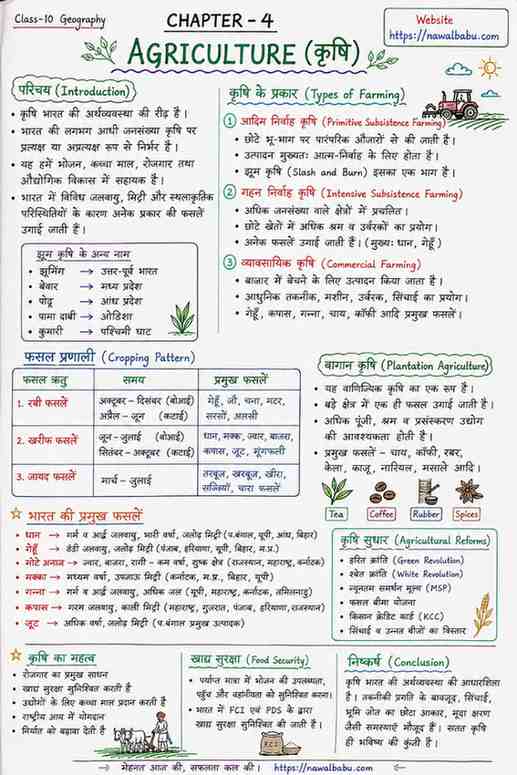
Types of Farming in India (भारत में कृषि के प्रकार)
India has different types of farming depending on climate, technology, and land conditions. Farmers use traditional as well as modern farming methods. Some farming methods are labor-intensive while others use machines and modern technology. Farming types also differ according to rainfall and market demand. The major types are Primitive Subsistence Farming, Intensive Subsistence Farming, and Commercial Farming. Each farming system has its own characteristics and importance in Indian agriculture.
भारत में जलवायु, तकनीक और भूमि की स्थिति के अनुसार अलग-अलग प्रकार की खेती की जाती है। कुछ खेती पारंपरिक तरीकों से होती है जबकि कुछ आधुनिक तकनीकों से। प्रमुख कृषि प्रकार हैं – आदिम निर्वाह कृषि, गहन निर्वाह कृषि और वाणिज्यिक कृषि।
Primitive Subsistence Farming (आदिम निर्वाह कृषि)
Primitive Subsistence Farming is the oldest type of farming. It is practiced on small pieces of land using primitive tools like hoe, dao, and digging sticks. Family members work together on farms. This farming mainly depends on monsoon and natural fertility of soil. Farmers grow crops mainly for their own use and not for sale in markets. Slash and burn agriculture is a part of this farming system and is called by different names in different states.
यह खेती छोटे भू-भाग पर पारंपरिक औजारों से की जाती है। इसमें परिवार के सदस्य मिलकर खेती करते हैं। उत्पादन कम होता है और किसान मुख्यतः अपने उपयोग के लिए खेती करते हैं।
Important Names of Slash and Burn Farming
- Jhumming – North East India
- Bewar – Madhya Pradesh
- Podu – Andhra Pradesh
- Pama Dabi – Odisha
- Kumari – Western Ghats
Intensive Subsistence Farming (गहन निर्वाह कृषि)
This type of farming is practiced in densely populated areas. Farmers use small plots of land but apply more labor and fertilizers to increase production. Multiple cropping is common in this farming system. Rice and wheat are major crops grown under this system. Modern irrigation and HYV seeds are also used in some regions. This farming provides food for a large population but increases pressure on land resources.
यह खेती अधिक जनसंख्या वाले क्षेत्रों में की जाती है। इसमें छोटे खेतों पर अधिक श्रम और उर्वरकों का उपयोग किया जाता है ताकि अधिक उत्पादन प्राप्त हो सके।
Commercial Farming (व्यावसायिक कृषि)
Commercial farming is done for selling crops in the market and earning profit. Farmers use modern technology, machines, chemical fertilizers, pesticides, and irrigation facilities. Large areas of land are generally used in this farming. Crops like wheat, cotton, sugarcane, tea, and coffee are grown commercially. Plantation agriculture is also a type of commercial farming where a single crop is grown on a large scale.
व्यावसायिक कृषि में किसान बाजार में बेचने के लिए फसल उगाते हैं। इसमें आधुनिक मशीनों और तकनीकों का उपयोग किया जाता है।
Features of Commercial Farming
- Use of modern machines
- High productivity
- Large investment
- Market-oriented farming
- Use of HYV seeds and chemicals
Read More: Class 10 Geography Chapter 3 Water Resources Notes in Hindi | जल संसाधन Class 10 Notes PDF
Plantation Agriculture (बागान कृषि)
Plantation agriculture is a type of commercial farming where a single crop is grown on a large area. Large capital investment and labor are required in this farming. Processing industries are usually located near plantations because the produce needs quick processing. Tea, coffee, rubber, sugarcane, banana, and spices are major plantation crops in India. Plantation farming is mainly practiced in hilly and tropical regions with favorable climate conditions.
बागान कृषि में बड़े क्षेत्र में केवल एक फसल उगाई जाती है। इसमें अधिक पूंजी और श्रम की आवश्यकता होती है। चाय, कॉफी, रबर आदि प्रमुख बागान फसलें हैं।
Cropping Pattern in India (भारत की फसल पद्धति)
India has three main cropping seasons – Rabi, Kharif, and Zaid. Different crops are grown in different seasons depending on temperature and rainfall. Farmers select crops according to climatic conditions and availability of water. Cropping patterns vary from region to region. Multiple cropping and crop rotation help maintain soil fertility and increase agricultural productivity. India’s diverse climate supports a wide variety of crops throughout the year.
भारत में मुख्यतः तीन फसल ऋतुएँ होती हैं – रबी, खरीफ और जायद। विभिन्न मौसमों में अलग-अलग फसलें उगाई जाती हैं।
Rabi Crops (रबी फसलें)
Rabi crops are sown in winter from October to December and harvested in summer from April to June. These crops require cool climate during growth and warm climate during ripening. Wheat is the main rabi crop. Other important crops include barley, peas, gram, and mustard. States like Punjab, Haryana, Uttar Pradesh, and Bihar are major producers of rabi crops due to fertile soil and irrigation facilities.
रबी फसलें सर्दियों में बोई जाती हैं और गर्मियों में काटी जाती हैं। गेहूँ इसकी प्रमुख फसल है।
Examples
- Wheat
- Gram
- Mustard
- Peas
- Barley
Kharif Crops (खरीफ फसलें)
Kharif crops are grown during the monsoon season. They are sown in June-July and harvested in September-October. These crops need high temperature and heavy rainfall. Rice is the major kharif crop. Other crops include maize, millet, cotton, jute, and groundnut. Monsoon plays an important role in kharif cultivation. Areas with good rainfall are more suitable for these crops.
खरीफ फसलें मानसून के मौसम में उगाई जाती हैं। धान इसकी प्रमुख फसल है।
Examples
- Rice
- Maize
- Cotton
- Jute
- Groundnut
Zaid Crops (जायद फसलें)
Zaid crops are grown between rabi and kharif seasons during summer. These crops require warm and dry weather. Watermelons, muskmelons, cucumbers, vegetables, and fodder crops are commonly grown during this season. Irrigation is important for zaid crops because rainfall is low during summer months. Farmers often grow short-duration crops during this period to increase income.
जायद फसलें गर्मियों में उगाई जाती हैं। इनमें तरबूज, खरबूजा और सब्जियाँ प्रमुख हैं।
Major Crops of India (भारत की प्रमुख फसलें)
India produces food crops as well as cash crops. Different regions specialize in different crops depending on climate and soil conditions. Some crops are important for food security while others provide raw materials to industries. Rice and wheat are staple food crops. Cotton and jute are fiber crops. Tea and coffee are beverage crops. Sugarcane is an important cash crop for sugar industries.
भारत में खाद्यान्न और नकदी दोनों प्रकार की फसलें उगाई जाती हैं। प्रत्येक फसल के लिए विशेष जलवायु और मिट्टी की आवश्यकता होती है।
Rice (धान)
Rice is the staple food crop of India. It requires high temperature, heavy rainfall, and fertile alluvial soil. It is mainly grown in plains and delta regions. West Bengal, Uttar Pradesh, Punjab, Andhra Pradesh, and Bihar are major rice-producing states. Rice cultivation needs abundant labor because many farming activities are done manually. Irrigation is used in areas with less rainfall.
धान भारत की मुख्य खाद्यान्न फसल है। इसे अधिक तापमान और वर्षा की आवश्यकता होती है।
Wheat (गेहूँ)
Wheat is the second most important food crop in India. It requires cool growing season and bright sunshine during ripening. Fertile alluvial soil is ideal for wheat cultivation. Punjab, Haryana, Uttar Pradesh, Madhya Pradesh, and Bihar are leading wheat-producing states. Modern farming methods and irrigation have increased wheat production in India after the Green Revolution.
गेहूँ भारत की दूसरी प्रमुख खाद्यान्न फसल है। यह ठंडी जलवायु में अच्छी होती है।
Millets (मोटे अनाज)
Millets are highly nutritious crops rich in minerals, iron, and fiber. They grow well in dry regions with low rainfall and poor soil. Jowar, Bajra, and Ragi are important millets. Rajasthan, Maharashtra, Karnataka, and Gujarat are major producers. Millets are called coarse grains but are very healthy and drought-resistant crops.
मोटे अनाज कम वर्षा वाले क्षेत्रों में उगाए जाते हैं। ये पौष्टिक और स्वास्थ्यवर्धक होते हैं।
Maize (मक्का)
Maize is used as food as well as fodder. It requires moderate rainfall and fertile soil. Modern inputs like HYV seeds and fertilizers improve maize production. Karnataka, Madhya Pradesh, Bihar, and Uttar Pradesh are major maize-producing states. Maize is also used in industries for making starch and other products.
मक्का भोजन और पशु चारे दोनों के रूप में उपयोग किया जाता है।
Sugarcane (गन्ना)
Sugarcane is a tropical and subtropical crop. It requires hot climate and plenty of water. India is one of the largest producers of sugarcane in the world. Uttar Pradesh, Maharashtra, Karnataka, Tamil Nadu, and Bihar are major producers. Sugarcane is used to produce sugar, jaggery, molasses, and ethanol.
गन्ना एक महत्वपूर्ण नकदी फसल है जिससे चीनी और गुड़ बनाया जाता है।
Cotton (कपास)
Cotton is a major fiber crop and requires high temperature, light rainfall, and bright sunshine. Black soil is best for cotton cultivation. Maharashtra, Gujarat, Punjab, Haryana, and Rajasthan are major cotton-producing states. Cotton is the raw material for textile industries.
कपास वस्त्र उद्योग के लिए महत्वपूर्ण कच्चा माल है।
Jute (जूट)
Jute is known as the “Golden Fiber.” It requires high temperature, heavy rainfall, and alluvial soil. West Bengal is the leading producer of jute in India. Jute is used to make bags, ropes, mats, and carpets. It is eco-friendly and biodegradable.
जूट को स्वर्ण रेशा कहा जाता है। इसका उपयोग बोरे और रस्सी बनाने में होता है।
Technological and Institutional Reforms (तकनीकी एवं संस्थागत सुधार)
The Indian government has introduced many reforms to improve agriculture. Farmers are encouraged to use modern techniques, irrigation, HYV seeds, and fertilizers. Land reforms and collectivization were introduced after independence. The Green Revolution increased food grain production significantly. Government also provides minimum support prices, crop insurance, and rural banking facilities to help farmers.
सरकार ने कृषि सुधारों के लिए कई योजनाएँ शुरू की हैं। हरित क्रांति से उत्पादन में बहुत वृद्धि हुई।
Major Reforms
- Green Revolution
- White Revolution
- Crop Insurance
- Minimum Support Price (MSP)
- Kisan Credit Card (KCC)
- Irrigation Development
Contribution of Agriculture to National Economy (राष्ट्रीय अर्थव्यवस्था में कृषि का योगदान)
Agriculture plays a vital role in India’s economy. It provides employment to millions of people and supports industries with raw materials. Agriculture contributes to food security and export earnings. However, its share in GDP is decreasing due to industrial and service sector growth. Even today, rural livelihoods largely depend on agriculture and allied activities.
कृषि भारत की अर्थव्यवस्था का महत्वपूर्ण आधार है। यह रोजगार और खाद्य सुरक्षा प्रदान करती है।
Food Security (खाद्य सुरक्षा)
Food security means availability, accessibility, and affordability of food to all people at all times. India has improved food production after the Green Revolution. The government maintains buffer stock through the Food Corporation of India (FCI). Public Distribution System (PDS) helps poor people get food grains at lower prices.
खाद्य सुरक्षा का अर्थ है सभी लोगों को पर्याप्त भोजन उपलब्ध होना। सरकार PDS और FCI के माध्यम से खाद्य सुरक्षा सुनिश्चित करती है।
Conclusion (निष्कर्ष)
Agriculture is the foundation of Indian life and economy. It provides food, employment, and raw materials for industries. Modern farming methods have increased production, but challenges like small land holdings, dependence on monsoon, and soil degradation still exist. Sustainable agriculture and proper use of resources are necessary for future development. Farmers are the backbone of the nation and agriculture remains essential for India’s progress.
कृषि भारत की अर्थव्यवस्था और समाज का आधार है। आधुनिक तकनीकों ने उत्पादन बढ़ाया है, लेकिन कई चुनौतियाँ अभी भी मौजूद हैं। सतत कृषि और संसाधनों का सही उपयोग भारत के भविष्य के लिए आवश्यक है।