
संघवाद (Federalism) लोकतंत्र की एक महत्वपूर्ण व्यवस्था है, जिसमें देश की शक्तियों को केंद्र सरकार और राज्य सरकारों के बीच बाँटा जाता है। कक्षा 10 राजनीति विज्ञान (Political Science) के इस अध्याय में छात्रों को संघवाद की अवधारणा, उसकी विशेषताएँ, भारत में संघीय व्यवस्था, शक्तियों का विभाजन, पंचायती राज व्यवस्था तथा विकेंद्रीकरण के बारे में विस्तार से जानकारी मिलती है। यह अध्याय परीक्षा की दृष्टि से बहुत महत्वपूर्ण है क्योंकि इससे बोर्ड परीक्षा में अक्सर प्रश्न पूछे जाते हैं।
इस पोस्ट में आपको सरल और आसान भाषा में Federalism Class 10 Notes in Hindi, महत्वपूर्ण प्रश्न, मुख्य बिंदु तथा NCERT आधारित सम्पूर्ण नोट्स मिलेंगे। ये नोट्स छात्रों को जल्दी याद करने, रिवीजन करने और अच्छे अंक प्राप्त करने में मदद करेंगे। अगर आप Class 10 SST Political Science Chapter 2 के आसान और समझने योग्य नोट्स खोज रहे हैं, तो यह पोस्ट आपके लिए बेहद उपयोगी है। Download NCERT Book PDF.
Federalism (संघवाद) – Class 10 Political Science Notes
Federalism means a system of government in which powers are divided between the central government and state governments. In India, powers are shared between the Union Government and State Governments according to the Constitution. संघवाद ऐसी शासन व्यवस्था है जिसमें शक्तियाँ केंद्र सरकार और राज्य सरकारों के बीच बाँटी जाती हैं। भारत में संविधान द्वारा दोनों स्तर की सरकारों को अधिकार दिए गए हैं। Federalism helps in maintaining unity in diversity and provides equal importance to different regions, languages, and cultures of the country.
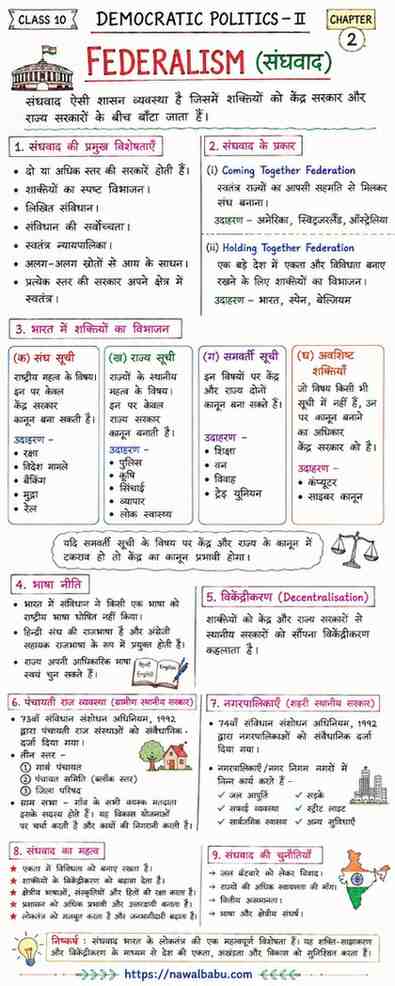
What is Federalism? (संघवाद क्या है?)
Meaning of Federalism (संघवाद का अर्थ)
Federalism is a system where two or more levels of government govern the same citizens but each level has its own powers and responsibilities. संघवाद में एक ही देश में अलग-अलग स्तर की सरकारें कार्य करती हैं। भारत में मुख्य रूप से केंद्र सरकार और राज्य सरकारें होती हैं। Both governments work independently in their own areas. The Constitution clearly explains the powers of each government. This system prevents concentration of power and promotes cooperation among governments for smooth administration.
Key Features of Federalism (संघवाद की प्रमुख विशेषताएँ)
1. Two or More Levels of Government
संघीय व्यवस्था में कम-से-कम दो स्तर की सरकारें होती हैं। In India, these are:
- Union Government (केंद्र सरकार)
- State Government (राज्य सरकार)
- Local Government (स्थानीय सरकार)
Each level works for the welfare of people in its own area.
2. Division of Powers
The Constitution divides powers between different levels of government. केंद्र और राज्य सरकारों के अधिकार स्पष्ट रूप से बाँटे गए हैं। No government can take away powers of another government without constitutional amendment. This division reduces conflicts and maintains balance.
3. Written Constitution
Federal countries usually have a written constitution. भारत का संविधान लिखित संविधान है। It explains the structure, powers, and responsibilities of governments. Written rules help in maintaining transparency and stability.
4. Supremacy of Constitution
The Constitution is the supreme law of the country. संविधान सर्वोच्च होता है। Both central and state governments must follow constitutional rules. Any law against the Constitution can be declared invalid by courts.
5. Independent Judiciary
An independent judiciary protects the Constitution and resolves disputes between governments. भारत में सर्वोच्च न्यायालय (Supreme Court) इस कार्य को करता है। It ensures that powers are properly used according to constitutional provisions.
6. Separate Sources of Revenue
Each government has its own source of income. केंद्र और राज्य सरकारों को अलग-अलग कर व राजस्व प्राप्त होते हैं। This financial independence helps governments perform their duties effectively.
Types of Federalism (संघवाद के प्रकार)
1. Coming Together Federation
In this type, independent states come together to form a bigger country. इसमें राज्यों ने अपनी शक्ति बढ़ाने के लिए संघ बनाया।
Examples:
- United States
- Switzerland
- Australia
States have equal powers in this system.
2. Holding Together Federation
In this type, a large country divides powers between central and state governments. बड़े देश में विविधताओं को संभालने के लिए शक्ति बाँटी जाती है।
Examples:
- India
- Spain
- Belgium
The central government is usually more powerful than states.
Federalism in India (भारत में संघवाद)
India as a Federal Country
India is a federal country because powers are divided between the Union and State Governments. However, the Indian Constitution uses the word “Union of States” because India’s federation is not the result of an agreement among states. भारत में केंद्र सरकार को अधिक शक्तियाँ दी गई हैं ताकि राष्ट्रीय एकता बनी रहे। Indian federalism is unique because it combines features of both federal and unitary systems.
Division of Powers in India (भारत में शक्तियों का विभाजन)
Union List (संघ सूची)
Subjects of national importance are included in the Union List. इन विषयों पर केवल केंद्र सरकार कानून बना सकती है।
Examples:
- Defence
- Foreign Affairs
- Banking
- Currency
- Railways
These subjects require uniform policies across the country.
State List (राज्य सूची)
State governments make laws on subjects related to local importance. राज्य सूची के विषयों पर राज्य सरकार कानून बनाती है।
Examples:
- Police
- Agriculture
- Trade
- Irrigation
- Public Health
These subjects are connected with local administration and development.
Concurrent List (समवर्ती सूची)
Both Union and State Governments can make laws on these subjects. केंद्र और राज्य दोनों कानून बना सकते हैं।
Examples:
- Education
- Forests
- Marriage
- Trade Unions
If there is conflict, Union law gets priority.
Residuary Powers (अवशिष्ट शक्तियाँ)
Subjects not mentioned in any list are called residuary subjects. इन पर कानून बनाने का अधिकार केंद्र सरकार को होता है। Example:
- Computer technology
- Cyber laws
These powers help the government deal with modern issues.
Language Policy in India (भारत की भाषा नीति)
India has many languages and cultures. संविधान किसी एक भाषा को राष्ट्रीय भाषा घोषित नहीं करता। Hindi is the official language, but English is also used for official purposes. States can choose their own official languages. This flexible policy has helped in maintaining national unity and respecting regional diversity.
Centre-State Relations (केंद्र-राज्य संबंध)
Administrative Relations
The central government can give directions to state governments on certain matters. केंद्र और राज्य प्रशासनिक कार्यों में सहयोग करते हैं। During emergencies, the central government becomes more powerful.
Financial Relations
The central government collects more taxes, but states also need money for development. इसलिए केंद्र राज्यों को वित्तीय सहायता देता है। Finance Commission recommends distribution of taxes between Centre and States.
Decentralisation in India (भारत में विकेंद्रीकरण)
Meaning of Decentralisation
When powers are transferred from central and state governments to local governments, it is called decentralisation. विकेंद्रीकरण से जनता की भागीदारी बढ़ती है। Local problems can be solved more effectively at local levels.
Panchayati Raj System (पंचायती राज व्यवस्था)
Rural Local Government
In villages, local government is called Panchayati Raj. गाँवों में ग्राम पंचायत स्थानीय प्रशासन का कार्य करती है।
Three levels:
- Gram Panchayat
- Panchayat Samiti
- Zila Parishad
The head of Gram Panchayat is called Sarpanch or Mukhiya.
Gram Sabha (ग्राम सभा)
All adult voters of the village are members of Gram Sabha. ग्राम सभा स्थानीय विकास योजनाओं पर चर्चा करती है। It approves budgets and monitors the work of Gram Panchayat.
Municipalities (नगरपालिका)
Urban Local Government
Urban areas have municipalities and municipal corporations. शहरों में स्थानीय प्रशासन नगरपालिका द्वारा चलाया जाता है। They work for:
- Water supply
- Roads
- Sanitation
- Street lights
- Public health
The head of Municipal Corporation is called Mayor.
Importance of Federalism (संघवाद का महत्व)
Federalism is important because it:
- Maintains unity in diversity
- Reduces burden on central government
- Encourages regional development
- Protects local culture and language
- Increases people’s participation in governance
संघवाद लोकतंत्र को मजबूत बनाता है और लोगों को शासन में भाग लेने का अवसर देता है।
Challenges of Federalism (संघवाद की चुनौतियाँ)
Some major challenges are:
- Disputes over sharing of river water
- Demand for more autonomy by states
- Financial inequality among states
- Language conflicts
Despite these challenges, Indian federalism has remained successful due to cooperation and constitutional values.
Important Constitutional Amendments (महत्वपूर्ण संवैधानिक संशोधन)
73rd Amendment Act (1992)
This amendment gave constitutional status to Panchayati Raj Institutions. इससे ग्रामीण स्थानीय सरकारों को मजबूती मिली।
74th Amendment Act (1992)
This amendment strengthened urban local governments. इससे नगरपालिकाओं को संवैधानिक दर्जा मिला।
Conclusion (निष्कर्ष)
Federalism is an important feature of Indian democracy. It promotes cooperation between different levels of government and helps in managing the diversity of India. संघवाद भारत की एकता और अखंडता को मजबूत बनाता है। Through decentralisation and power-sharing, people participate actively in governance. Indian federalism has successfully balanced national unity with regional diversity, making democracy more effective and inclusive.
Important Keywords (महत्वपूर्ण शब्द)
- Federalism – संघवाद
- Constitution – संविधान
- Union Government – केंद्र सरकार
- State Government – राज्य सरकार
- Decentralisation – विकेंद्रीकरण
- Panchayati Raj – पंचायती राज
- Municipality – नगरपालिका
- Concurrent List – समवर्ती सूची
- Judiciary – न्यायपालिका
- Autonomy – स्वायत्तता
Important Questions (महत्वपूर्ण प्रश्न)
Very Short Answer Questions
- What is federalism?
- Name the three lists in the Indian Constitution.
- What is Gram Sabha?
- Which amendment strengthened Panchayati Raj?
- What is decentralisation?
Short Answer Questions
- Explain any three features of federalism.
- Differentiate between Union List and State List.
- Describe the Panchayati Raj system in India.
- Explain the importance of federalism in India.
Long Answer Questions
- Explain the division of powers in India.
- Describe the major features of Indian federalism.
- How does decentralisation strengthen democracy?