Class 10 Political Science Chapter “Gender, Religion and Caste” भारतीय लोकतंत्र में सामाजिक विविधताओं और उनके राजनीतिक प्रभाव को समझने के लिए बहुत महत्वपूर्ण अध्याय है। इस chapter में हम जानेंगे कि gender inequality (लैंगिक असमानता), communalism (सांप्रदायिकता) और caste system (जाति व्यवस्था) किस प्रकार समाज और राजनीति को प्रभावित करते हैं। साथ ही यह भी समझेंगे कि भारतीय संविधान सभी नागरिकों को समान अधिकार देकर equality और social justice को कैसे मजबूत करता है। Download NCERT PDF.
इन आसान और सरल Hindi + English Medium notes में आपको NCERT आधारित सभी महत्वपूर्ण topics, key points, definitions, constitutional provisions, important questions तथा quick revision points विस्तार से मिलेंगे। ये notes board exam preparation, quick revision और school assignments के लिए बहुत उपयोगी हैं। यदि आप Class 10 Political Science Chapter 3 के आसान, detailed और exam-oriented notes खोज रहे हैं, तो यह पोस्ट आपके लिए बेहद helpful साबित होगी।
Gender, Religion and Caste Class 10 Notes: NCERT Political Science
India is a country of diversity where people belong to different religions, castes, languages and cultures. In a democratic country, every citizen should get equal rights and equal opportunities. But in society, differences based on gender, religion and caste sometimes create inequality and discrimination. Democracy tries to remove these inequalities through laws, rights and representation. In this chapter, we will study how gender, religion and caste influence politics and society in India and how democracy deals with these issues.
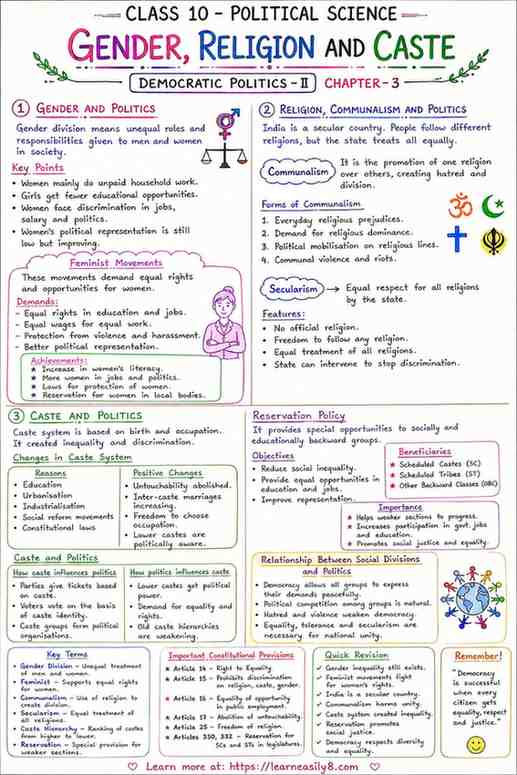
Gender and Politics (लैंगिकता और राजनीति)
Gender division means unequal roles and responsibilities given to men and women in society. Traditionally, women were expected to do household work while men were considered responsible for earning money. This division created inequality between men and women.
Important Points About Gender Division
- Women generally perform unpaid household work such as cooking, cleaning and taking care of children.
- Men are usually given more importance in education and employment.
- In many families, girls are not encouraged to study higher education.
- Women face discrimination in jobs, salary and political participation.
- Democracy believes in equality, so discrimination based on gender is against democratic values.
- India has improved in women’s education and employment, but inequality still exists.
Feminist Movements (नारीवादी आंदोलन)
Feminist movements are movements started by women and supporters of women’s rights to demand equality in society and politics.
Main Objectives of Feminist Movements
- Equal rights for women in education and jobs.
- Equal wages for equal work.
- Protection against domestic violence and harassment.
- Better political representation for women.
- Equal participation in decision-making.
Achievements of Feminist Movements
- Women’s literacy rate has increased.
- More women are working in offices, schools and industries.
- Laws have been made to protect women from violence.
- Women now participate more actively in politics and administration.
- Reservation for women has increased their role in local government.
Read More: Federalism Class 10 Notes in Hindi | संघवाद Notes PDF, Important Questions & Summary
Political Representation of Women: महिलाओं का राजनीतिक प्रतिनिधित्व
Women constitute almost half of India’s population, but their representation in politics is still low.
Important Features
- The Indian Constitution gives equal political rights to women.
- One-third seats are reserved for women in Panchayats and Municipalities.
- Many women are now elected as sarpanch and mayor.
- Women leaders often focus on education, health and social welfare.
- There is a demand for 33% reservation for women in Parliament and State Assemblies.
- Increased participation of women strengthens democracy.
Religion, Communalism and Politics: धर्म, सांप्रदायिकता और राजनीति
Religion is an important part of people’s lives. India is a secular country where people follow different religions such as Hinduism, Islam, Christianity, Sikhism, Buddhism and Jainism.
Democracy allows people to practice their religion freely. However, when religion is used for political gain, it may create conflicts and division in society.
Religious Diversity in India: भारत में धार्मिक विविधता
India is known for its religious diversity and tolerance.
Important Features
- Citizens have the freedom to follow any religion.
- Every religion is treated equally by the state.
- No religion is declared as the official religion of India.
- People can preach and practice their religion freely.
- Religious diversity increases cultural richness and unity in diversity.
Communalism (सांप्रदायिकता)
Communalism means promoting the interests of one religion over others and creating hatred among religious communities.
Features of Communalism
- It creates division on religious lines.
- One religion is presented as superior to others.
- Political parties may use religion to gain votes.
- Communalism leads to mistrust and social tension.
- It can result in riots and violence.
- Communalism weakens democracy and national unity.
Different Forms of Communalism: सांप्रदायिकता के विभिन्न रूप
1. Everyday Religious Prejudices
- People may discriminate against others because of religion.
- Stereotypes and biased thinking develop in society.
2. Demand for Religious Dominance
- A religious group may try to dominate politics and administration.
3. Political Mobilisation on Religious Lines
- Political leaders may ask people to vote in the name of religion.
- Religious emotions are used during elections.
4. Communal Violence
- Religious conflicts sometimes lead to riots and violence.
- Such violence disturbs peace and harmony in the country.
Secularism (धर्मनिरपेक्षता)
Secularism means equal treatment of all religions by the government.
Features of Secular State
- No official religion of the country.
- Equal respect for all religions.
- Freedom to practice and propagate religion.
- Government can interfere to stop religious discrimination.
- The Constitution prohibits religious inequality.
Importance of Secularism
- Maintains peace and harmony in society.
- Protects religious freedom of citizens.
- Strengthens democracy and national unity.
- Prevents religious conflicts in politics.
Read Also: Class 10 Geography Chapter 3 Water Resources Notes in Hindi | जल संसाधन Class 10 Notes PDF
Caste and Politics (जाति और राजनीति)
The caste system is an old social system in India in which people were divided into different groups based on birth and occupation.
Problems Created by Caste System
- Society was divided into higher and lower castes.
- Lower castes suffered discrimination and untouchability.
- Educational and job opportunities were unequal.
- Social inequality increased because of caste hierarchy.
Changes in the Caste System: जाति व्यवस्था में परिवर्तन
Modern education and democracy have reduced many caste inequalities.
Reasons for Change
- Spread of education.
- Urbanization and industrialization.
- Economic development.
- Social reform movements.
- Constitutional laws against discrimination.
Positive Changes
- Untouchability has been legally abolished.
- Inter-caste marriages are increasing.
- People are choosing occupations freely.
- Lower caste groups are becoming socially and politically aware.
Caste and Politics in India: भारत में जाति और राजनीति
Caste plays an important role in Indian politics because political parties seek support from different caste groups.
How Caste Influences Politics
- Parties select candidates based on caste composition.
- Voters may vote according to caste identity.
- Different caste groups form political organizations.
- Election campaigns sometimes focus on caste equations.
How Politics Influences Caste
- Democracy has given political power to lower castes.
- Backward classes demand equality and representation.
- Political participation has reduced old caste hierarchies.
- Caste-based discrimination is being challenged through laws and awareness.
Reservation Policy (आरक्षण नीति)
Reservation is a special policy that provides opportunities to socially and educationally backward groups.
Main Objectives of Reservation
- To reduce social inequality.
- To provide equal opportunities in education and jobs.
- To improve representation of weaker sections.
Groups Benefited by Reservation
- Scheduled Castes (SC)
- Scheduled Tribes (ST)
- Other Backward Classes (OBC)
Importance of Reservation
- Helps weaker sections progress socially and economically.
- Increases participation in government services and education.
- Promotes social justice and equality.
- Strengthens inclusive democracy.
Relationship Between Social Divisions and Politics: सामाजिक विभाजन और राजनीति का संबंध
Social divisions and politics are closely connected in democratic countries.
Important Points
- Democracy allows all social groups to express their demands peacefully.
- Political competition among different groups is natural.
- Problems arise when social differences create hatred and violence.
- Healthy political participation strengthens democracy.
- Equality, tolerance and secularism are necessary for national unity.
Key Terms (मुख्य शब्द)
Gender Division
Unequal roles and treatment given to men and women in society.
Feminist
A person who supports equal rights and opportunities for women.
Communalism
Using religion to create political division and hatred.
Secularism
Equal treatment of all religions by the state.
Caste Hierarchy
Ranking of castes from higher to lower social status.
Reservation
Special provision for weaker sections in education and jobs.
Important Constitutional Provisions: महत्वपूर्ण संवैधानिक प्रावधान
- Right to Equality ensures equal treatment to all citizens.
- Article 17 abolishes untouchability.
- Freedom of Religion is guaranteed by the Constitution.
- Discrimination based on religion, caste or gender is prohibited.
- Reservation is provided for socially backward groups.
Conclusion (निष्कर्ष)
Gender, religion and caste are important parts of Indian society and politics. Democracy tries to provide equality, justice and dignity to every citizen. Social divisions may create challenges, but democratic politics provides peaceful solutions. India’s Constitution promotes secularism, equality and social justice to maintain unity in diversity. Citizens should respect all religions, castes and genders to strengthen democracy and national integration.
Important Questions and Answers: महत्वपूर्ण प्रश्न उत्तर
1. What is gender division?
Gender division refers to unequal roles and responsibilities assigned to men and women in society.
2. What is communalism?
Communalism means promoting one religion over others and creating hatred among religious communities.
3. What is secularism?
Secularism means equal treatment of all religions by the state.
4. Why is reservation important?
Reservation provides equal opportunities to weaker sections in education and jobs.
5. How does caste affect politics?
Caste affects candidate selection, voting behavior and political alliances.
6. What are feminist movements?
Feminist movements demand equal rights and opportunities for women.
7. Why is secularism important in India?
Secularism maintains peace, religious freedom and national unity.
Quick Revision Points (त्वरित पुनरावृत्ति)
- Gender inequality still exists in society.
- Feminist movements fight for women’s rights.
- India is a secular country.
- Communalism harms democracy.
- Caste system created social inequality.
- Reservation promotes social justice.
- Democracy respects diversity and equality.