Political Parties Class 10: लोकतंत्र को सफल बनाने में राजनीतिक दलों की सबसे महत्वपूर्ण भूमिका होती है। बिना राजनीतिक दलों के लोकतांत्रिक व्यवस्था की कल्पना करना लगभग असंभव है। Class 10 Political Science Chapter 4 “Political Parties” में विद्यार्थियों को राजनीतिक दलों का अर्थ, उनके कार्य, आवश्यकता, राष्ट्रीय एवं राज्य दल, दलीय व्यवस्था, विपक्ष की भूमिका तथा राजनीतिक दलों की चुनौतियों के बारे में विस्तार से पढ़ाया जाता है।
Political Parties Class 10 बोर्ड परीक्षा की दृष्टि से अत्यंत महत्वपूर्ण है क्योंकि इससे कई महत्वपूर्ण प्रश्न पूछे जाते हैं। इन नोट्स में सभी विषयों को सरल Hindi + English भाषा में समझाया गया है ताकि विद्यार्थी आसानी से याद कर सकें। यदि आप Class 10 NCERT Political Science Chapter 4 Political Parties Notes खोज रहे हैं, तो यह पोस्ट आपके लिए बहुत उपयोगी साबित होगी। Download NCERT Book PDF.
Political Parties Class 10 Notes: NCERT Chapter 4
Political Parties are an important part of democracy. Without political parties, democratic government cannot function properly. A political party is a group of people who come together to contest elections, hold power in the government, and work for public welfare according to their policies and ideologies. In India, different political parties represent different ideas and interests of people. Political parties help citizens participate in politics and strengthen democracy.
राजनीतिक दल लोकतंत्र का एक महत्वपूर्ण हिस्सा हैं। इनके बिना लोकतांत्रिक शासन सही ढंग से कार्य नहीं कर सकता। राजनीतिक दल ऐसे लोगों का समूह होता है जो चुनाव लड़ते हैं, सरकार बनाते हैं और अपनी नीतियों के अनुसार जनता के लिए कार्य करते हैं। भारत में विभिन्न राजनीतिक दल लोगों के अलग-अलग विचारों और हितों का प्रतिनिधित्व करते हैं। ये लोकतंत्र को मजबूत बनाते हैं।
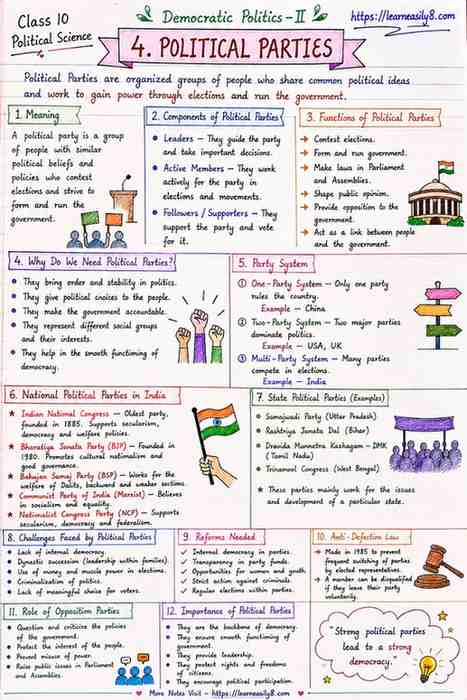
What is a Political Party? (राजनीतिक दल क्या है?)
A political party is an organized group of people who share common political ideas and aim to gain political power through elections. Political parties prepare policies, contest elections, and try to form government.
राजनीतिक दल ऐसे संगठित लोगों का समूह है जिनके राजनीतिक विचार समान होते हैं और जो चुनावों के माध्यम से सत्ता प्राप्त करना चाहते हैं। ये दल नीतियाँ बनाते हैं, चुनाव लड़ते हैं और सरकार बनाने का प्रयास करते हैं।
Important Features of Political Parties (राजनीतिक दलों की विशेषताएँ)
- Political parties have common ideology and policies.
- They participate in elections.
- They aim to form and run government.
- They work for public welfare.
- They try to influence public opinion.
- Every party has leaders, active members, and supporters.
Read More: Gender, Religion and Caste Class 10 Notes in Hindi + English | Gender Religion and Caste Notes PDF
Components of a Political Party (राजनीतिक दल के मुख्य भाग)
Every political party has three major components:
1. Leaders (नेता)
Leaders guide the party and make important decisions. They represent the party in public and government.
नेता पार्टी का नेतृत्व करते हैं और महत्वपूर्ण निर्णय लेते हैं।
2. Active Members (सक्रिय सदस्य)
These members work for the party during elections and public campaigns.
ये सदस्य चुनाव और प्रचार में सक्रिय भूमिका निभाते हैं।
3. Followers or Supporters (समर्थक)
They support the party and vote for it during elections.
ये लोग चुनाव में पार्टी को समर्थन देते हैं।
Functions of Political Parties (राजनीतिक दलों के कार्य)
Political parties perform many important functions in a democracy.
1. Contest Elections (चुनाव लड़ना)
Political parties select candidates and participate in elections.
राजनीतिक दल उम्मीदवार चुनते हैं और चुनाव लड़ते हैं।
2. Form and Run Government (सरकार बनाना)
The party that gets majority forms the government.
जिस दल को बहुमत मिलता है वह सरकार बनाता है।
3. Make Laws (कानून बनाना)
Political parties play an important role in law-making in Parliament and Assemblies.
संसद और विधानसभा में कानून बनाने में दलों की भूमिका होती है।
4. Shape Public Opinion (जनमत बनाना)
Political parties explain their policies through rallies, debates, and media.
ये रैली, मीडिया और भाषणों के माध्यम से जनता को जागरूक करते हैं।
5. Provide Opposition (विपक्ष की भूमिका)
Opposition parties question the government and prevent misuse of power.
विपक्ष सरकार की गलतियों को उजागर करता है।
6. Link Between People and Government (जनता और सरकार के बीच संबंध)
Political parties communicate public demands to the government.
ये जनता की समस्याओं को सरकार तक पहुँचाते हैं।
Why Do We Need Political Parties? (राजनीतिक दलों की आवश्यकता क्यों है?)
Modern democracies cannot function without political parties because they organize elections and governance effectively.
आधुनिक लोकतंत्र राजनीतिक दलों के बिना सफल नहीं हो सकता क्योंकि ये शासन और चुनाव को व्यवस्थित बनाते हैं।
Importance of Political Parties
- They reduce confusion in politics.
- They bring different policies and ideas.
- They make government accountable.
- They provide stability in governance.
- They encourage public participation.
Party System (दलीय व्यवस्था)
Party system means the number of political parties working in a country.
दलीय व्यवस्था का अर्थ है किसी देश में कार्य करने वाले राजनीतिक दलों की संख्या।
1. One-Party System (एक दलीय व्यवस्था)
Only one political party controls the government.
केवल एक ही दल शासन करता है।
Example: China
2. Two-Party System (द्विदलीय व्यवस्था)
Two major parties dominate politics.
दो प्रमुख दल राजनीति में प्रभावी होते हैं।
Example: United States, United Kingdom
3. Multi-Party System (बहुदलीय व्यवस्था)
Many political parties compete in elections.
कई राजनीतिक दल चुनाव में भाग लेते हैं।
Example: India
India follows a multi-party system because it is a large country with social and cultural diversity.
भारत में सामाजिक और सांस्कृतिक विविधता के कारण बहुदलीय व्यवस्था है।
National Political Parties (राष्ट्रीय दल)
A national party works in different states and has influence across the country.
राष्ट्रीय दल पूरे देश में कार्य करते हैं और कई राज्यों में प्रभाव रखते हैं।
Major National Parties in India (भारत के प्रमुख राष्ट्रीय दल)
1. Indian National Congress
- Founded in 1885.
- Played major role in freedom struggle.
- Supports secularism and welfare policies.
2. Bharatiya Janata Party
- Formed in 1980.
- Promotes cultural nationalism and strong governance.
3. Bahujan Samaj Party
- Focuses on Dalits and weaker sections.
- Founded by Kanshi Ram.
4. Communist Party of India (Marxist)
- Believes in socialism and equality.
- Strong support in Kerala, West Bengal, and Tripura.
5. Nationalist Congress Party
- Formed in 1999.
- Supports democracy and secularism.
State Parties (राज्य दल)
State parties work mainly within a particular state.
राज्य दल मुख्य रूप से किसी एक राज्य में कार्य करते हैं।
Examples of State Parties (राज्य दलों के उदाहरण)
- Samajwadi Party
- Rashtriya Janata Dal
- Dravida Munnetra Kazhagam
- Trinamool Congress
State parties play an important role in representing regional issues.
राज्य दल क्षेत्रीय समस्याओं को उठाने में महत्वपूर्ण भूमिका निभाते हैं।
Challenges Faced by Political Parties (राजनीतिक दलों के सामने चुनौतियाँ)
Political parties face several challenges in modern democracy.
राजनीतिक दलों के सामने कई समस्याएँ हैं।
1. Lack of Internal Democracy (आंतरिक लोकतंत्र की कमी)
Top leaders control decision-making.
निर्णय कुछ नेताओं तक सीमित रहते हैं।
2. Dynastic Succession (वंशवाद)
Leadership often passes within families.
नेतृत्व परिवार के सदस्यों को दिया जाता है।
3. Money and Muscle Power (धन और बाहुबल)
Rich and powerful people influence elections.
धन और अपराध राजनीति को प्रभावित करते हैं।
4. Lack of Meaningful Choice (विकल्पों की कमी)
Sometimes parties do not offer very different policies.
कई बार दलों की नीतियों में अधिक अंतर नहीं होता।
Reforms in Political Parties (राजनीतिक दलों में सुधार)
Several reforms can improve political parties.
राजनीतिक दलों को बेहतर बनाने के लिए सुधार आवश्यक हैं।
Suggested Reforms (सुझाए गए सुधार)
- Conduct regular internal elections.
- Increase transparency in funding.
- Give opportunities to women and youth.
- Reduce criminal influence in politics.
- Strengthen internal democracy.
Anti-Defection Law (दल-बदल विरोधी कानून)
This law was made to stop elected representatives from changing parties frequently.
यह कानून नेताओं को बार-बार पार्टी बदलने से रोकता है।
Main Features
- A member can lose seat if he/she leaves the party.
- It helps maintain stability in government.
Role of Opposition Parties (विपक्षी दलों की भूमिका)
Opposition parties are very important in democracy.
लोकतंत्र में विपक्षी दलों की महत्वपूर्ण भूमिका होती है।
Functions of Opposition
- Question government policies.
- Protect public interest.
- Prevent misuse of power.
- Raise public issues in Parliament.
Importance of Political Parties in Democracy (लोकतंत्र में राजनीतिक दलों का महत्व)
Political parties are the backbone of democracy. They connect people with government and provide political education to citizens.
राजनीतिक दल लोकतंत्र की रीढ़ हैं। ये जनता और सरकार के बीच संबंध स्थापित करते हैं तथा नागरिकों को राजनीतिक शिक्षा देते हैं।
Key Importance
- Ensure smooth functioning of democracy.
- Provide leadership.
- Protect citizens’ rights.
- Encourage political participation.
Political Parties Class 10: Important Terms
| Term | Meaning |
|---|---|
| Political Party | चुनाव लड़ने वाला संगठित समूह |
| Opposition | सरकार का विरोध करने वाला दल |
| Coalition Government | कई दलों की मिलकर बनी सरकार |
| Defection | पार्टी बदलना |
| Ideology | राजनीतिक विचारधारा |
Political Parties Class 10: Conclusion (निष्कर्ष)
Political parties are essential for democratic governance. They help in elections, policy-making, and public representation. Although political parties face many challenges, reforms can make them more democratic and transparent. Strong political parties lead to a strong democracy.
राजनीतिक दल लोकतांत्रिक शासन के लिए आवश्यक हैं। ये चुनाव, नीति निर्माण और जनता के प्रतिनिधित्व में महत्वपूर्ण भूमिका निभाते हैं। सुधारों के माध्यम से इन्हें अधिक पारदर्शी और लोकतांत्रिक बनाया जा सकता है। मजबूत राजनीतिक दल मजबूत लोकतंत्र का निर्माण करते हैं।
Political Parties Class 10: FAQ
What is a political party?
A political party is an organized group of people who share similar political ideas and contest elections to form and run the government.
राजनीतिक दल ऐसे लोगों का समूह है जो समान राजनीतिक विचार रखते हैं और सरकार बनाने के लिए चुनाव लड़ते हैं।
Why are political parties important in democracy?
Political parties are important because they help in forming government, making laws, representing people, and maintaining democracy.
लोकतंत्र को सफल बनाने के लिए राजनीतिक दल आवश्यक होते हैं क्योंकि ये सरकार बनाते हैं और जनता का प्रतिनिधित्व करते हैं।
What are the main functions of political parties?
Political parties contest elections, form governments, make laws, shape public opinion, and act as a link between people and government.
What are the three components of a political party?
The three main components are:
Leaders
Active Members
Followers or Supporters
What is a multi-party system?
A multi-party system is a system where many political parties participate in elections and compete for power.
भारत में बहुदलीय व्यवस्था पाई जाती है।
What is the difference between national and state parties?
National parties work across the country, while state parties mainly work within a particular state.
Name any two national political parties of India.
Bharatiya Janata Party (BJP)
Indian National Congress (INC)
What are the challenges faced by political parties?
Major challenges include:
Lack of internal democracy
Dynastic succession
Money and muscle power
Criminalization of politics
What is the Anti-Defection Law?
The Anti-Defection Law prevents elected representatives from changing political parties frequently after elections.
What is the role of opposition parties?
Opposition parties question the government, protect public interest, and prevent misuse of power.