The Making of a Scientist Class 10 Notes in Hindi विद्यार्थियों के लिए NCERT Footprints Without Feet Supplementary Reader का एक महत्वपूर्ण chapter है। यह प्रेरणादायक कहानी प्रसिद्ध वैज्ञानिक Richard H. Ebright के जीवन और उनके वैज्ञानिक बनने की यात्रा को प्रस्तुत करती है। इस chapter में बताया गया है कि curiosity, hard work, observation, experiments और सही guidance किस प्रकार एक साधारण बच्चे को सफल scientist बना सकते हैं।
Richard बचपन से ही butterflies, rocks, fossils और अन्य चीजों को collect करने में रुचि रखते थे। उनकी माँ ने उनकी जिज्ञासा को समझा और हमेशा उन्हें सीखने के लिए प्रेरित किया। धीरे-धीरे उनका शौक scientific research में बदल गया। इस पोस्ट में आपको The Making of a Scientist Summary in Hindi, आसान Explanation, Character Sketch, Important Questions and Answers, Word Meanings और NCERT आधारित महत्वपूर्ण Notes सरल Hindi + English भाषा में मिलेंगे। ये notes परीक्षा की तैयारी और quick revision के लिए बहुत उपयोगी हैं। Download your NCERT BOOK PDF.
The Making of a Scientist Class 10 Notes: Summary, Explanation
1. Chapter Introduction (परिचय)
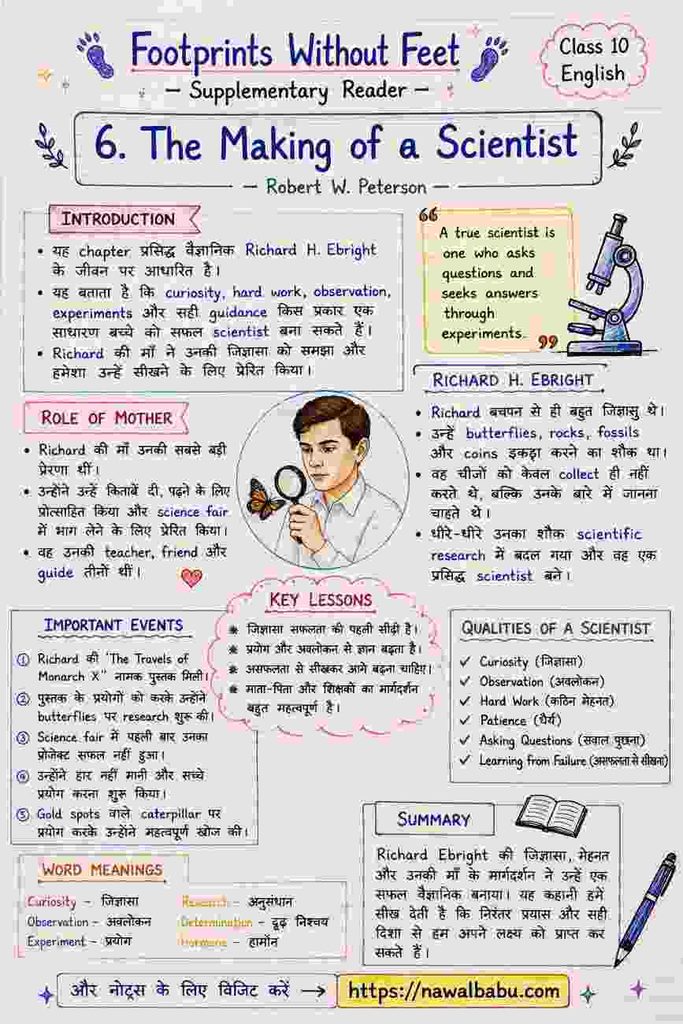
“The Making of a Scientist” is an inspiring chapter written by Robert W. Peterson. This chapter tells the real-life story of Richard H. Ebright, a famous scientist. It explains how an ordinary child can become a successful scientist through curiosity, मेहनत (hard work), observation, discipline, and proper guidance. Richard was interested in collecting butterflies from an early age. His mother encouraged him to learn and experiment. धीरे-धीरे, his hobbies developed into scientific research, and he eventually became a successful scientist.
2. About the Author – Robert W. Peterson
Robert W. Peterson presents the inspiring journey of Richard H. Ebright in a simple and interesting manner. The chapter is based on Ebright’s childhood experiences, scientific experiments, and achievements. Through this biography-like story, the author shows that a scientist is not created suddenly. वैज्ञानिक बनने के लिए curiosity, hard work, सही दिशा और लगातार प्रयास की आवश्यकता होती है. The story especially highlights the important role played by Richard’s mother in developing his interest in learning and scientific research.
3. Main Character – Richard H. Ebright
Richard H. Ebright was a brilliant, curious, and hardworking boy who later became a famous scientist. बचपन से ही वह नई चीजों को जानने और समझने में रुचि रखता था. He collected butterflies, rocks, fossils, and coins. Richard was also interested in astronomy and other scientific activities. His success did not come only because he was intelligent. He worked seriously, asked questions, performed experiments, and learned from failures. His mother continuously encouraged him and provided books and opportunities to explore new ideas.
Summary of The Making of a Scientist
Richard’s Childhood and Early Interests
Richard Ebright grew up in Reading, Pennsylvania, USA. His father died when Richard was young, so his mother played a very important role in his life. Richard was an active and curious child. वह चीजों को केवल देखता नहीं था बल्कि उनके बारे में जानना चाहता था. He collected butterflies, rocks, fossils, and coins. However, collecting things alone could not satisfy his curiosity. His mother understood his interests and encouraged him by giving him books, equipment, and opportunities to learn.
Richard’s Mother – The Greatest Inspiration
Richard’s mother was the biggest source of encouragement in his life. She acted as a friend, teacher, and guide for him. जब Richard के पास खेलने के लिए दोस्त नहीं होते थे, तब उसकी माँ उसके साथ समय बिताती थी. She took him on trips, bought him books, and encouraged him to participate in educational activities. She gave him the famous book “The Travels of Monarch X”, which changed his life and developed his interest in scientific experiments and butterfly research.
The Book “The Travels of Monarch X”
The book “The Travels of Monarch X” became an important turning point in Richard’s life. The book explained the life and migration of monarch butterflies. इसमें बच्चों के लिए विभिन्न activities और experiments दिए गए थे. Richard followed the instructions carefully and started raising butterflies for scientific study. The book taught him that science was not simply about reading facts. Science involved asking questions, observing nature, conducting experiments, and discovering answers through research.
Richard Ebright’s Scientific Journey
Collecting Butterflies Was Not Enough
Initially, Richard collected butterflies as a hobby. However, he soon realized that simply collecting and displaying butterflies was not a real scientific achievement. He wanted to do something meaningful and discover something new. This realization was very important in his development. केवल संग्रह करना एक hobby थी, लेकिन सवाल पूछना और उत्तर खोजने की कोशिश करना science था. Richard gradually moved from being a collector to becoming a serious young researcher.
The First Science Fair Experience
Richard participated in a science fair with his butterfly collection. However, his project did not win any prize because it was only a collection and did not involve an experiment. This experience disappointed him, but it also taught him an important lesson. He understood that successful science projects require investigation and original thinking. उस दिन Richard ने सीखा कि केवल जानकारी दिखाना काफी नहीं है; एक वैज्ञानिक को नए प्रश्न पूछकर उनके उत्तर खोजने चाहिए.
Experiment with the Monarch Butterfly
Richard later started studying monarch butterflies seriously. He conducted experiments to understand different stages of their life. He raised butterflies and observed their development carefully. His scientific work became more advanced with time. He learned how researchers collect information and test ideas. इस प्रकार, Richard ने observation और experimentation की आदत विकसित की. These qualities later helped him become a successful scientist and make important discoveries in the field of biology.
The Mystery of the Gold Spots
One of Richard’s important experiments involved the gold spots on a monarch pupa. Scientists did not know the exact purpose of these spots. Richard wanted to find out their function. He carefully observed and experimented with the pupa. Through his research, he discovered that the gold spots were connected with the production of a hormone necessary for the development of the butterfly. यह खोज उसकी वैज्ञानिक सोच और careful observation का एक महत्वपूर्ण उदाहरण थी.
Research on the Hormone Theory
Richard’s research helped him understand an important biological process. He discovered that the cells near the gold spots produced a hormone that was necessary for the butterfly’s development. His work showed that scientific discoveries are made through systematic experiments and careful observation. Richard did not accept things blindly. वह हर चीज के पीछे कारण जानना चाहता था. His questioning attitude and willingness to investigate helped him move closer to becoming a real scientist.
Richard’s Work on the Twelve-Spotted Milkweed Beetle
Richard also conducted experiments involving the twelve-spotted milkweed beetle. He tried to discover why the beetle had a particular life cycle and how environmental conditions affected its development. His research involved careful planning and experimentation. Through these projects, Richard gained experience in scientific methods. हर experiment ने उसे कुछ नया सिखाया. Even when he did not get immediate success, he continued learning and improving his methods.
Richard’s Qualities as a Scientist
Curiosity – The Desire to Know
Curiosity was one of Richard’s strongest qualities. He always wanted to know how and why things happened. वह किसी भी तथ्य को बिना समझे स्वीकार नहीं करता था. His questions encouraged him to investigate the natural world. A scientist must have curiosity because every discovery begins with a question. Richard’s life teaches students that asking intelligent questions is the first step toward knowledge and discovery.
Example:
- Why do butterflies behave differently?
- What is the function of the gold spots?
- How does a living organism develop?
Hard Work and Dedication
Richard was extremely hardworking and dedicated to his goals. He spent many hours observing insects, conducting experiments, and studying scientific ideas. Success did not come overnight. उसने लगातार मेहनत की और अपनी गलतियों से सीखा. His achievements prove that intelligence alone is not enough. A person must also be disciplined and willing to work consistently. Richard’s journey is an excellent example of how dedication can transform a child’s interest into a successful career.
Observation Skills
A good scientist must observe things carefully, and Richard had excellent observation skills. He noticed small details that many people could easily ignore. His careful study of butterflies and insects helped him discover important scientific facts. Observation means looking carefully and understanding what is happening. Richard’s success shows students that paying attention to details can lead to important discoveries. छोटी-छोटी चीजों को ध्यान से देखना भी बड़े ज्ञान और discoveries का कारण बन सकता है.
The Importance of Asking Questions
Richard always asked questions about the things he observed. This habit made him different from an ordinary student. Instead of simply memorizing information, he wanted to understand the reason behind it. यही एक सच्चे scientist की सबसे महत्वपूर्ण quality है. Science grows through questions and experiments. Richard teaches students that they should not be afraid to ask questions. A good question can sometimes become the beginning of a great discovery.
Role of Richard’s Mother
How His Mother Helped Him Become a Scientist
Richard’s mother played a major role in his success. She recognized his interests and encouraged him to explore them. She provided books, equipment, educational trips, and emotional support. Instead of forcing him to study only textbooks, she helped him learn through practical activities. उसकी माँ ने उसकी curiosity को दबाया नहीं बल्कि उसे बढ़ावा दिया. This support helped Richard develop confidence, knowledge, and scientific thinking from an early age.
Mother as a Teacher and Friend
Richard’s mother was not only his parent but also his teacher and friend. She spent time with him and helped him learn new things. She encouraged him to participate in competitions and science fairs. When Richard faced disappointment, she motivated him to continue. एक बच्चे के जीवन में सही guidance बहुत महत्वपूर्ण होती है. Richard’s story proves that parents and teachers can help children discover their talents by providing encouragement and opportunities.
The Making of a Scientist – Important Themes
Curiosity Leads to Discovery
The central theme of the chapter is that curiosity leads to knowledge and discovery. Richard became interested in science because he wanted to understand the world around him. His questions motivated him to perform experiments. धीरे-धीरे उसकी curiosity scientific research में बदल गई. The chapter teaches students that curiosity should be encouraged. Instead of only memorizing answers, students should try to understand concepts and ask questions about how and why things happen.
Failure Is a Part of Success
Richard did not win every competition immediately. His early science fair project failed to receive a prize because it was only a collection. However, he did not give up. He learned from his mistake and improved his future projects. यह lesson विद्यार्थियों के लिए बहुत महत्वपूर्ण है. Failure does not mean the end of success. If we analyze our mistakes and continue working, failure can become an important step toward achievement.
Scientific Thinking and Experimentation
The chapter explains that science is based on observation, questions, experiments, and conclusions. Richard followed this process throughout his life. He observed butterflies, asked questions, created experiments, and studied the results. यही scientific method का आधार है. A scientist does not simply believe something without evidence. Richard’s journey teaches students to develop logical thinking and look for evidence before accepting conclusions.
Character Sketch of Richard H. Ebright
Richard H. Ebright as a Curious Boy
Richard was extremely curious from childhood. He wanted to learn about everything around him. He collected butterflies, rocks, fossils, and coins. However, his curiosity did not remain limited to collecting things. He wanted to understand their scientific importance. यही curiosity धीरे-धीरे उसे scientific research की ओर ले गई. His desire to know more was one of the main reasons behind his success as a scientist.
Richard as a Hardworking and Intelligent Student
Richard was intelligent, but his success was also the result of hard work. He carefully planned and conducted experiments. He spent time studying scientific problems and learning from results. वह अपने काम को गंभीरता और dedication के साथ करता था. Richard shows that intelligence becomes more powerful when combined with discipline and consistent effort. His life is a motivation for students who want to achieve success in academics or any other field.
Richard as a Determined Person
Richard never allowed disappointment to stop him. When he failed to win at the science fair, he did not quit. Instead, he understood his mistake and started doing real experiments. This shows his determination and positive attitude. वह failures से डरता नहीं था बल्कि उनसे सीखता था. His determination helped him improve continuously and eventually become a successful scientist.
Know More: Federalism Class 10 Notes in Hindi | संघवाद Notes PDF, Important Questions & Summary
Important Lessons from the Chapter
What Students Can Learn from Richard Ebright
Students can learn many important lessons from Richard’s life. Success requires curiosity, hard work, patience, and proper guidance. केवल अच्छे marks प्राप्त करना ही learning नहीं है; real learning means understanding and exploring. Students should ask questions, observe carefully, and learn from mistakes. Richard’s journey teaches that every child has potential. With encouragement and consistent effort, a simple hobby can develop into a great achievement.
Key Lessons:
- Always remain curious.
- Ask meaningful questions.
- Learn from failures.
- Work hard consistently.
- Observe things carefully.
- Use knowledge practically.
- Never stop learning.
- Take guidance from parents and teachers.
Important NCERT Questions and Answers
Why did Richard Ebright’s mother encourage him?
Richard’s mother encouraged him because she understood that he was curious and interested in learning. She wanted to develop his intellectual abilities and scientific interests. She bought him books, took him on educational trips, and encouraged him to participate in activities and competitions. जब Richard के पास खेलने के लिए ज्यादा दोस्त नहीं थे, तब उसकी माँ उसके लिए एक friend और guide भी बनी. Her continuous support played a major role in making Richard a successful scientist.
What did Richard learn from his first science fair?
Richard learned an important lesson from his first science fair. His butterfly collection did not win a prize because it was only a collection and did not involve any scientific experiment. This experience taught him that real science requires investigation and original research. इसके बाद उसने केवल चीजें collect करना बंद करके scientific questions और experiments पर ध्यान देना शुरू किया. This failure became an important turning point in his journey toward becoming a scientist.
What was the importance of “The Travels of Monarch X”?
“The Travels of Monarch X” was very important because it changed Richard’s interest from simple butterfly collecting to scientific research. The book contained information and activities related to monarch butterflies. Richard followed its instructions and began raising butterflies for experiments. इस पुस्तक ने उसे science को practically सीखने का अवसर दिया. It opened the door to serious scientific investigation and helped develop the qualities that later made Richard a successful scientist.
How did Richard Ebright become a successful scientist?
Richard became successful because of his curiosity, intelligence, hard work, and determination. He carefully observed nature, asked questions, and performed experiments. His mother also provided constant encouragement and guidance. Richard learned from his failures and continuously improved his scientific projects. वह केवल किताबों से knowledge लेने तक सीमित नहीं रहा बल्कि practical experiments करता रहा. These qualities and experiences gradually transformed him from a curious child into a successful scientist.
What qualities are necessary to become a scientist?
According to Richard Ebright’s story, a scientist needs curiosity, observation skills, hard work, patience, and determination. A scientist should ask questions and search for answers through experiments. Logical thinking and the ability to learn from failures are also important. केवल intelligent होना पर्याप्त नहीं है. A person must work consistently and remain eager to learn. Richard’s life demonstrates that scientific success comes from curiosity combined with disciplined effort and proper guidance.
Short Summary in Hindi
The Making of a Scientist – Hindi Summary
यह chapter प्रसिद्ध scientist Richard H. Ebright के जीवन पर आधारित है। बचपन से ही Richard को butterflies, rocks, fossils और coins collect करने का शौक था। उसकी माँ ने उसकी curiosity को समझा और उसे books तथा learning opportunities प्रदान कीं। “The Travels of Monarch X” पुस्तक ने उसे scientific research की ओर प्रेरित किया। शुरुआत में failure मिलने के बावजूद उसने हार नहीं मानी। लगातार observation, experiments, मेहनत और determination के कारण वह एक सफल scientist बन गया।
Short Summary in English
“The Making of a Scientist” tells the inspiring story of Richard H. Ebright. As a child, he was curious and interested in collecting butterflies, rocks, fossils, and coins. His mother encouraged him and provided books and learning opportunities. The book “The Travels of Monarch X” inspired him to conduct scientific experiments. Richard learned from failure and continued working hard. Through curiosity, observation, experimentation, determination, and proper guidance, he gradually developed into a successful scientist.
Word Meanings
- Curiosity – जिज्ञासा
- Scientist – वैज्ञानिक
- Experiment – प्रयोग
- Observation – अवलोकन / निरीक्षण
- Discovery – खोज
- Research – अनुसंधान
- Determination – दृढ़ निश्चय
- Encouragement – प्रोत्साहन
- Failure – असफलता
- Achievement – उपलब्धि
- Collect – इकट्ठा करना
- Fossil – जीवाश्म
- Species – प्रजाति
- Theory – सिद्धांत
- Hormone – हार्मोन
Conclusion
“The Making of a Scientist” is much more than the story of one successful scientist. It teaches students how success is developed step by step. Richard Ebright became successful because he remained curious, worked hard, learned from failure, and received excellent guidance from his mother. यह chapter हमें सिखाता है कि हर विद्यार्थी में कुछ विशेष क्षमता होती है. With proper encouragement, discipline, curiosity, and continuous learning, students can achieve great success in science and in life.
⭐ Quick Revision Points
- Author: Robert W. Peterson
- Main Character: Richard H. Ebright
- Main Theme: Curiosity + Hard Work + Scientific Thinking
- Biggest Support: Richard’s Mother
- Important Book: The Travels of Monarch X
- Important Lesson: Failure helps us learn and improve
- Scientist बनने के गुण: Curiosity, Observation, Experimentation, Hard Work
- Message: Ask questions, learn continuously, and never give up.