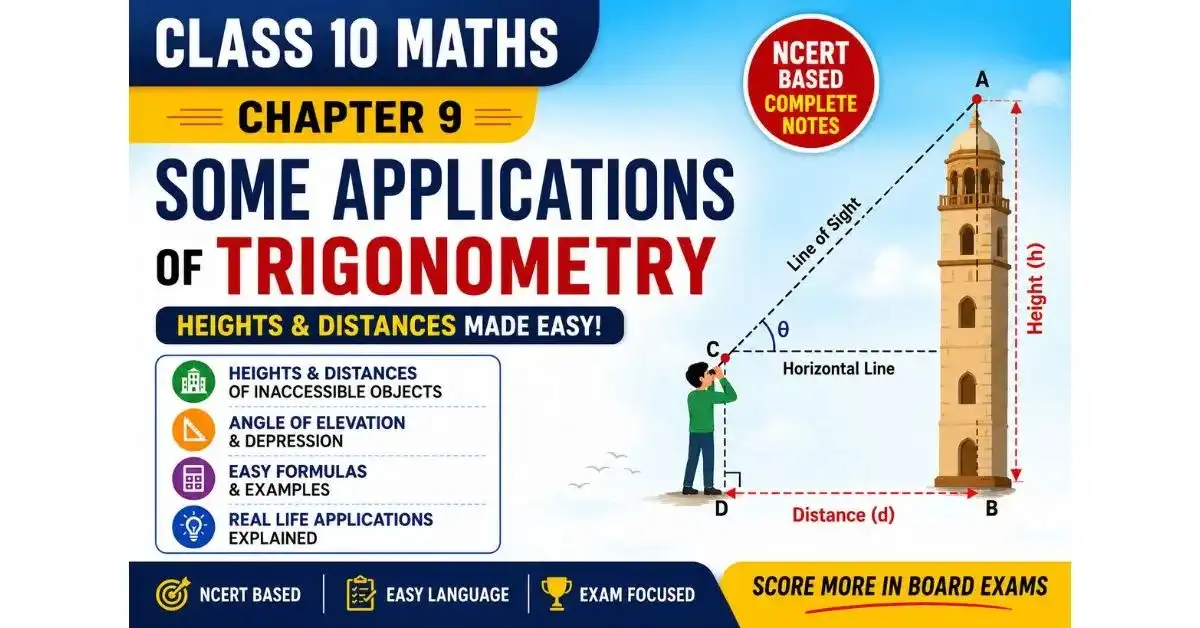
यदि आप Class 10 Maths Chapter 9 – Some Applications of Trigonometry Class 10 Notes in Hindi की आसान, विस्तृत और NCERT आधारित स्टडी मटेरियल की तलाश कर रहे हैं, तो यह लेख आपके लिए है। इस अध्याय में ऊँचाई (Height), दूरी (Distance), Angle of Elevation, Angle of Depression, Line of Sight तथा उनके वास्तविक जीवन (Real-Life Applications) में उपयोग को सरल भाषा में समझाया गया है।
इन नोट्स को इस प्रकार तैयार किया गया है कि विद्यार्थी कम समय में पूरे अध्याय का प्रभावी रिवीजन कर सकें। इसमें प्रत्येक टॉपिक को Hindi + English में आसान शब्दों में समझाया गया है, साथ ही आवश्यक सूत्र (Formulas), महत्वपूर्ण बिंदु, मानक त्रिकोणमितीय मान (Standard Values), परीक्षा उपयोगी टिप्स तथा बोर्ड परीक्षा के दृष्टिकोण से महत्वपूर्ण जानकारी भी शामिल की गई है। यदि आप CBSE Board Exam 2026 या किसी अन्य राज्य बोर्ड की तैयारी कर रहे हैं, तो ये नोट्स आपकी तैयारी को मजबूत बनाने और अच्छे अंक प्राप्त करने में अत्यंत सहायक सिद्ध होंगे। Download NCERT BOOK PDF.
Some Applications of Trigonometry Class 10 Notes: NCERT Chapter 9 Maths
Some Applications of Trigonometry is one of the most important chapters of Class 10 Mathematics. In this chapter, we use trigonometric ratios to find the height and distance of objects that cannot be measured directly. Examples include the height of a building, a tree, a tower, or the distance of a ship from a lighthouse.
इस अध्याय में हम त्रिकोणमितीय अनुपातों (Trigonometric Ratios) की सहायता से उन वस्तुओं की ऊँचाई (Height) और दूरी (Distance) ज्ञात करते हैं जिन्हें सीधे मापना कठिन होता है। यह अध्याय वास्तविक जीवन (Real Life Applications) पर आधारित है।
What is Application of Trigonometry? (त्रिकोणमिति का अनुप्रयोग क्या है?)
- Trigonometry helps us calculate unknown heights and distances.
- It is widely used in Engineering, Architecture, Surveying, Navigation and Astronomy.
- We use right-angled triangles for solving problems.
- Height and distance are calculated using trigonometric ratios like sin, cos and tan.
- Real-life examples include measuring mountains, electric poles, towers and bridges.
- इस अध्याय में मुख्य रूप से tan θ का सबसे अधिक उपयोग होता है।
- सभी प्रश्न चित्र (Diagram) बनाकर हल किए जाते हैं।
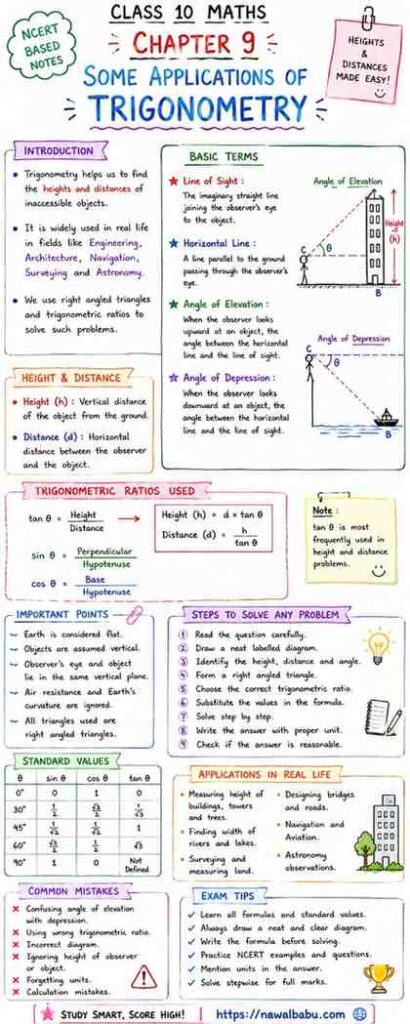
Line of Sight (दृष्टि रेखा)
Definition
The imaginary straight line joining the observer’s eye to the object is called the Line of Sight.
दर्शक (Observer) की आँख से वस्तु तक जाने वाली काल्पनिक सीधी रेखा को दृष्टि रेखा (Line of Sight) कहते हैं।
Important Points
- It is always a straight line.
- It joins the observer and the object.
- It helps in measuring angle of elevation or depression.
- बिना Line of Sight के कोण नहीं बनाया जा सकता।
- सभी प्रश्नों में यह सबसे पहले बनायी जाती है।
Horizontal Line (क्षैतिज रेखा)
Definition
A line parallel to the ground passing through the observer’s eye is called the Horizontal Line.
दर्शक की आँख से होकर भूमि के समानांतर जाने वाली रेखा को क्षैतिज रेखा कहते हैं।
Important Points
- It is always parallel to the ground.
- It is used as the reference line.
- Angles of elevation and depression are measured from this line.
- Horizontal line हमेशा 0° दिशा को दर्शाती है।
- Diagram में इसे सीधी रेखा के रूप में बनाया जाता है।
Angle of Elevation (उन्नयन कोण)
Definition
When the observer looks upward at an object, the angle formed between the horizontal line and the line of sight is called the Angle of Elevation.
जब कोई व्यक्ति ऊपर स्थित वस्तु को देखता है, तब क्षैतिज रेखा और दृष्टि रेखा के बीच बनने वाला कोण उन्नयन कोण कहलाता है।
Important Points
- Observer looks upward.
- Angle is always above the horizontal line.
- Mostly used to calculate height.
- Angle of Elevation is always positive.
- Tower, tree and building questions generally use this angle.
Angle of Depression (अवनमन कोण)
Definition
When the observer looks downward at an object, the angle formed between the horizontal line and the line of sight is called the Angle of Depression.
जब कोई व्यक्ति नीचे स्थित वस्तु को देखता है, तब क्षैतिज रेखा और दृष्टि रेखा के बीच बनने वाला कोण अवनमन कोण कहलाता है।
Important Points
- Observer looks downward.
- Angle is measured below the horizontal line.
- Mostly used in lighthouse and aircraft problems.
- It is equal to the corresponding angle of elevation.
- Alternate Interior Angle property is generally used.
Height (ऊँचाई)
Definition
The vertical distance from the ground to the top of an object is called its Height.
भूमि से किसी वस्तु के शीर्ष तक की लंबवत दूरी उसकी ऊँचाई कहलाती है।
Important Points
- Height is always vertical.
- Represented by h.
- Measured in metre or centimetre.
- Height is generally the perpendicular side.
- Height is calculated using tan θ or sin θ.
Distance (दूरी)
Definition
The horizontal distance between the observer and the object is called Distance.
दर्शक और वस्तु के आधार के बीच की क्षैतिज दूरी को दूरी कहते हैं।
Important Points
- Distance is always horizontal.
- Represented by d.
- Usually forms the base of right triangle.
- Calculated using tan, cos or Pythagoras theorem.
- Unit is metre or kilometre.
Read Also: Consumer Rights Class 10 Notes in Hindi & English | NCERT Economics Chapter 5 Complete Notes
Assumptions Used in NCERT (NCERT में प्रयुक्त मान्यताएँ)
- Surface of Earth is assumed to be flat.
- Objects are considered vertical.
- Observer’s eye and object lie in the same vertical plane.
- Air resistance and Earth’s curvature are ignored.
- Questions are based on right-angled triangles only.
- Measurements are considered accurate.
Trigonometric Ratios Used (प्रयुक्त त्रिकोणमितीय अनुपात)
Important Formulae
Important Points
- tan θ is most frequently used.
- sin and cos are used when hypotenuse is given.
- Choose the ratio according to the given information.
- Always write formula before calculation.
General Steps to Solve Questions (प्रश्न हल करने की सामान्य विधि)
- Read the question carefully.
- Draw a neat labelled diagram.
- Identify height, distance and angle.
- Form a right triangle.
- Choose suitable trigonometric ratio.
- Substitute given values.
- Solve step by step.
- Write final answer with correct unit.
- Check if the answer is reasonable.
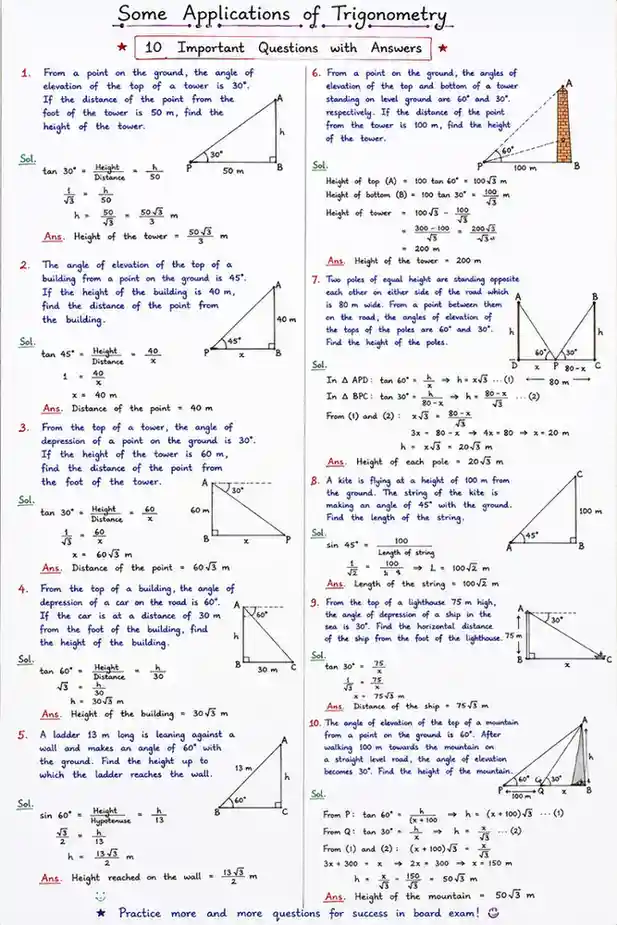
Important Standard Values (मानक त्रिकोणमितीय मान)
| Angle | sinθ | cosθ | tanθ |
|---|---|---|---|
| 0° | 0 | 1 | 0 |
| 30° | 1/2 | √3/2 | 1/√3 |
| 45° | 1/√2 | 1/√2 | 1 |
| 60° | √3/2 | 1/2 | √3 |
| 90° | 1 | 0 | Not Defined |
Real Life Applications (वास्तविक जीवन में उपयोग)
- Measuring height of buildings.
- Finding height of mountains.
- Calculating width of rivers.
- Surveying land.
- Designing bridges.
- Aviation and navigation.
- Satellite communication.
- Architecture and construction.
- Military applications.
- Astronomy observations.
Common Mistakes to Avoid (सामान्य गलतियाँ)
- Confusing angle of elevation with depression.
- Drawing incorrect diagram.
- Using wrong trigonometric ratio.
- Forgetting units.
- Ignoring observer’s eye level.
- Not writing formula.
- Wrong standard values.
- Calculation mistakes.
- Forgetting to simplify surds.
Exam Tips (Board Exam Tips)
- Draw neat diagrams.
- Learn all standard trigonometric values.
- Revise formulas daily.
- Identify opposite and adjacent sides carefully.
- Practice NCERT examples.
- Always mention units.
- Write formula before solving.
- Solve stepwise for full marks.
- Practice previous year questions.
- Keep calculations neat and accurate.
Chapter Summary (अध्याय सारांश)
- Trigonometry helps calculate inaccessible heights and distances.
- Line of Sight joins observer and object.
- Horizontal Line is parallel to the ground.
- Angle of Elevation is measured upward.
- Angle of Depression is measured downward.
- Height is vertical distance.
- Distance is horizontal distance.
- tan θ = Height / Distance is the most useful formula.
- Draw diagrams carefully before solving.
- This chapter is highly scoring and application-based in board examinations.
Frequently Asked Questions (FAQs)
Some Applications of Trigonometry Class 10 Chapter 9 में क्या पढ़ाया जाता है?
इस अध्याय में त्रिकोणमिति (Trigonometry) का उपयोग करके ऊँचाई (Height) और दूरी (Distance) ज्ञात करना सिखाया जाता है। इसमें Line of Sight, Angle of Elevation, Angle of Depression तथा इनके वास्तविक जीवन में उपयोग को भी समझाया गया है।
क्या Chapter 9 बोर्ड परीक्षा के लिए महत्वपूर्ण है?
हाँ, यह अध्याय CBSE Class 10 Board Exam के लिए बहुत महत्वपूर्ण है। इस अध्याय से हर वर्ष सूत्र आधारित (Formula-based) और अनुप्रयोग (Application-based) प्रश्न पूछे जाते हैं।
Angle of Elevation क्या होता है?
जब कोई व्यक्ति किसी ऊँची वस्तु को ऊपर की ओर देखता है, तब क्षैतिज रेखा (Horizontal Line) और दृष्टि रेखा (Line of Sight) के बीच बनने वाले कोण को Angle of Elevation (उन्नयन कोण) कहते हैं।
Angle of Depression क्या होता है?
जब कोई व्यक्ति किसी नीचे स्थित वस्तु को देखता है, तब क्षैतिज रेखा और दृष्टि रेखा के बीच बनने वाले कोण को Angle of Depression (अवनमन कोण) कहते हैं।
Line of Sight क्या होती है?
Line of Sight वह काल्पनिक सीधी रेखा है जो प्रेक्षक (Observer) की आँख और देखी जाने वाली वस्तु को जोड़ती है। इसी के आधार पर Elevation और Depression के कोण बनाए जाते हैं।
इस अध्याय में सबसे अधिक कौन-सा Trigonometric Ratio प्रयोग होता है?
इस अध्याय में सबसे अधिक tan θ = Height / Distance का उपयोग किया जाता है। इसके अलावा आवश्यकता अनुसार sin θ और cos θ का भी प्रयोग किया जाता है।
Height और Distance में क्या अंतर है?
Height (ऊँचाई) किसी वस्तु की भूमि से ऊपर की लंबवत दूरी होती है, जबकि Distance (दूरी) प्रेक्षक और वस्तु के आधार के बीच की क्षैतिज दूरी होती है।
क्या इस अध्याय में डायग्राम बनाना आवश्यक है?
हाँ। लगभग सभी प्रश्नों में सही और साफ-सुथरा Right Triangle Diagram बनाना आवश्यक होता है। इससे प्रश्न समझने और सही सूत्र चुनने में आसानी होती है तथा परीक्षा में बेहतर अंक मिलते हैं।
Some Applications of Trigonometry के वास्तविक जीवन में क्या उपयोग हैं?
इसका उपयोग भवनों, टावरों, पहाड़ों और पेड़ों की ऊँचाई मापने, नदियों की चौड़ाई ज्ञात करने, सर्वेक्षण (Surveying), इंजीनियरिंग, आर्किटेक्चर, नेविगेशन और खगोल विज्ञान (Astronomy) में किया जाता है।
Chapter 9 की तैयारी कैसे करें?
इस अध्याय की तैयारी के लिए पहले सभी Trigonometric Ratios और उनके मान याद करें, फिर NCERT के उदाहरण और अभ्यास प्रश्न हल करें। प्रत्येक प्रश्न का डायग्राम बनाकर सूत्र लगाएँ और नियमित रूप से रिवीजन करें।
क्या ये Notes NCERT और CBSE Board Exam के अनुसार हैं?
हाँ। ये नोट्स NCERT Class 10 Maths पर आधारित हैं और CBSE Board Exam 2026 सहित अन्य राज्य बोर्डों के विद्यार्थियों के लिए भी उपयोगी हैं।
क्या इन Notes से परीक्षा की तैयारी पूरी हो सकती है?
ये नोट्स Quick Revision, Formula Revision, Concept Clarity और Board Exam Preparation के लिए बहुत उपयोगी हैं। बेहतर तैयारी के लिए इन्हें NCERT Exercise, Exemplars और Previous Year Questions के साथ अवश्य पढ़ें।