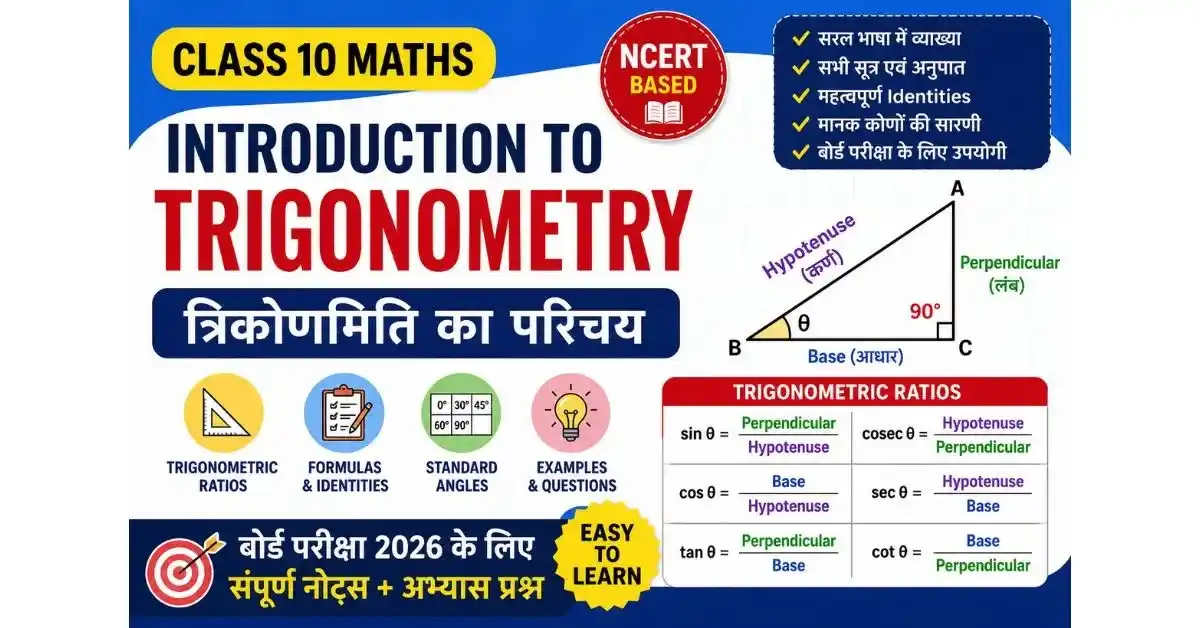
Introduction to Trigonometry Class 10 Notes: यदि आप Class 10 Maths Chapter 8 – Introduction to Trigonometry (त्रिकोणमिति का परिचय) के आसान, विस्तृत और NCERT आधारित नोट्स खोज रहे हैं, तो यह लेख आपके लिए है। इस पोस्ट में आपको त्रिकोणमिति के सभी महत्वपूर्ण टॉपिक्स जैसे Right Triangle (समकोण त्रिभुज), Trigonometric Ratios (sin, cos, tan, cosec, sec, cot), Standard Angle Values, Important Identities, Formulas, Exam Tips और NCERT आधारित आसान व्याख्या हिंदी + English (Bilingual) भाषा में मिलेगी।
प्रत्येक विषय को सरल भाषा, बुलेट पॉइंट्स और विद्यार्थियों की समझ के अनुसार समझाया गया है ताकि आप कम समय में पूरे अध्याय का प्रभावी रिवीजन कर सकें। चाहे आप CBSE Board Exam 2026, स्कूल परीक्षा या प्रतियोगी परीक्षाओं की तैयारी कर रहे हों, ये नोट्स आपकी तैयारी को मजबूत बनाएंगे और अच्छे अंक प्राप्त करने में मदद करेंगे। इन्हें एक बार अवश्य पढ़ें और अपनी परीक्षा की तैयारी को आसान बनाएं। Download NCERT BOOK PDF.
Introduction to Trigonometry Class 10 Notes: Based on NCERT
Trigonometry is a branch of Mathematics that studies the relationship between the angles and sides of a right-angled triangle. The word Trigonometry comes from the Greek words Tri (Three), Gon (Angle), and Metron (Measure), meaning measurement of triangles. This chapter helps students solve problems related to heights, distances, engineering, astronomy, navigation, and architecture. त्रिकोणमिति गणित की एक महत्वपूर्ण शाखा है जो समकोण त्रिभुज की भुजाओं और कोणों के बीच संबंध बताती है।
What is Trigonometry? (त्रिकोणमिति क्या है?)
- Trigonometry deals with Right-Angled Triangles.
- It studies the relation between angles and sides.
- It helps calculate unknown heights and distances.
- Widely used in Physics, Engineering, Surveying, Navigation, and Astronomy.
- Only one angle (other than 90°) is considered while defining trigonometric ratios.
- त्रिकोणमिति का उपयोग वास्तविक जीवन में ऊँचाई, दूरी और दिशा ज्ञात करने के लिए किया जाता है।
- This chapter forms the base for higher mathematics in Classes 11 and 12.
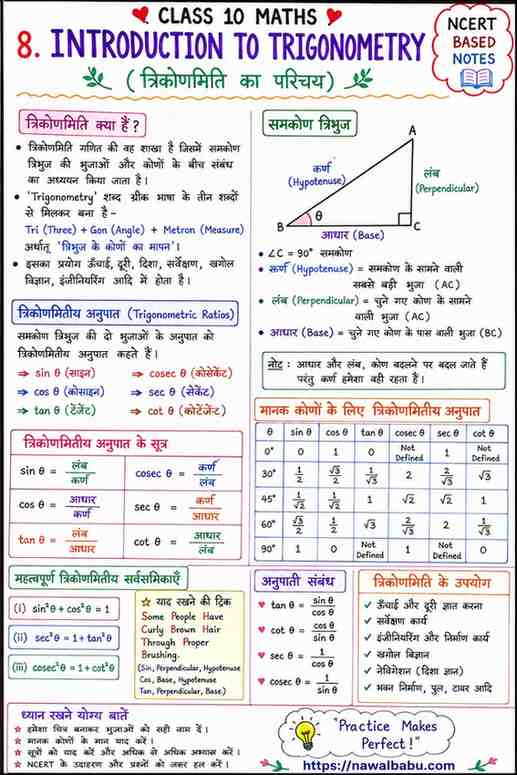
Right-Angled Triangle (समकोण त्रिभुज)
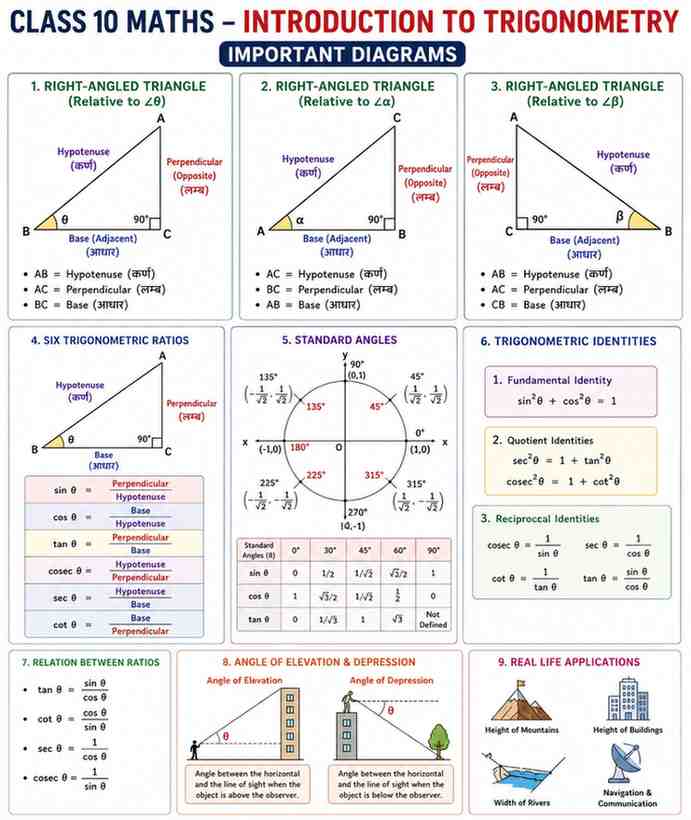
A Right-Angled Triangle is a triangle having one angle equal to 90°. It has three sides with different names based on the selected angle.
- One angle is always 90°.
- The longest side is called Hypotenuse (कर्ण).
- The side opposite the selected angle is Perpendicular (लंब).
- The remaining side is Base (आधार).
- The names of Base and Perpendicular change depending on the chosen angle.
- Right-angled triangles are the foundation of all trigonometric concepts.
Read More: Arithmetic Progressions Class 10 Notes in Hindi | NCERT Maths Chapter 5 समांतर श्रेणी सम्पूर्ण नोट्स
Parts of a Right Triangle (समकोण त्रिभुज के भाग)
Hypotenuse (कर्ण)
- Opposite the right angle.
- Longest side of the triangle.
- Always remains the same regardless of the selected angle.
- Symbolically represented as the largest side.
Perpendicular (लंब)
- Side opposite the chosen angle.
- Also called the opposite side.
- Changes when the reference angle changes.
- Used in several trigonometric ratios.
Base (आधार)
- Side adjacent to the chosen angle.
- Also called the adjacent side.
- Changes with the reference angle.
- Helps calculate cosine and cotangent ratios.
Reference Angle (संदर्भ कोण)
In trigonometry, one acute angle is selected as the Reference Angle. According to this angle, the names of Base and Perpendicular are decided.
- Reference angle is always less than 90°.
- Hypotenuse never changes.
- Base is next to the angle.
- Perpendicular is opposite the angle.
- Choosing the correct reference angle is very important for solving questions accurately.
Trigonometric Ratios (त्रिकोणमितीय अनुपात)
Trigonometric ratios compare the lengths of different sides of a right triangle.
There are six basic trigonometric ratios:
- Sine (sin)
- Cosine (cos)
- Tangent (tan)
- Cosecant (cosec)
- Secant (sec)
- Cotangent (cot)
These ratios are fixed for a particular angle and are widely used in solving mathematical problems.
Sine Ratio (sin θ)
Formula:
sin θ = Perpendicular / Hypotenuse
- Measures the ratio of opposite side to hypotenuse.
- Always lies between 0 and 1 for acute angles.
- One of the most frequently used trigonometric ratios.
- Useful in height and distance problems.
- हिंदी में:
sin θ = लंब / कर्ण
Cosine Ratio (cos θ)
Formula:
cos θ = Base / Hypotenuse
- Ratio of adjacent side to hypotenuse.
- Used in many geometrical calculations.
- Value decreases as angle increases.
- Important in engineering and physics applications.
- हिंदी में:
cos θ = आधार / कर्ण
Tangent Ratio (tan θ)
Formula:
tan θ = Perpendicular / Base
- Ratio of opposite side to adjacent side.
- Does not involve hypotenuse.
- Frequently used in practical applications.
- Helps determine unknown angles and sides.
- हिंदी में:
tan θ = लंब / आधार
Cosecant Ratio (cosec θ)
Formula:
cosec θ = Hypotenuse / Perpendicular
- Reciprocal of sine.
- Undefined when perpendicular is zero.
- Value is always greater than or equal to 1.
- हिंदी में:
cosec θ = कर्ण / लंब
Secant Ratio (sec θ)
Formula:
sec θ = Hypotenuse / Base
- Reciprocal of cosine.
- Used in higher mathematics.
- Always greater than or equal to 1.
- हिंदी में:
sec θ = कर्ण / आधार
Cotangent Ratio (cot θ)
Formula:
cot θ = Base / Perpendicular
- Reciprocal of tangent.
- Used in geometry and advanced mathematics.
- Helpful in solving angle-related problems.
- हिंदी में:
cot θ = आधार / लंब
Read Also: Electricity Class 10 Notes in Hindi + English | Important Formulas, Numericals & Board Exam Guide
Summary Table of Trigonometric Ratios (त्रिकोणमितीय अनुपात सारणी)
| Ratio | Formula |
|---|---|
| sin θ | Perpendicular / Hypotenuse |
| cos θ | Base / Hypotenuse |
| tan θ | Perpendicular / Base |
| cosec θ | Hypotenuse / Perpendicular |
| sec θ | Hypotenuse / Base |
| cot θ | Base / Perpendicular |
Mnemonic to Remember Ratios (अनुपात याद रखने की ट्रिक)
Students can easily remember the six ratios using the famous mnemonic:
“Some People Have Curly Brown Hair Through Proper Brushing.”
| Word | Ratio |
|---|---|
| Some | Sin |
| People | Perpendicular |
| Have | Hypotenuse |
| Curly | Cos |
| Brown | Base |
| Hair | Hypotenuse |
| Through | Tan |
| Proper | Perpendicular |
| Brushing | Base |
Hindi Trick:
“लंब-कर्ण, आधार-कर्ण, लंब-आधार”
Reciprocal Ratios (व्युत्क्रम अनुपात)
Some trigonometric ratios are reciprocals of each other.
- sin θ ↔ cosec θ
- cos θ ↔ sec θ
- tan θ ↔ cot θ
Formulas:
- cosec θ = 1/sin θ
- sec θ = 1/cos θ
- cot θ = 1/tan θ
These relations make calculations easier.
Trigonometric Ratios of Standard Angles (मानक कोणों के अनुपात)
| Angle | sin | cos | tan |
|---|---|---|---|
| 0° | 0 | 1 | 0 |
| 30° | 1/2 | √3/2 | 1/√3 |
| 45° | 1/√2 | 1/√2 | 1 |
| 60° | √3/2 | 1/2 | √3 |
| 90° | 1 | 0 | Not Defined |
Students should memorize this table because many board exam questions are based on it.
Important Trigonometric Identities (महत्वपूर्ण त्रिकोणमितीय सर्वसमिकाएँ)
Identity 1
sin²θ + cos²θ = 1
This is the most important identity in trigonometry. It is used in almost every chapter of higher mathematics and helps verify equations.
Identity 2
sec²θ = 1 + tan²θ
Derived from the first identity by dividing by cos²θ. Used frequently in solving algebraic expressions.
Identity 3
cosec²θ = 1 + cot²θ
Obtained by dividing the first identity by sin²θ. Useful in proving identities.
Relationship Between Ratios (अनुपातों के बीच संबंध)
- tan θ = sin θ / cos θ
- cot θ = cos θ / sin θ
- sec θ = 1/cos θ
- cosec θ = 1/sin θ
- These formulas simplify lengthy calculations.
- Board exams often ask questions based on these relationships.
Applications of Trigonometry (त्रिकोणमिति के उपयोग)
- Measuring heights of buildings and mountains.
- Finding distances across rivers.
- Navigation of ships and aircraft.
- Construction and architecture.
- Astronomy and satellite calculations.
- Surveying land.
- Physics and engineering.
- Computer graphics and robotics.
- त्रिकोणमिति का उपयोग विज्ञान और दैनिक जीवन दोनों में अत्यंत महत्वपूर्ण है।
Important Exam Tips (परीक्षा हेतु महत्वपूर्ण सुझाव)
- Learn all six formulas by heart.
- Memorize the standard angle table.
- Always identify Base, Perpendicular, and Hypotenuse correctly.
- Practice NCERT examples thoroughly.
- Remember reciprocal relationships.
- Solve previous year board questions.
- Do not confuse tan and cot or sec and cosec.
- Draw neat right triangles whenever required.
Chapter Summary (अध्याय सारांश)
- Trigonometry studies the relationship between the sides and angles of a right triangle.
- Six trigonometric ratios are sin, cos, tan, cosec, sec, and cot.
- Hypotenuse is always the longest side.
- Base and Perpendicular depend on the reference angle.
- Standard angle values and identities are essential for board exams.
- Trigonometry has many practical applications in science, engineering, architecture, and navigation.
- NCERT exercises mainly focus on formulas, identities, and standard angle values, so regular practice is the key to scoring full marks.
Frequently Asked Questions (FAQs) – Introduction to Trigonometry Class 10 Notes
त्रिकोणमिति (Trigonometry) क्या है?
त्रिकोणमिति गणित की वह शाखा है जिसमें समकोण त्रिभुज (Right-Angled Triangle) की भुजाओं और कोणों के बीच संबंध का अध्ययन किया जाता है। इसका उपयोग ऊँचाई, दूरी और कोण ज्ञात करने में किया जाता है।
Class 10 Chapter 8 में कौन-कौन से Trigonometric Ratios पढ़ाए जाते हैं?
NCERT Class 10 Chapter 8 में छह मुख्य त्रिकोणमितीय अनुपात (Trigonometric Ratios) पढ़ाए जाते हैं:
sin θ
cos θ
tan θ
cosec θ
sec θ
cot θ
Right-Angled Triangle में Hypotenuse (कर्ण) क्या होता है?
Hypotenuse (कर्ण) समकोण (90°) के सामने वाली भुजा होती है। यह त्रिभुज की सबसे लंबी भुजा होती है और इसका नाम कभी नहीं बदलता।
Base (आधार) और Perpendicular (लंब) कैसे पहचानें?
जिस कोण (Reference Angle) को चुना जाता है:
उसके सामने वाली भुजा Perpendicular (लंब) कहलाती है।
उसके पास वाली भुजा Base (आधार) कहलाती है।
जबकि Hypotenuse (कर्ण) हमेशा वही रहता है।
Trigonometric Ratios के सूत्र (Formulas) क्या हैं?
मुख्य सूत्र निम्नलिखित हैं:
sin θ = Perpendicular / Hypotenuse
cos θ = Base / Hypotenuse
tan θ = Perpendicular / Base
cosec θ = Hypotenuse / Perpendicular
sec θ = Hypotenuse / Base
cot θ = Base / Perpendicular
Class 10 Board Exam के लिए कौन-सी Trigonometric Identity सबसे महत्वपूर्ण है?
सबसे महत्वपूर्ण पहचान (Identity) है:
sin²θ + cos²θ = 1
इसके अलावा:
sec²θ = 1 + tan²θ
cosec²θ = 1 + cot²θ
भी बोर्ड परीक्षा में अक्सर पूछी जाती हैं।
क्या Standard Angle Values याद करना आवश्यक है?
हाँ। 0°, 30°, 45°, 60° और 90° के sin, cos और tan के मान बोर्ड परीक्षा और प्रतियोगी परीक्षाओं के लिए अत्यंत महत्वपूर्ण हैं। इनका नियमित अभ्यास करना चाहिए।
Introduction to Trigonometry Chapter से बोर्ड परीक्षा में किस प्रकार के प्रश्न पूछे जाते हैं?
इस अध्याय से सामान्यतः निम्न प्रकार के प्रश्न पूछे जाते हैं:
Trigonometric Ratios निकालना
Standard Angle Values
Trigonometric Identities सिद्ध करना
Missing Side या Angle ज्ञात करना
NCERT आधारित संख्यात्मक प्रश्न
Introduction to Trigonometry Class 10 Notes किस बोर्ड के विद्यार्थियों के लिए उपयोगी हैं?
ये नोट्स मुख्य रूप से CBSE Class 10 के लिए तैयार किए गए हैं, लेकिन Bihar Board, UP Board, Rajasthan Board, MP Board तथा अन्य राज्य बोर्डों के विद्यार्थियों के लिए भी समान रूप से उपयोगी हैं क्योंकि विषयवस्तु NCERT पर आधारित है।
Introduction to Trigonometry Chapter में पूरे अंक (Full Marks) कैसे प्राप्त करें?
पूरे अंक प्राप्त करने के लिए:
सभी Trigonometric Ratios और उनके सूत्र याद करें।
Standard Angle Table कंठस्थ करें।
तीनों महत्वपूर्ण Identities का अभ्यास करें।
NCERT के सभी उदाहरण और अभ्यास प्रश्न हल करें।
नियमित रूप से Revision करें और पिछले वर्षों के प्रश्नपत्रों का अभ्यास करें।