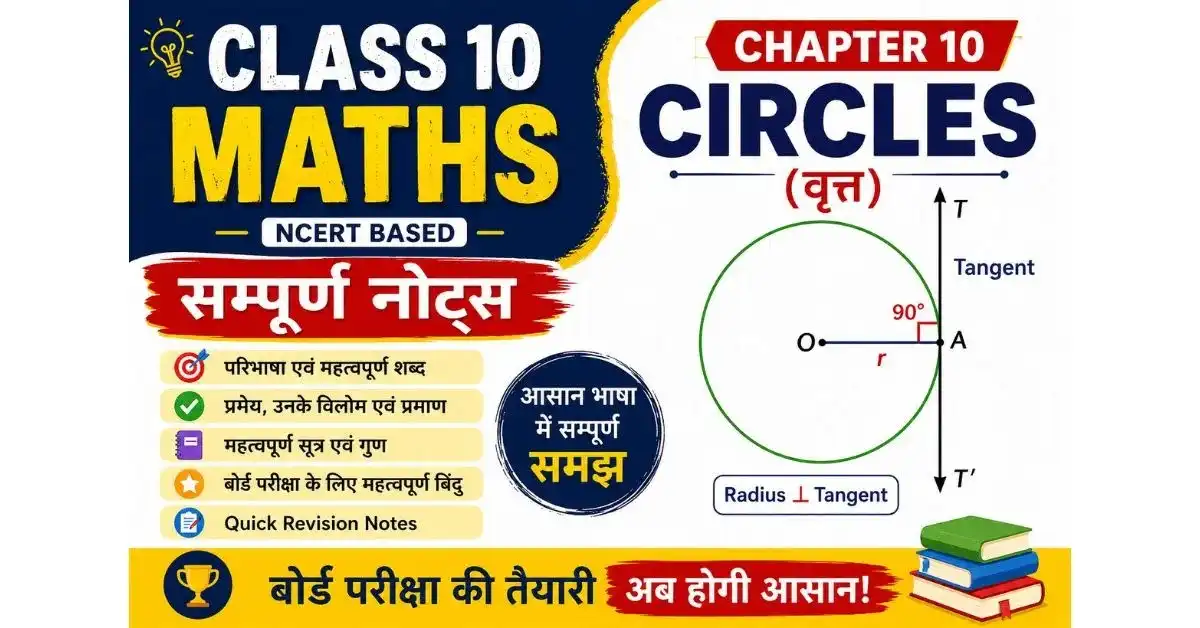
यदि आप कक्षा 10 गणित के Chapter 10 – Circles (वृत्त) के आसान, विस्तृत और परीक्षा-उपयोगी नोट्स खोज रहे हैं, तो यह पोस्ट आपके लिए है। यहाँ आपको NCERT आधारित सम्पूर्ण नोट्स सरल हिंदी + English भाषा में दिए गए हैं, ताकि हर विद्यार्थी इस अध्याय को आसानी से समझ सके। इस नोट्स में वृत्त की परिभाषा, केन्द्र, त्रिज्या, व्यास, जीवा, चाप, स्पर्श रेखा (Tangent), छेदक (Secant), दोनों महत्वपूर्ण प्रमेय, उनके गुण, आवश्यक सूत्र, बोर्ड परीक्षा के महत्वपूर्ण बिंदु, सामान्य गलतियाँ तथा Quick Revision Notes को विस्तार से समझाया गया है।
प्रत्येक विषय के बाद सरल भाषा में विवरण दिया गया है, जिससे पढ़ना और याद रखना दोनों आसान हो जाता है। यदि आप CBSE, Bihar Board या अन्य राज्य बोर्ड की कक्षा 10 परीक्षा की तैयारी कर रहे हैं, तो यह नोट्स आपके लिए त्वरित पुनरावृत्ति (Quick Revision) और बोर्ड परीक्षा में अच्छे अंक प्राप्त करने के लिए अत्यंत उपयोगी सिद्ध होंगे। Download NCERT BOOK PDF.
Class 10 Circles Notes: वृत्त अध्याय के सम्पूर्ण नोट्स
(Based on NCERT | Hindi + English | Simple Language | Student-Friendly Notes)
Circle is one of the most important topics in Class 10 Mathematics. In this chapter, we study the relationship between tangent and radius, the properties of tangents drawn from an external point, and how these concepts are applied in solving geometry problems. This chapter is frequently asked in board exams and helps develop logical reasoning.
वृत्त (Circle) कक्षा 10 गणित का एक महत्वपूर्ण अध्याय है। इसमें स्पर्श रेखा (Tangent), त्रिज्या (Radius), तथा बाह्य बिंदु से खींची गई स्पर्श रेखाओं के गुणों का अध्ययन किया जाता है। यह अध्याय बोर्ड परीक्षा में नियमित रूप से पूछा जाता है तथा ज्यामिति की समझ को मजबूत बनाता है।
What is a Circle? | वृत्त क्या है?
- A Circle is the collection of all points in a plane that are at the same distance from a fixed point called the centre.
- This fixed distance is known as the radius.
- Every point on the boundary of the circle is equally distant from the centre.
- A circle has no corners or edges and forms a perfectly closed curve.
- It is represented by its centre and radius.
- बोर्ड परीक्षा में Circle की परिभाषा कई बार सीधे पूछी जाती है।
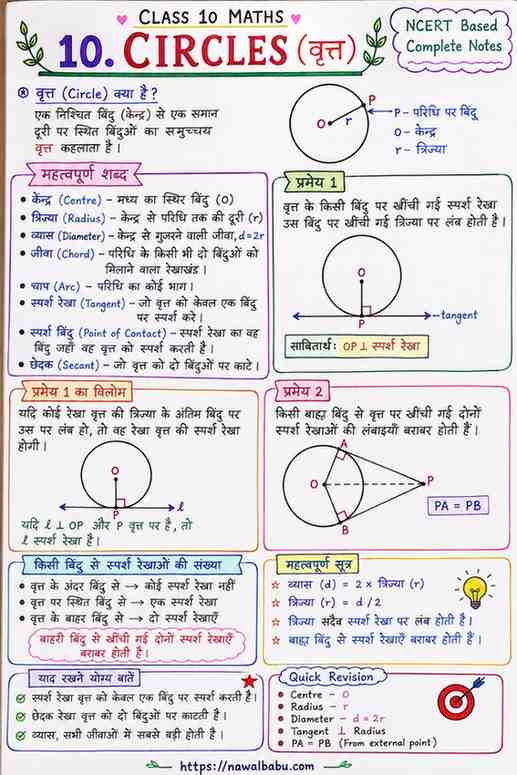
Important Terms Related to Circle | वृत्त से जुड़े महत्वपूर्ण शब्द
Centre (केन्द्र)
- The fixed point inside the circle is called the centre.
- It is represented by O.
- All radii originate from the centre.
- केन्द्र से वृत्त की परिधि तक की दूरी हमेशा समान होती है।
- Centre is the reference point for all measurements in a circle.
Radius (त्रिज्या)
- Radius is the line segment joining the centre to any point on the circle.
- It is represented by r.
- All radii of the same circle are equal.
- Radius is half of the diameter.
- त्रिज्या वृत्त का सबसे महत्वपूर्ण भाग है क्योंकि स्पर्श रेखा इससे संबंधित होती है।
Diameter (व्यास)
- Diameter is the longest chord of the circle.
- It passes through the centre.
- Diameter = 2 × Radius.
- Every diameter divides the circle into two equal semicircles.
- व्यास हमेशा केन्द्र से होकर गुजरता है।
Chord (जीवा)
- A chord joins any two points on the circle.
- Every diameter is a chord, but every chord is not a diameter.
- Longer chords lie closer to the centre.
- जीवा वृत्त के भीतर स्थित होती है।
- बोर्ड परीक्षा में Diameter और Chord का अंतर पूछा जा सकता है।
Arc (चाप)
- An arc is a part of the circumference of a circle.
- It may be a minor arc or major arc.
- Arc is measured in degrees.
- चाप वृत्त की परिधि का एक भाग होता है।
- Arc is useful in advanced geometry.
Tangent (स्पर्श रेखा)
- A tangent touches the circle at exactly one point.
- It never cuts the circle.
- The touching point is called the Point of Contact.
- किसी वृत्त पर किसी बिंदु पर केवल एक स्पर्श रेखा बनाई जा सकती है।
- Tangent plays the most important role in this chapter.
Point of Contact (स्पर्श बिंदु)
- The point where the tangent touches the circle is called the point of contact.
- Radius is drawn from the centre to this point.
- यही बिंदु प्रमेयों में सबसे महत्वपूर्ण होता है।
- Only one common point exists between tangent and circle.
- इसे सामान्यतः P से दर्शाते हैं।
Secant (छेदक रेखा)
- A secant intersects the circle at two distinct points.
- Unlike a tangent, it cuts through the circle.
- Every secant contains one chord.
- यह स्पर्श रेखा से भिन्न होती है।
- NCERT में Tangent और Secant का अंतर समझना आवश्यक है।
Tangent and Radius Relationship | स्पर्श रेखा और त्रिज्या का संबंध
- The radius drawn to the point of contact is always perpendicular to the tangent.
- Radius makes an angle of 90° with the tangent.
- This is one of the most important results of the chapter.
- किसी स्पर्श बिंदु पर त्रिज्या और स्पर्श रेखा सदैव समकोण बनाते हैं।
- लगभग सभी प्रश्न इसी गुण पर आधारित होते हैं।
Theorem 1 | प्रमेय 1
Statement
The tangent at any point of a circle is perpendicular to the radius through the point of contact.
हिंदी
वृत्त के किसी बिंदु पर खींची गई स्पर्श रेखा उस बिंदु पर खींची गई त्रिज्या पर लंब होती है।
Important Points
- Radius ⟂ Tangent
- Angle = 90°
- Point of contact is unique.
- Used in most NCERT questions.
- बोर्ड परीक्षा का सबसे महत्वपूर्ण प्रमेय।
Converse of Theorem | प्रमेय का विलोम
Statement
If a line is perpendicular to the radius at its endpoint on the circle, then the line is a tangent to the circle.
हिंदी
यदि कोई रेखा वृत्त की त्रिज्या के अंतिम बिंदु पर उस पर लंब हो, तो वह रेखा वृत्त की स्पर्श रेखा होगी।
Key Points
- Radius must end on the circle.
- Angle should be exactly 90°.
- Helps identify tangents.
- प्रमेय का विलोम भी प्रश्नों में प्रयोग होता है।
- Geometry proofs में उपयोगी।
Number of Tangents from a Point | किसी बिंदु से स्पर्श रेखाओं की संख्या
Inside the Circle (वृत्त के अंदर)
- No tangent can be drawn.
- अंदर स्थित बिंदु से कोई स्पर्श रेखा संभव नहीं।
On the Circle (वृत्त पर)
- Exactly one tangent.
- केवल एक स्पर्श रेखा।
Outside the Circle (वृत्त के बाहर)
- Exactly two tangents.
- दोनों स्पर्श रेखाएँ बराबर लंबाई की होती हैं।
- यह बोर्ड परीक्षा का अत्यंत महत्वपूर्ण तथ्य है।
Theorem 2 | प्रमेय 2
Statement
The lengths of tangents drawn from an external point to a circle are equal.
हिंदी
किसी बाह्य बिंदु से वृत्त पर खींची गई दोनों स्पर्श रेखाओं की लंबाइयाँ समान होती हैं।
Important Points
- PA = PB
- P is the external point.
- OA = OB (Radii)
- OP is common.
- RHS Congruence is generally used in proof.
Proof Idea of Theorem 2 | प्रमेय 2 का प्रमाण
- Join centre O with points A and B.
- OA = OB (Radii)
- OP = OP (Common side)
- OA ⟂ PA and OB ⟂ PB.
- Therefore, triangles OPA and OPB are congruent.
- Hence PA = PB.
Important Formulae | महत्वपूर्ण सूत्र
- Diameter = 2 Radius
- Radius = Diameter ÷ 2
- OA ⟂ Tangent
- Tangent Length 1 = Tangent Length 2
- Radius joins centre to point of contact.
- बाह्य बिंदु से दोनों स्पर्श रेखाएँ बराबर होती हैं।
Difference Between Tangent and Secant | स्पर्श रेखा एवं छेदक रेखा में अंतर
| Tangent (स्पर्श रेखा) | Secant (छेदक रेखा) |
|---|---|
| Touches at one point | Cuts at two points |
| One common point | Two common points |
| Perpendicular to radius | Not always perpendicular |
| No chord formed | Forms a chord |
| One tangent at contact point | Many secants possible |
Board Exam Important Points | बोर्ड परीक्षा के लिए महत्वपूर्ण तथ्य
- Radius is perpendicular to tangent.
- Two tangents from an external point are equal.
- Inside point → No tangent.
- On circle → One tangent.
- Outside point → Two tangents.
- Diameter is the longest chord.
- Every diameter is a chord.
- Tangent touches only one point.
- Secant cuts the circle at two points.
- Proof-based questions are frequently asked.
Common Mistakes to Avoid | सामान्य गलतियाँ
- Diameter and chord are not always the same.
- Tangent never cuts the circle.
- Radius must meet tangent at the point of contact.
- Do not forget the 90° angle.
- External tangents are always equal in length.
- Figure should be drawn neatly in proofs.
- प्रमेय लिखते समय सही कथन अवश्य लिखें।
Quick Revision Notes | त्वरित पुनरावृत्ति
- Circle has one centre.
- Radius joins centre to circle.
- Diameter = 2 Radius.
- Tangent touches only once.
- Radius ⟂ Tangent.
- One tangent at one point.
- Two tangents from an external point are equal.
- Diameter is the longest chord.
- Secant intersects the circle twice.
- These concepts form the foundation of all NCERT exercises.
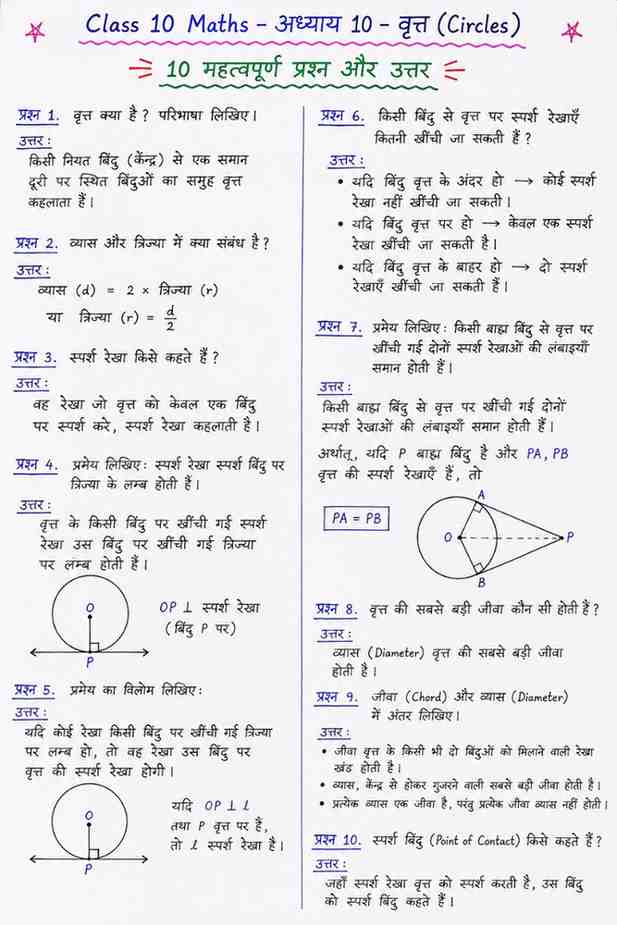
Chapter Summary | अध्याय का सारांश
This chapter mainly explains the concept of tangent, its relationship with the radius, and the equality of tangents drawn from an external point. Only two theorems are included, but they are highly important for board examinations. Understanding the definitions, properties, diagrams, and theorem proofs thoroughly will make solving NCERT and exam questions much easier.
यह अध्याय मुख्य रूप से स्पर्श रेखा, त्रिज्या, तथा बाह्य बिंदु से खींची गई स्पर्श रेखाओं के गुणों पर आधारित है। इसमें केवल दो प्रमुख प्रमेय हैं, लेकिन बोर्ड परीक्षा में इनका महत्व बहुत अधिक है। यदि विद्यार्थी परिभाषाएँ, गुण, चित्र तथा प्रमेयों के प्रमाण अच्छी तरह समझ लें, तो इस अध्याय के अधिकांश प्रश्न आसानी से हल किए जा सकते हैं।
Frequently Asked Questions (FAQs) – Class 10 Circles Notes in Hindi
Class 10 Circles Chapter में सबसे महत्वपूर्ण टॉपिक कौन-कौन से हैं?
इस अध्याय में स्पर्श रेखा (Tangent), त्रिज्या (Radius), स्पर्श बिंदु (Point of Contact), बाह्य बिंदु से खींची गई स्पर्श रेखाएँ तथा दोनों प्रमुख प्रमेय (Theorems) सबसे महत्वपूर्ण विषय हैं। बोर्ड परीक्षा में इन्हीं से अधिक प्रश्न पूछे जाते हैं।
NCERT Class 10 Circles Chapter में कितने प्रमुख प्रमेय (Theorems) हैं?
इस अध्याय में दो प्रमुख प्रमेय (Theorems) हैं—
स्पर्श रेखा स्पर्श बिंदु पर त्रिज्या के लंब होती है।
किसी बाह्य बिंदु से वृत्त पर खींची गई दोनों स्पर्श रेखाओं की लंबाइयाँ बराबर होती हैं।
क्या ये Circles Notes NCERT पर आधारित हैं?
हाँ। ये नोट्स NCERT Class 10 Mathematics Chapter 10 – Circles पर आधारित हैं और इन्हें बोर्ड परीक्षा की तैयारी को ध्यान में रखकर सरल हिंदी + English भाषा में तैयार किया गया है।
क्या ये नोट्स CBSE और Bihar Board दोनों के लिए उपयोगी हैं?
हाँ। ये नोट्स CBSE, Bihar Board तथा अधिकांश राज्य बोर्डों के कक्षा 10 के विद्यार्थियों के लिए उपयोगी हैं क्योंकि अध्याय की मूल अवधारणाएँ (Concepts) समान हैं।
स्पर्श रेखा (Tangent) क्या होती है?
स्पर्श रेखा वह रेखा होती है जो वृत्त को केवल एक बिंदु पर स्पर्श करती है। यह वृत्त को काटती नहीं है तथा स्पर्श बिंदु पर त्रिज्या के लंब (90°) होती है।
Radius और Diameter में क्या अंतर है?
Radius (त्रिज्या) केन्द्र से वृत्त की परिधि तक की दूरी होती है, जबकि Diameter (व्यास) केन्द्र से होकर गुजरने वाली सबसे बड़ी जीवा होती है। व्यास का मान हमेशा 2 × Radius होता है।
बोर्ड परीक्षा में Circles Chapter से किस प्रकार के प्रश्न पूछे जाते हैं?
इस अध्याय से प्रमेय आधारित प्रश्न, प्रमाण (Proof), आकृति आधारित प्रश्न, अवधारणात्मक (Conceptual) प्रश्न तथा MCQs पूछे जाते हैं। दोनों प्रमेयों का अभ्यास करना बहुत आवश्यक है।
किसी बाह्य बिंदु से कितनी स्पर्श रेखाएँ खींची जा सकती हैं?
किसी बाह्य बिंदु (External Point) से वृत्त पर दो स्पर्श रेखाएँ खींची जा सकती हैं और दोनों की लंबाइयाँ समान होती हैं।
Circles Chapter की जल्दी Revision कैसे करें?
Revision के लिए पहले महत्वपूर्ण परिभाषाएँ, दोनों प्रमेय, आवश्यक सूत्र, आकृतियाँ और Quick Revision Notes पढ़ें। इसके बाद NCERT के सभी प्रश्नों का अभ्यास करें।
क्या केवल NCERT पढ़ने से बोर्ड परीक्षा में अच्छे अंक आ सकते हैं?
हाँ। यदि आप NCERT के सभी उदाहरण (Examples), अभ्यास प्रश्न (Exercises), प्रमेय तथा इनके प्रमाण अच्छी तरह समझकर अभ्यास करते हैं, तो बोर्ड परीक्षा में उत्कृष्ट अंक प्राप्त किए जा सकते हैं।