कक्षा 10 अर्थशास्त्र (Economics) के अध्याय “मुद्रा और ऋण (Money and Credit)” में हम समझेंगे कि आधुनिक अर्थव्यवस्था में मुद्रा (Money) और ऋण (Credit) की क्या भूमिका है। प्राचीन समय में लोग वस्तु विनिमय प्रणाली (Barter System) का उपयोग करते थे, लेकिन उसमें कई कठिनाइयाँ थीं। इन समस्याओं को दूर करने के लिए मुद्रा का विकास हुआ, जो आज लेन-देन का सबसे महत्वपूर्ण माध्यम है। Download NCERT BOOK PDF.
इस अध्याय में आप मुद्रा के कार्य, बैंकिंग प्रणाली, बैंक जमा, ऋण, संपार्श्विक (Collateral), औपचारिक एवं अनौपचारिक ऋण स्रोत तथा स्वयं सहायता समूह (SHGs) के बारे में विस्तार से जानेंगे। साथ ही, परीक्षा की दृष्टि से महत्वपूर्ण प्रश्न-उत्तर भी दिए गए हैं। यह नोट्स सरल हिंदी और अंग्रेज़ी भाषा में तैयार किए गए हैं ताकि CBSE, Bihar Board एवं अन्य बोर्ड के छात्र अध्याय को आसानी से समझ सकें और परीक्षा में बेहतर अंक प्राप्त कर सकें।
Money and Credit Class 10 Notes: मुद्रा और ऋण NCERT
Money and Credit (मुद्रा और ऋण) आधुनिक अर्थव्यवस्था (Modern Economy) का महत्वपूर्ण आधार है। आज के समय में वस्तुओं और सेवाओं का अधिकांश लेन-देन मुद्रा (Money) के माध्यम से होता है। पहले लोग वस्तु विनिमय प्रणाली (Barter System) का उपयोग करते थे, लेकिन उसकी कई सीमाएँ थीं। इन समस्याओं को दूर करने के लिए मुद्रा का विकास हुआ। बैंक और अन्य वित्तीय संस्थाएँ ऋण (Credit) प्रदान करके आर्थिक गतिविधियों को बढ़ावा देती हैं।
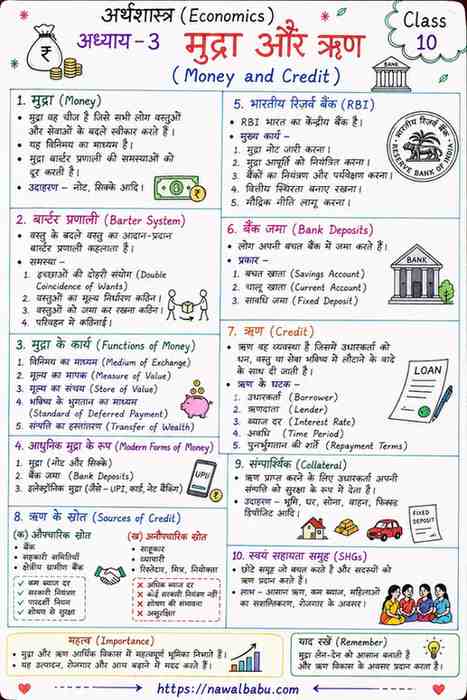
What is Money? (मुद्रा क्या है?)
Definition of Money (मुद्रा की परिभाषा)
Money is anything that is commonly accepted as a medium of exchange.
मुद्रा वह वस्तु है जिसे वस्तुओं और सेवाओं के लेन-देन में सभी लोग स्वीकार करते हैं।
Important Points
- Money acts as a medium of exchange.
- It removes the difficulties of barter system.
- It is accepted by everyone in the economy.
- Currency notes and coins are common forms of money.
- In India, the Reserve Bank of India (RBI) issues currency notes.
- Money helps in buying and selling goods easily.
- It saves time and effort in transactions.
- Money has become an essential part of modern economic life.
Barter System (वस्तु विनिमय प्रणाली)
Meaning
The exchange of goods for goods without using money is called Barter System.
मुद्रा के बिना वस्तु के बदले वस्तु का आदान-प्रदान वस्तु विनिमय प्रणाली कहलाता है।
Example
A farmer gives wheat to a tailor and receives clothes in return.
Problems of Barter System
- Lack of Double Coincidence of Wants.
- Difficult to determine value of goods.
- Problem of storing wealth.
- Difficulties in future payments.
- Limited scope of trade.
- Transportation and exchange were inconvenient.
Double Coincidence of Wants
It means both parties must agree to sell and buy each other’s goods simultaneously.
उदाहरण: किसान को जूते चाहिए और मोची को गेहूँ चाहिए तभी लेन-देन संभव होगा।
This requirement makes barter transactions difficult.
Money as a Medium of Exchange (विनिमय के माध्यम के रूप में मुद्रा)
Importance
Money solves the problem of double coincidence of wants.
Functions
- Facilitates buying and selling.
- Accepted by everyone.
- Simplifies trade.
- Helps in large-scale transactions.
- Encourages specialization and division of labour.
- Increases efficiency in the economy.
- Makes exchange convenient and quick.
Example
A shoe manufacturer sells shoes and receives money. With that money, he can buy any product he wants.
Modern Forms of Money (मुद्रा के आधुनिक रूप)
Currency (मुद्रा)
Currency includes coins and paper notes.
Features
- Issued by RBI and Government of India.
- Accepted as legal tender.
- Can be used for all transactions.
- Easy to carry and transfer.
- Widely accepted across the country.
Legal Tender (वैध मुद्रा)
Money that cannot legally be refused in payment is called legal tender.
भारत में ₹10, ₹50, ₹100, ₹200, ₹500 आदि के नोट वैध मुद्रा हैं।
Reserve Bank of India (RBI)
Role of RBI
RBI is the central bank of India.
Functions
- Issues currency notes.
- Controls money supply.
- Supervises banks.
- Maintains financial stability.
- Regulates banking activities.
- Protects interests of depositors.
- Implements monetary policy.
Importance
RBI ensures trust and confidence in India’s banking system.
Bank Deposits (बैंक जमा)
What are Deposits?
Money kept by people in banks is called deposits.
Types of Deposits
1. Savings Account
- Used by individuals.
- Earns interest.
- Easy withdrawal facility.
2. Current Account
- Mainly for businesses.
- Frequent transactions allowed.
- Usually no interest.
3. Fixed Deposit
- Money deposited for a fixed period.
- Higher rate of interest.
- Withdrawal restrictions.
Advantages of Deposits
- Safe storage of money.
- Earn interest.
- Easy transactions.
- Useful for future needs.
How Banks Work? (बैंक कैसे कार्य करते हैं?)
Collection of Deposits
Banks collect money from depositors.
Lending Activities
Banks give loans to borrowers.
Income of Banks
Banks charge higher interest on loans and pay lower interest on deposits.
The difference between the two is their profit.
Importance
- Encourages savings.
- Provides loans.
- Promotes investment.
- Supports economic growth.
Credit (ऋण)
Meaning
Credit refers to an agreement where a lender provides money, goods, or services and the borrower promises to repay later.
ऋण वह व्यवस्था है जिसमें उधारदाता धन देता है और उधार लेने वाला भविष्य में उसे वापस करने का वादा करता है।
Components of Credit
- Borrower (उधारकर्ता)
- Lender (ऋणदाता)
- Interest Rate (ब्याज दर)
- Time Period (अवधि)
- Repayment Terms (भुगतान की शर्तें)
Credit Situation: A Positive Example
Example of Salim
Salim takes a loan to grow crops.
Positive Outcomes
- Good crop production.
- Higher income.
- Loan repayment possible.
- Profit increases.
- Standard of living improves.
Conclusion
Credit can help in increasing production and income.
Credit Situation: A Negative Example
Example of Swapna
Swapna takes a loan for farming.
Problems
- Crop failure due to poor rainfall.
- Unable to repay loan.
- Falls into debt trap.
- Financial burden increases.
Conclusion
Credit can also lead to difficulties if income does not increase.
Terms of Credit (ऋण की शर्तें)
Important Terms
Interest Rate (ब्याज दर)
Extra amount paid along with principal.
Collateral (संपार्श्विक)
Asset pledged as security against loan.
Examples:
- Land
- Building
- Gold
- Vehicle
- Fixed Deposit
Documentation
Borrower must submit required documents.
Repayment Period
Time allowed for repayment of loan.
Importance
These terms protect both lenders and borrowers.
Collateral (संपार्श्विक)
Meaning
Collateral is an asset owned by the borrower and used as security for a loan.
Examples
- Agricultural land
- House
- Gold jewellery
- Vehicle
- Property papers
Benefits
- Reduces risk for banks.
- Helps borrowers get larger loans.
- Encourages formal lending.
Formal Sources of Credit (औपचारिक ऋण स्रोत)
Meaning
Loans provided by banks and cooperative societies.
Examples
- Commercial Banks
- Cooperative Banks
- Regional Rural Banks
- Cooperative Societies
Features
- Lower interest rates.
- Government regulations.
- Transparent rules.
- Legal protection.
- Better loan conditions.
Advantages
- Affordable loans.
- Safe borrowing.
- Prevents exploitation.
Informal Sources of Credit (अनौपचारिक ऋण स्रोत)
Meaning
Loans obtained from individuals or private lenders.
Examples
- Moneylenders
- Traders
- Employers
- Relatives and Friends
Features
- Easy availability.
- Less paperwork.
- Higher interest rates.
- No government control.
Disadvantages
- Exploitation of borrowers.
- Debt trap risk.
- Unfair lending practices.
Difference Between Formal and Informal Credit
| Basis | Formal Credit | Informal Credit |
|---|---|---|
| Regulation | Government controlled | Not controlled |
| Interest Rate | Low | High |
| Documentation | Required | Minimal |
| Transparency | High | Low |
| Security | Better | Less |
| Risk of Exploitation | Low | High |
Self Help Groups (SHGs) – स्वयं सहायता समूह
Meaning
Small groups of people, especially women, who save regularly and provide loans to members.
Features
- Usually 15–20 members.
- Promote savings habit.
- Provide small loans.
- Encourage self-employment.
- Improve financial independence.
Benefits
- Easy access to credit.
- Lower interest rates.
- Women empowerment.
- Reduction in poverty.
- Strengthens rural economy.
Why Credit is Important? (ऋण का महत्व)
Importance
- Helps in business expansion.
- Supports agriculture.
- Creates employment.
- Increases production.
- Improves living standards.
- Encourages entrepreneurship.
- Promotes economic development.
Economic Impact
Availability of credit increases investment and growth in the economy.
Need for Expansion of Formal Credit (औपचारिक ऋण का विस्तार क्यों आवश्यक है?)
Reasons
- To reduce dependence on moneylenders.
- To provide affordable loans.
- To prevent debt traps.
- To support poor households.
- To promote financial inclusion.
- To ensure fair lending practices.
Government Efforts
- Jan Dhan Yojana
- SHG-Bank Linkage Programme
- Rural Banking Expansion
- Digital Banking Services
Key NCERT Terms (महत्वपूर्ण शब्दावली)
| Term | Meaning |
|---|---|
| Money | Medium of Exchange |
| Credit | Loan given for future repayment |
| Bank Deposit | Money kept in bank |
| Collateral | Asset pledged against loan |
| Interest | Extra amount paid on loan |
| RBI | Central Bank of India |
| SHG | Self Help Group |
| Formal Credit | Bank and cooperative loans |
| Informal Credit | Loans from moneylenders and others |
Chapter Summary (अध्याय का सारांश)
- Money eliminates the difficulties of barter system.
- Modern economy depends on money and banking.
- Banks accept deposits and provide loans.
- Credit plays a vital role in economic activities.
- Credit can have positive as well as negative outcomes.
- Formal credit is safer and cheaper than informal credit.
- RBI regulates the banking system in India.
- Self Help Groups improve access to credit, especially for rural women.
- Expansion of formal credit is essential for inclusive economic development.
Exam-Oriented Important Questions
Very Short Questions
- What is money?
- What is collateral?
- Who issues currency notes in India?
- What is credit?
- What is double coincidence of wants?
Short Answer Questions
- Explain any three functions of money.
- Differentiate between formal and informal credit.
- What are the advantages of bank deposits?
- Explain the role of RBI.
- What are Self Help Groups?
Long Answer Questions
- Explain the modern forms of money and their importance.
- Describe the role of banks in the economy.
- Explain the positive and negative aspects of credit with examples.
- Why should formal sources of credit be expanded in India?
- Compare formal and informal sources of credit.
Here are the detailed answers to all the chapter-end questions from Class 10 Economics Chapter 3: Money and Credit.
Money and Credit – Important Questions with Answers
Very Short Answer Questions
Q1. What is Money?
Answer:
Money is anything that is widely accepted as a medium of exchange for buying and selling goods and services. In modern times, currency notes and coins are the most common forms of money. Money removes the difficulties of the barter system and makes transactions easy and convenient.
Q2. What is Collateral?
Answer:
Collateral is an asset owned by the borrower that is pledged as security against a loan. If the borrower fails to repay the loan, the lender can sell the collateral to recover the amount. Examples include land, house, gold jewellery, and vehicles.
Q3. Who issues currency notes in India?
Answer:
The Reserve Bank of India (RBI) issues currency notes in India on behalf of the Government of India. RBI regulates the circulation of money and ensures the stability of the financial system.
Q4. What is Credit?
Answer:
Credit refers to an agreement in which a lender provides money, goods, or services to a borrower with the promise that the borrower will repay the amount in the future, usually with interest.
Q5. What is Double Coincidence of Wants?
Answer:
Double coincidence of wants is a situation where two persons each have something that the other wants. It was essential in the barter system and made exchange difficult because both parties had to agree on the exchange at the same time.
Short Answer Questions
Q1. Explain any three functions of Money.
Answer:
Money performs several important functions:
- Medium of Exchange: Money is used to buy and sell goods and services.
- Store of Value: People can save money and use it in the future.
- Measure of Value: Money helps determine the value or price of different goods and services.
Thus, money simplifies economic transactions and promotes trade.
Q2. Differentiate between Formal and Informal Credit.
Answer:
| Basis | Formal Credit | Informal Credit |
|---|---|---|
| Source | Banks and Cooperatives | Moneylenders, Traders |
| Regulation | Regulated by RBI | Not regulated |
| Interest Rate | Low | High |
| Documentation | Required | Usually not required |
| Exploitation | Less | More |
Formal credit is safer and more affordable, whereas informal credit often charges high interest rates.
Q3. What are the advantages of Bank Deposits?
Answer:
Advantages of bank deposits are:
- Safe place to keep money.
- Earn interest on savings.
- Easy withdrawal through ATM, cheque, or online banking.
- Encourages saving habits.
- Helps banks provide loans to others.
- Useful during emergencies and future needs.
Therefore, bank deposits are both safe and beneficial.
Q4. Explain the Role of RBI.
Answer:
The Reserve Bank of India (RBI) plays an important role in the economy:
- Issues currency notes.
- Controls the money supply.
- Supervises and regulates banks.
- Maintains financial stability.
- Protects depositors’ interests.
- Implements monetary policies.
RBI acts as the central bank of India and ensures the smooth functioning of the banking system.
Q5. What are Self Help Groups (SHGs)?
Answer:
Self Help Groups are small groups of people, usually women, who regularly save money and provide loans to members from their pooled savings.
Benefits of SHGs:
- Easy access to credit.
- Encourages savings.
- Promotes self-employment.
- Empowers women.
- Reduces dependence on moneylenders.
SHGs play an important role in rural development.
Long Answer Questions
Q1. Explain the Modern Forms of Money and their Importance.
Answer:
Modern forms of money include:
1. Currency Notes and Coins
These are issued by the RBI and Government of India and are accepted as legal tender.
2. Bank Deposits
People keep their money in banks and use cheques, ATM cards, debit cards, UPI, and online transfers for transactions.
Importance of Modern Money
- Acts as a medium of exchange.
- Eliminates the problems of barter system.
- Facilitates trade and commerce.
- Helps in saving and investment.
- Promotes economic growth.
- Makes transactions faster and safer.
Thus, modern money is the backbone of the modern economy.
Q2. Describe the Role of Banks in the Economy.
Answer:
Banks play a vital role in economic development.
Functions of Banks
- Accept deposits from the public.
- Provide loans to individuals and businesses.
- Encourage savings.
- Facilitate online and cashless transactions.
- Support trade, industry, and agriculture.
Importance of Banks
- Mobilize savings.
- Promote investment.
- Create employment opportunities.
- Increase production and income.
- Contribute to economic growth.
Hence, banks are essential institutions in a modern economy.
Q3. Explain the Positive and Negative Aspects of Credit with Examples.
Answer:
Credit can have both positive and negative effects.
Positive Aspect
When credit is used for productive purposes, it increases income and profits.
Example:
A farmer takes a loan to buy seeds and fertilizers. A good harvest increases his income, enabling him to repay the loan and earn profit.
Negative Aspect
When income does not increase as expected, repayment becomes difficult.
Example:
A farmer takes a loan but crops fail due to drought. He cannot repay the loan and falls into a debt trap.
Conclusion
Credit is useful when used wisely, but it can become a burden if income generation fails.
Q4. Why should Formal Sources of Credit be Expanded in India?
Answer:
Formal sources of credit should be expanded because:
- They provide loans at lower interest rates.
- They are regulated by RBI.
- They reduce dependence on moneylenders.
- They prevent exploitation of poor borrowers.
- They promote financial inclusion.
- They support agriculture, business, and employment.
Expansion of formal credit helps achieve inclusive and sustainable economic development.
Q5. Compare Formal and Informal Sources of Credit.
Answer:
Formal and informal credit differ in many ways.
| Basis | Formal Sources | Informal Sources |
|---|---|---|
| Examples | Banks, Cooperatives | Moneylenders, Traders |
| Interest Rate | Low | High |
| Regulation | RBI regulated | No regulation |
| Transparency | High | Low |
| Borrower Protection | Available | Limited |
| Risk of Exploitation | Low | High |
Conclusion
Formal credit is safer, cheaper, and more reliable than informal credit. Therefore, people should prefer formal sources of borrowing whenever possible.
These answers are written in NCERT exam-oriented format, suitable for CBSE, Bihar Board, and school examinations, and can be directly added below the notes section of your blog post.