
Animals Class 10 English Poem Notes in Hindi उन विद्यार्थियों के लिए उपयोगी हैं जो NCERT First Flight की कविता Animals को आसान भाषा में समझना और परीक्षा की तैयारी करना चाहते हैं। इस कविता के कवि Walt Whitman हैं। कविता में कवि जानवरों के शांत, संतुष्ट, सरल और प्राकृतिक जीवन की तुलना मनुष्यों के जटिल जीवन से करते हैं। जानवर अपनी परिस्थितियों से शिकायत नहीं करते, धन-संपत्ति के पीछे नहीं भागते और अनावश्यक चिंता नहीं करते। इसके विपरीत, मनुष्य अक्सर लालच, असंतोष, सामाजिक प्रतिस्पर्धा और भौतिक वस्तुओं की इच्छा में उलझा रहता है।
इन Animals Class 10 Notes में कविता का सरल Hindi + English Explanation, summary, central idea, theme, poetic devices, difficult words, important questions and answers तथा exam-oriented revision points दिए गए हैं। ये notes विद्यार्थियों को कविता को आसानी से समझने, याद करने और Class 10 English Board Exam में बेहतर उत्तर लिखने में मदद करेंगे। Download NCERT BOOK PDF.
Animals Class 10 English Notes: Summary, Explanation, Questions & Answers
Poet: Walt Whitman
Poem: Animals
Book: NCERT First Flight, Class 10 English
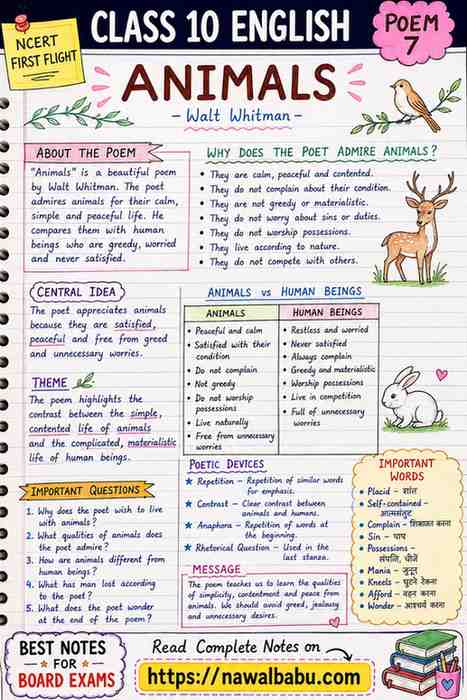
Central Idea: The poet admires animals because they are calm, satisfied, innocent and free from greed, jealousy and unnecessary complaints. He feels that human beings have lost many natural and noble qualities because of materialistic desires and social pressures.
About the Poem – कविता के बारे में
The poem “Animals” by Walt Whitman presents a comparison between human beings and animals. The poet feels attracted to animals because they live peacefully and naturally. They do not complain about their condition, worship wealth, or run after possessions. Humans, on the other hand, are often restless because of greed, desires and social competition. Through this comparison, the poet indirectly criticizes several weaknesses of human society and appreciates the simple and contented life of animals.
- Poet: Walt Whitman
- Poem: Animals
- Theme: Human beings versus animals
- Tone: Admiring, thoughtful and critical
- Main message: Contentment and simplicity make life peaceful.
Animals Class 10 English– कविता का सारांश
The poet says that he wishes he could live among animals because they are peaceful and satisfied with their lives. They do not complain about their conditions or worry about worldly possessions. They do not spend their lives discussing duties to God or regretting their mistakes. The poet observes that animals are calm, self-contained and honest. He believes humans have lost these qualities. Finally, he wonders whether humans once possessed these virtues and somehow lost them while developing civilization.
Easy Hindi Summary:
कवि जानवरों के बीच रहना चाहता है क्योंकि वे शांत, संतुष्ट और सरल जीवन जीते हैं। वे अपनी परिस्थितियों की शिकायत नहीं करते और न ही धन-संपत्ति के पीछे भागते हैं। वे पाप, ईश्वर और सामाजिक दिखावे जैसी बातों में परेशान नहीं होते। कवि को लगता है कि मनुष्यों ने अपनी प्राकृतिक अच्छाइयाँ खो दी हैं।
Stanza 1 Explanation – प्रथम पद्यांश की व्याख्या
The poet begins by saying that he wishes he could live with animals. He feels that animals are much calmer and more peaceful than human beings. They are self-contained and satisfied with their condition. They do not complain about their lives. Humans frequently remain dissatisfied and continuously want more comfort, money and success. Therefore, the poet finds animals attractive because they live naturally without unnecessary desires, competition or anxiety.
Important Points:
- The poet wants to live with animals.
- Animals are calm and peaceful.
- They are satisfied with their condition.
- They do not complain.
- Humans are often restless and dissatisfied.
Hindi:
कवि जानवरों के साथ रहना चाहता है क्योंकि वे शांत और संतुष्ट रहते हैं। वे अपनी परिस्थितियों की शिकायत नहीं करते।
Read More: Mijbil the Otter Class 10 Notes in Hindi: Summary, Question Answers, MCQs & NCERT Solutions
Stanza 2 Explanation – द्वितीय पद्यांश की व्याख्या
The poet continues to admire animals because they do not suffer from the greed and materialism found in humans. Animals do not remain awake at night worrying about their sins or discussing their responsibilities towards God. They do not make the poet sick by discussing their duties and religious obligations. Unlike human beings, animals simply live according to nature. Their lives are free from unnecessary guilt, anxiety and artificial social behaviour.
Important Points:
- Animals do not worry about sins.
- They do not discuss duties towards God.
- They live according to nature.
- They are free from unnecessary guilt.
- Humans often create mental worries for themselves.
Hindi:
जानवर पाप, धार्मिक कर्तव्यों और सामाजिक दिखावे की चिंता नहीं करते। वे प्रकृति के अनुसार सहज जीवन जीते हैं।
Stanza 3 Explanation – तृतीय पद्यांश की व्याख्या
The poet observes that animals are not dissatisfied with their lives. They do not suffer from the desire to possess things. They do not show respect or worship material possessions. They do not care about whether someone owns more wealth or property than others. Human beings, however, often measure happiness through money, possessions and social status. The poet admires animals because they remain independent of these materialistic values and live a simple and peaceful existence.
Important Points:
- Animals are not obsessed with possessions.
- They do not compare themselves with others.
- They do not worship wealth.
- Humans often connect happiness with material things.
- Animals remain naturally satisfied.
Hindi:
जानवर धन-संपत्ति और सामाजिक प्रतिष्ठा के पीछे नहीं भागते। वे दूसरों से अपनी तुलना भी नहीं करते।
Stanza 4 Explanation – चतुर्थ पद्यांश की व्याख्या
The poet says that no animal is dissatisfied with its condition. Animals do not suffer from the madness of owning things. They do not spend their lives worrying about possessions. They do not kneel before one another because of wealth or social position. The poet contrasts this with human society, where people often become slaves to money, status and possessions. This stanza highlights the freedom and self-respect that animals naturally possess.
Important Points:
- Animals accept their natural condition.
- They are not greedy.
- They do not worship possessions.
- They do not seek social superiority.
- They possess natural dignity and freedom.
Hindi:
जानवर अपनी स्थिति से संतुष्ट रहते हैं। वे धन या पद के कारण किसी के सामने झुकते नहीं हैं।
Stanza 5 Explanation – पंचम पद्यांश की व्याख्या
The poet further says that animals do not make him sick by discussing their duties towards God. Human beings often spend a lot of time discussing religious duties, morality and guilt. The poet does not criticize spirituality itself; rather, he criticizes the artificial anxiety and hypocrisy that people sometimes create around religion. Animals simply follow their natural instincts without pretending to be morally superior. Their behaviour is direct, natural and free from unnecessary intellectual complications.
Important Points:
- Animals do not create religious anxiety.
- They do not pretend to be morally superior.
- They live naturally.
- Their behaviour is simple and direct.
- The poet criticizes human hypocrisy.
Stanza 6 Explanation – षष्ठ पद्यांश की व्याख्या
The poet says that no animal is unhappy with its condition. Animals do not suffer from the desire to own more and more things. They do not become obsessed with material possessions. They do not kneel before one another or respect people merely because they are rich or powerful. This is an important criticism of human society. People frequently judge others according to wealth, position and possessions, whereas animals treat life naturally without such artificial divisions.
Hindi:
कवि के अनुसार मनुष्य धन और पद के कारण एक-दूसरे को महत्व देते हैं, जबकि जानवरों में ऐसी कृत्रिम सामाजिक व्यवस्था नहीं होती।
Stanza 7 Explanation – अंतिम पद्यांश की व्याख्या
At the end, the poet wonders where animals got these beautiful qualities. He thinks that perhaps human beings once possessed the same qualities but lost them long ago. He imagines that the qualities may have been left behind when humans developed civilization and became increasingly materialistic. The ending is reflective rather than simply praising animals. It makes readers think about whether progress has actually made human beings happier or whether they have sacrificed peace, innocence and contentment for material success.
Important Points:
- The poet wonders about the origin of animal qualities.
- He thinks humans may once have possessed them.
- Civilization may have caused their loss.
- Humans have become materialistic.
- The ending makes us think about the meaning of true progress.
Characteristic Qualities of Animals – Animals Class 10 English
The poem presents animals as symbols of natural goodness. They are calm, satisfied and free from greed. They do not complain about their circumstances and do not compete for wealth or status. They do not feel guilty about imaginary sins or continuously discuss religious duties. Most importantly, they remain true to their natural instincts. The poet sees these qualities as valuable because human beings have gradually lost them through excessive desires, materialism, social competition and artificial behaviour.
Qualities of Animals
- Calm: शांत
- Contented: संतुष्ट
- Simple: सरल
- Natural: प्राकृतिक
- Peaceful: शांतिपूर्ण
- Non-greedy: लालच से मुक्त
- Independent: स्वतंत्र
- Self-contained: आत्मनिर्भर
- Free from jealousy: ईर्ष्या से मुक्त
- Free from unnecessary guilt: अनावश्यक अपराध-बोध से मुक्त
Human Beings vs Animals – मनुष्य और जानवरों में अंतर
The poem creates a strong contrast between animals and human beings. Animals are presented as peaceful, satisfied and natural, while humans are shown as restless, greedy and dissatisfied. Animals do not complain or worry about possessions, whereas humans continuously desire more. Animals do not compare themselves with others, but humans often compete for wealth and status. Through this contrast, Whitman asks readers to examine whether modern civilization has improved human life or has taken away its natural peace and contentment.
| Animals | Human Beings |
|---|---|
| Calm and peaceful | Restless and anxious |
| Contented | Dissatisfied |
| Non-greedy | Often greedy |
| Natural | Artificial/social |
| Do not complain | Frequently complain |
| Do not worship possessions | Often value possessions |
| Do not compete for status | Compete for status |
| Free from unnecessary guilt | Often troubled by guilt |
| Live naturally | Live under social pressures |
Animals Class 10 English– मुख्य विषय
The central theme of “Animals” is the contrast between the natural life of animals and the complicated life of human beings. Whitman suggests that animals possess qualities such as peace, satisfaction, honesty and simplicity, while humans have become greedy, restless and materialistic. The poem is not simply about animals; it is also a criticism of human civilization. The poet wants us to reconsider our priorities and learn from animals that happiness does not always come from wealth, possessions or social status.
Theme in one line:
“Animals have natural contentment, while humans have lost peace because of greed and unnecessary desires.”
Animals Class 10 English – कविता का संदेश
The poem teaches us that a peaceful life does not depend on having unlimited wealth or possessions. We should learn to remain satisfied with what we have and avoid unnecessary competition. Human beings should preserve qualities such as simplicity, honesty, contentment and naturalness. The poet does not literally ask everyone to become animals; instead, he encourages us to learn positive qualities from them. The poem reminds us that excessive materialism can make human life stressful, complicated and less meaningful.
Exam Point
Message:
We should control greed, avoid unnecessary comparison and learn the values of contentment, simplicity and peaceful living.
Title “Animals” – शीर्षक की सार्थकता
The title “Animals” is simple but highly appropriate. The entire poem focuses on the qualities of animals and compares them with the weaknesses of human beings. Animals become the central symbols through which Whitman examines human behaviour. Their calmness, contentment, simplicity and naturalness are contrasted with human greed, dissatisfaction and materialism. Therefore, the title immediately directs the reader towards the poem’s main subject and its deeper criticism of human civilization.
Why is the title appropriate?
- The poem is centred on animals.
- Animals represent natural goodness.
- They are compared with human beings.
- The title reflects the central idea.
- It helps convey the poem’s message of simplicity and contentment.
Literary Devices in Animals – Animals Class 10 English
Walt Whitman uses several poetic devices to make the comparison between animals and humans effective. Repetition emphasizes the poet’s strong admiration for animals. Anaphora appears through repeated beginnings of lines. Alliteration adds rhythm to expressions. Personification gives animals human-like qualities such as thinking and possessing moral characteristics. Rhetorical questions at the end encourage readers to think deeply. Contrast is the most important technique because the poet continuously places animal qualities against human weaknesses.
Important Literary Devices
1. Repetition:
Repeated ideas emphasize the animals’ qualities.
2. Anaphora:
Several lines begin with similar expressions.
3. Alliteration:
Repetition of consonant sounds creates musical effect.
4. Personification:
Animals are described with qualities generally associated with humans.
5. Rhetorical Question:
The ending contains questions that make readers think.
6. Contrast:
Animals and human beings are compared throughout the poem.
Important Symbols – Animals Class 10 English
Animals in the poem symbolize simplicity, innocence, contentment, freedom and natural living. They are not merely creatures in the poem; they represent an alternative way of life. Human civilization symbolizes materialism, competition, greed and unnecessary complications. Possessions symbolize the human desire for wealth and social status. The poet’s desire to live with animals symbolizes his wish to return to a more natural and peaceful way of living. Thus, the poem uses animals to reflect upon the condition of modern humanity.
Important Symbols
- Animals → Natural goodness and contentment
- Possessions → Materialism
- Human civilization → Complexity and competition
- Freedom of animals → Natural independence
- Poet’s desire to live with animals → Desire for peace
Why Does the Poet Want to Live with Animals?
The poet wants to live with animals because he finds them peaceful, satisfied and natural. They do not complain about their conditions or suffer from greed. They are not obsessed with possessions, social status or religious guilt. Unlike human beings, they do not create unnecessary problems for themselves. The poet admires their ability to live simply according to nature. Therefore, his wish to live with animals expresses his dissatisfaction with the complicated, materialistic and competitive behaviour of human society.
What Does the Poet Mean by “They Are So Placid and Self-contained”?
The words “placid” and “self-contained” describe the peaceful nature of animals. “Placid” means calm and peaceful, while “self-contained” means satisfied with oneself and not dependent on unnecessary external things for happiness. Animals do not constantly seek wealth, recognition or social approval. They live according to their natural needs. Through these words, the poet appreciates animals for possessing inner peace and contentment, qualities that he believes human beings have largely lost because of excessive desires and materialism.
Why Does the Poet Criticize Human Beings?
The poet criticizes human beings because they are often dissatisfied, greedy and materialistic. People complain about their circumstances, worry about sins, discuss duties towards God and compete for possessions and status. Human beings frequently create unnecessary mental and social pressures. The poet believes that civilization has made people more complicated rather than truly happier. His criticism is intended to make readers examine their own behaviour and understand the value of simplicity, contentment, natural living and freedom from unnecessary desires.
What Does “Not One Is Dissatisfied” Mean?
The expression means that animals do not complain about their natural condition. They accept life as it comes and remain satisfied with their basic needs. Unlike humans, they do not constantly desire more wealth, comfort, possessions or social recognition. Their satisfaction comes naturally rather than from external achievements. The poet admires this quality because human beings often remain unhappy even after achieving many things. Thus, the line highlights the difference between natural contentment in animals and human dissatisfaction.
What Does “Not One Is Demented with the Mania of Owning Things” Mean?
This expression means that animals are not crazy about possessing material things. The word “mania” suggests an excessive or uncontrolled desire. Human beings often become obsessed with buying, collecting and owning things because they associate possessions with happiness, success and status. Animals do not have this problem. They simply use what they need and live naturally. Through this expression, Whitman strongly criticizes materialism and reminds readers that excessive attachment to possessions can disturb peace and satisfaction.
Know More: Consumer Rights Class 10 Notes in Hindi & English | NCERT Economics Chapter 5 Complete Notes
What Does the Poet Mean by “No One Kneels to Another”?
The phrase suggests that animals do not show artificial respect to others because of wealth, power or social position. In human society, people may behave differently towards rich or powerful individuals. Animals, however, do not have such social hierarchies based on material possessions. They remain natural and independent. The poet appreciates this equality and freedom. The phrase therefore criticizes human society, where money and status can influence relationships and sometimes make people lose their dignity.
What Does the Last Question of the Poem Mean?
At the end, the poet wonders where animals got the qualities that make them so peaceful and contented. He asks whether these qualities were once present in human beings and whether humans lost them long ago. This is a symbolic question rather than a request for a factual answer. It makes readers think about the effects of civilization. The poet suggests that humans may have sacrificed natural simplicity, innocence and contentment while developing materialistic and competitive societies.
What Has Man Lost According to the Poet?
According to the poet, human beings have lost several natural qualities that animals still possess. These include peace, contentment, simplicity, innocence, self-satisfaction, freedom from greed and naturalness. Human beings have become increasingly concerned with possessions, status, religious guilt, competition and social approval. As civilization progressed, people developed many comforts but also created many unnecessary desires and anxieties. The poem therefore asks whether material progress is worthwhile if it causes people to lose their inner peace.
Animals Class 10 English – कठिन शब्दों के अर्थ
| Word | Meaning |
|---|---|
| Placid | Calm and peaceful – शांत |
| Self-contained | Satisfied with oneself – आत्मसंतुष्ट |
| Complain | Express dissatisfaction – शिकायत करना |
| Sin | Wrong or immoral act – पाप |
| Duties | Responsibilities – कर्तव्य |
| Possessions | Things owned – संपत्ति/वस्तुएँ |
| Mania | Excessive obsession – जुनून |
| Kneels | Bends down on knees – घुटने टेकना |
| Acknowledged | Accepted/recognized – स्वीकार किया |
| Likings | Preferences or desires – पसंद |
| Sweat | Work hard – मेहनत करना |
| Whine | Complain repeatedly – बार-बार शिकायत करना |
| Insane | Mentally disturbed/crazy – पागल |
| Afford | Have enough money for – खर्च वहन करना |
| Wonder | Think with curiosity – आश्चर्य करना |
One-Line Question Answers –Animals Class 10 English
Q1. Who is the poet of “Animals”?
Ans. Walt Whitman is the poet of “Animals”.
Q2. Why does the poet wish to live with animals?
Ans. He wants to live with animals because they are calm, contented and natural.
Q3. What quality of animals attracts the poet most?
Ans. Their peaceful and self-contained nature attracts him most.
Q4. Do animals complain about their condition?
Ans. No, animals do not complain about their condition.
Q5. Are animals obsessed with possessions?
Ans. No, animals are not obsessed with possessing things.
Q6. What human weakness does the poem criticize?
Ans. It criticizes greed, dissatisfaction, materialism and unnecessary social competition.
Q7. What does “placid” mean?
Ans. “Placid” means calm and peaceful.
Q8. What does “self-contained” mean?
Ans. It means satisfied and independent within oneself.
Q9. What do animals not discuss?
Ans. They do not discuss their duties towards God.
Q10. What does the poet wonder about at the end?
Ans. He wonders whether humans once possessed the qualities that animals have now.
Short Answer Questions – Important Exam Questions
Q1. Why does the poet admire animals?
The poet admires animals because they are calm, peaceful and satisfied with their lives. They do not complain about their condition or worry unnecessarily about sins and religious duties. They are not greedy for possessions and do not compete for wealth or status. Unlike human beings, animals live naturally and remain free from excessive desires. The poet therefore sees them as examples of simplicity, contentment and inner peace.
Q2. How are animals different from human beings?
Animals are peaceful, contented and natural, whereas human beings are often restless and dissatisfied. Animals do not complain about their condition or become obsessed with possessions. They do not compete for wealth and social status. Humans, however, frequently worry about money, possessions, sins and social position. Through this contrast, Whitman shows that animals have retained natural qualities that human beings have gradually lost because of civilization, materialism and excessive desires.
Q3. What is the poet’s attitude towards animals?
The poet’s attitude towards animals is highly appreciative and admiring. He sees them as peaceful, satisfied, honest and natural creatures. He believes they possess qualities that humans have lost. He is especially impressed by their freedom from greed, competition and unnecessary worries. His admiration is so strong that he wishes to live among them. Through his attitude, the poet encourages readers to observe animals and learn valuable lessons about simplicity and contentment.
Q4. What is the significance of possessions in the poem?
Possessions represent materialism and greed in the poem. Animals do not become obsessed with owning things, whereas humans often consider possessions a measure of success and happiness. The poet criticizes this attitude because excessive desire for wealth can create dissatisfaction and anxiety. By contrasting animals with humans, Whitman suggests that true happiness does not necessarily come from owning more things. Contentment, simplicity and inner peace can be more valuable than material wealth.
Q5. What does the poem teach modern human beings?
The poem teaches modern human beings to value simplicity, contentment and inner peace. People should not allow greed, competition and material possessions to control their lives. We should avoid unnecessary complaints and comparisons with others. The poem also encourages us to remain natural and honest rather than behaving according to artificial social expectations. Its deeper lesson is that material progress alone cannot guarantee happiness; humans must also preserve their natural goodness and peace.
Long Answer – How Does Whitman Contrast Animals and Humans?
Walt Whitman presents animals as calm, contented and natural beings and contrasts them with human beings who are often greedy, restless and dissatisfied. Animals do not complain about their condition, worry about possessions or compete for social status. They live according to nature and remain satisfied with their needs. Humans, however, are frequently troubled by material desires, social comparisons, guilt and unnecessary worries. Through this contrast, Whitman suggests that humans have lost several natural qualities because of civilization and materialism. The poem encourages us to learn contentment and simplicity from animals.
Long Answer – What Is the Central Idea of “Animals”?
The central idea of the poem is that animals possess natural qualities that human beings have gradually lost. Animals are peaceful, satisfied, independent and free from greed. They do not complain, compete for wealth or become obsessed with possessions. Human beings, in contrast, often create stress through material desires, social competition and unnecessary guilt. The poet admires animals and wishes to live with them because their lives appear simpler and more peaceful. The poem therefore encourages humans to reconsider their priorities and rediscover contentment and natural goodness.
Exam-Oriented Quick Revision – Animals Class 10 English
Remember These 10 Points:
- Poet: Walt Whitman
- Poem: Animals
- Book: First Flight
- Animals are: Calm, peaceful and contented.
- Animals do not: Complain about their condition.
- Animals are free from: Greed and materialism.
- Humans are shown as: Restless and dissatisfied.
- Main contrast: Natural life vs. materialistic life.
- Main theme: Contentment and simplicity.
- Final idea: Humans may have lost their natural goodness through civilization.
5-Second Revision Formula
ANIMALS = P + C + S + N – G
- P = Peaceful
- C = Contented
- S = Simple
- N = Natural
- G = Greed
Human Problem = Greed + Possessions + Competition + Dissatisfaction
Poet’s Solution = Learn simplicity and contentment from animals.
Animals Class 10 English – निष्कर्ष
“Animals” is a thoughtful poem in which Walt Whitman uses animals to examine the weaknesses of human society. He admires their calmness, contentment, simplicity and freedom from greed. In contrast, humans have become restless because of possessions, competition, social status and unnecessary worries. The poem does not simply praise animals; it asks us to reflect on our own lifestyle. Its lasting message is that true happiness requires inner peace, simplicity and contentment rather than endless material desires.
Best Exam Line:
“The poem ‘Animals’ teaches us that human beings should learn the virtues of simplicity, contentment, naturalness and peace from animals.”