
The Trees Class 10 English Poem NCERT की First Flight पुस्तक में शामिल एक महत्वपूर्ण कविता है, जिसे Adrienne Rich ने लिखा है। यह कविता प्रकृति, स्वतंत्रता और बंधन से मुक्ति की भावना को बहुत सुंदर तरीके से प्रस्तुत करती है। कविता में पेड़ों को घर के अंदर बंद दिखाया गया है, जबकि उनका वास्तविक स्थान जंगल है। पेड़ धीरे-धीरे घर से बाहर निकलकर अपने प्राकृतिक वातावरण की ओर बढ़ते हैं।
इस The Trees Class 10 Notes in Hindi में आपको कविता का आसान हिंदी में summary, detailed explanation, central idea, theme, poetic devices, symbolism, important vocabulary और important questions and answers मिलेंगे। साथ ही, बोर्ड परीक्षा की तैयारी के लिए short revision notes और exam-oriented questions भी दिए गए हैं। अगर आप Class 10 English The Trees Poem को सरल भाषा में समझना चाहते हैं, तो ये notes आपकी revision और परीक्षा की तैयारी के लिए बहुत उपयोगी होंगे। Download NCERT BOOK PDF.
The Trees Class 10 English Poem Notes: Summary
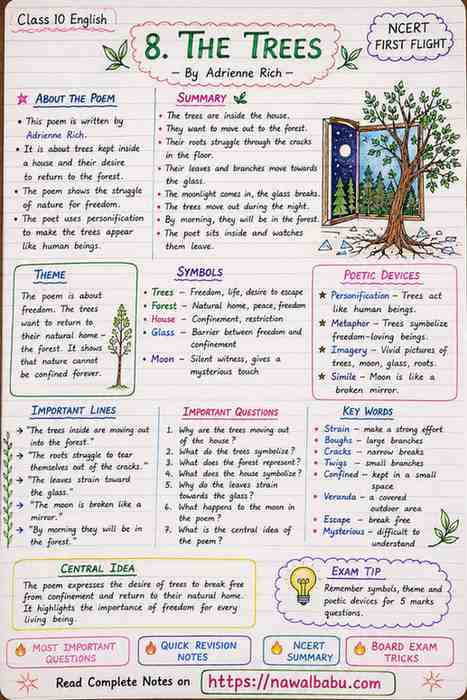
1. About the Poem
- Poem: The Trees
- Poet: Adrienne Rich
- Book: NCERT First Flight
- Class: 10 English
- Theme: Freedom, nature and the desire for independence.
- The poem presents trees as if they are living beings trying to escape from a house and return to the forest.
- The poet uses personification to give human qualities to trees.
- The poem also suggests that human beings have disturbed the natural freedom of nature.
2. About the Poet – Adrienne Rich
Adrienne Rich was an American poet, essayist and feminist writer. Her poetry often deals with freedom, identity, nature, social injustice and the position of women in society. In The Trees, she presents nature as a living force that wants to break free from human control. Through the movement of trees towards the forest, she beautifully expresses the importance of freedom and a return to the natural world.
3. Central Idea of the Poem
The central idea of The Trees is the struggle for freedom. The trees are kept inside a house, but they naturally belong in the forest. During the night, they slowly move towards the outside world. The poet describes their movement as if they were human beings trying to escape from imprisonment. The poem reminds us that nature cannot remain confined forever. It also symbolizes the desire of every living being to live freely.
4. Summary of the Poem
- The poet describes trees that are kept inside a house.
- The trees seem uncomfortable and want to return to the forest.
- During the night, their roots try to come out of the cracks in the floor.
- Their leaves and small branches move towards the glass windows.
- The moonlight enters the room and helps create a mysterious atmosphere.
- The trees gradually move outside.
- By morning, the trees will have reached the forest.
- The poet watches this process from inside the house.
- She compares the breaking of the glass to the trees gaining freedom.
- The poem ends with the trees finally moving into their natural surroundings.
5. Detailed Explanation – Stanza 1
“The trees inside are moving out into the forest…”
- The poem begins with a strange situation: trees are inside a house.
- Naturally, trees belong in forests, not inside rooms.
- The trees are trying to move out towards their natural home.
- Their movement represents their desire for freedom.
- The poet makes the trees appear like human beings.
- This use of human qualities for trees is called personification.
- The image suggests that nature has been artificially confined by humans.
Hindi Explanation:
कवयित्री बताती हैं कि घर के अंदर मौजूद पेड़ बाहर जंगल की ओर जा रहे हैं। पेड़ों का घर में होना अप्राकृतिक है। वे अपने प्राकृतिक स्थान, यानी जंगल, में वापस जाना चाहते हैं। यह उनकी स्वतंत्रता की इच्छा को दर्शाता है।
6. Detailed Explanation – Stanza 2
“The forest that was empty all these days…”
- The forest has been empty because its trees have been kept inside the house.
- Now the trees are returning to their original place.
- The roots struggle to free themselves from the cracks in the floor.
- The branches and leaves move towards the glass.
- Their movement is slow but determined.
- The poet describes this movement as a kind of struggle.
- It shows that nature continuously tries to regain its freedom.
Hindi Explanation:
जंगल खाली पड़ा है क्योंकि उसके पेड़ घर के अंदर बंद हैं। अब पेड़ वापस जंगल की ओर जा रहे हैं। उनकी जड़ें फर्श की दरारों से बाहर निकलने का प्रयास करती हैं। यह प्रकृति के स्वतंत्र होने के संघर्ष का प्रतीक है।
7. Detailed Explanation – Stanza 3
“The leaves strain toward the glass…”
- The leaves try hard to reach the outside world.
- The branches move under the roof and towards the windows.
- The glass creates a barrier between the trees and freedom.
- The trees appear determined to break this barrier.
- The poet describes their movement in a dramatic way.
- Their struggle represents the struggle of living beings against restrictions.
- Nature wants to return to its original and free condition.
Hindi Explanation:
पेड़ों की पत्तियाँ खिड़की के शीशे की ओर बढ़ती हैं। शीशा उनके रास्ते में बाधा है, लेकिन पेड़ बाहर निकलने के लिए लगातार प्रयास करते हैं। यह स्वतंत्रता पाने की तीव्र इच्छा को व्यक्त करता है।
8. Detailed Explanation – Stanza 4
“The moon is broken like a mirror…”
- The poet creates a beautiful image of moonlight and broken glass.
- The moon appears through the glass window.
- As the trees move out, the glass seems to break.
- The image of the broken moon creates a mysterious and poetic atmosphere.
- The moon also seems to witness the trees’ escape.
- The night becomes a symbol of transformation and freedom.
- The trees are almost ready to leave their artificial surroundings.
Hindi Explanation:
रात के समय चाँद की रोशनी शीशे से दिखाई देती है। पेड़ों के बाहर निकलने से शीशे के टूटने का दृश्य दिखाई देता है। चाँद का टूटे हुए आईने जैसा दिखाई देना एक सुंदर काव्यात्मक चित्र प्रस्तुत करता है।
9. Detailed Explanation – Final Part
“I sit inside, doors open to the verandah…”
- The poet is sitting inside while the trees are moving outside.
- The doors are open, suggesting that there is no need to stop nature anymore.
- The trees finally move towards the forest.
- Their departure creates a sense of freedom and relief.
- The poet hears the sound of the trees moving outside.
- By morning, the trees will be established in the forest.
- The ending shows that nature ultimately finds its way back to freedom.
Hindi Explanation:
कवयित्री घर के अंदर बैठी हैं और दरवाजे खुले हुए हैं। पेड़ धीरे-धीरे बाहर निकलकर जंगल की ओर चले जाते हैं। सुबह तक वे अपने प्राकृतिक स्थान पर पहुँच जाते हैं। यह अंत प्रकृति की स्वतंत्रता और उसकी शक्ति को दर्शाता है।
10. Theme of the Poem
The main theme of The Trees is freedom. The trees symbolize living beings that are restricted against their natural will. Their movement from the house to the forest represents the journey from confinement to freedom. The poem also highlights the relationship between human beings and nature. Nature cannot be permanently controlled or imprisoned. Eventually, it tries to return to its natural state.
Hindi:
कविता का मुख्य विषय स्वतंत्रता है। घर में बंद पेड़ उन जीवों का प्रतीक हैं जिन्हें उनकी इच्छा के विरुद्ध नियंत्रित किया जाता है। जंगल की ओर उनका जाना बंधन से स्वतंत्रता की यात्रा को दर्शाता है।
11. Symbolism in the Poem
Trees
- Trees symbolize freedom, nature and life.
- They also represent beings struggling against restrictions.
Forest
- The forest symbolizes the natural home and freedom of the trees.
- It represents a place where nature can exist freely.
House
- The house symbolizes confinement, control and artificial surroundings.
- It shows how humans restrict nature.
Glass
- Glass represents the barriers between nature and freedom.
- The trees must cross this barrier to escape.
Moon
- The moon creates a mysterious atmosphere.
- It also becomes a silent witness to the trees’ movement.
Personification in the Poem
Personification means giving human qualities, actions or feelings to non-human things.
In The Trees, the trees are shown as if they are human beings:
- They move out of the house.
- Their roots struggle to come out.
- Their leaves strain towards the glass.
- Their branches try to escape.
- They seem to have a strong desire for freedom.
This literary device makes the poem vivid and helps readers understand the emotional condition of nature.
Important Literary Devices
1. Personification
Trees are presented as living beings with human desires and actions.
2. Metaphor
The trees can be understood as a metaphor for people who want freedom from restrictions.
3. Simile
The poet compares the moon’s appearance to a broken mirror.
4. Imagery
The poem creates strong pictures of trees, roots, leaves, branches, glass, moonlight and forest.
5. Symbolism
Trees, forest, house and glass have deeper meanings related to freedom and confinement.
6. Repetition
Repeated ideas and images emphasize the continuous struggle of the trees to escape.
Important Vocabulary
| Word | Meaning |
|---|---|
| Strain | To make a strong effort |
| Boughs | Large branches of a tree |
| Twigs | Small branches |
| Crown | Top part of a tree |
| Veranda | A covered area outside a house |
| Glass | Transparent material used in windows |
| Night-long | Throughout the night |
| Whisper | A very soft sound |
| Cracks | Narrow breaks or lines |
| Forest | A large area covered with trees |
Important Questions and Answers
Q1. Why are the trees moving out of the house?
Answer:
The trees are moving out because they naturally belong in the forest. They have been confined inside the house and want to return to their natural environment. Their movement symbolizes the desire for freedom. The poet shows that nature cannot remain imprisoned forever. The trees struggle through the cracks and move towards the windows. Finally, they escape into the forest.
Hindi:
पेड़ घर से बाहर इसलिए जा रहे हैं क्योंकि उनका प्राकृतिक स्थान जंगल है। वे घर में बंद हैं और स्वतंत्र होकर अपने प्राकृतिक वातावरण में वापस जाना चाहते हैं।
Q2. What does the empty forest symbolize?
Answer:
The empty forest symbolizes the absence of trees from their natural environment. It also suggests that nature has been disturbed by human interference. The forest is waiting for the trees to return. When the trees move out of the house, the forest will regain its natural appearance. Thus, the empty forest represents the unnatural separation of nature from its original home.
Hindi:
खाली जंगल पेड़ों के उनके प्राकृतिक वातावरण से दूर होने का प्रतीक है। यह मानव हस्तक्षेप के कारण प्रकृति में आए असंतुलन को भी दर्शाता है।
Q3. What do the roots do?
Answer:
The roots make a great effort to free themselves from the cracks in the floor. This action shows that the trees are struggling to leave the house. Their roots represent their strong connection with the earth and nature. The struggle of the roots symbolizes the struggle for freedom.
Hindi:
जड़ें फर्श की दरारों से बाहर निकलने का प्रयास करती हैं। यह पेड़ों के स्वतंत्र होने के संघर्ष को दर्शाता है।
Q4. Why do the leaves and branches move towards the glass?
Answer:
The leaves and branches move towards the glass because they want to reach the outside world. The glass is a barrier separating them from freedom. Their movement shows their determination to escape from the house. The poet uses this image to show how strongly nature wants to return to its natural surroundings.
Hindi:
पत्तियाँ और शाखाएँ शीशे की ओर इसलिए बढ़ती हैं क्योंकि वे बाहर की दुनिया तक पहुँचना चाहती हैं। शीशा उनके लिए स्वतंत्रता की राह में बाधा है।
Q5. What does the movement of trees symbolize?
Answer:
The movement of the trees symbolizes the struggle for freedom. The trees are confined inside a house but naturally belong in the forest. Their escape represents the movement from restriction to independence. At a deeper level, the trees may symbolize people, especially those who struggle against social, emotional or physical restrictions.
Q6. Why is the forest described as empty?
Answer:
The forest is described as empty because the trees that naturally belong there have been brought inside the house. This creates an unnatural situation. The empty forest symbolizes the loss of natural freedom and balance. When the trees return, the forest will become complete again.
Q7. What is the significance of the glass?
Answer:
The glass represents a barrier between the trees and the outside world. It separates the trees from freedom and nature. The trees try to reach through or beyond it. Therefore, the glass symbolizes restrictions that prevent living beings from enjoying freedom.
Q8. What does the poet mean by “the forest that was empty all these days”?
Answer:
The poet means that the forest has been without its trees because they have been kept inside the house. The forest is their natural home, so its emptiness is unnatural. The line also suggests that nature has been separated from its original environment by human actions.
Q9. What is the message of the poem?
Answer:
The poem gives the message that freedom is essential for every living being. Nature should not be unnecessarily controlled or confined by human beings. The trees eventually leave the house and return to the forest. This shows that nature has its own power and desire for freedom. The poem encourages us to respect nature and allow it to exist naturally.
Q10. Why is the title “The Trees” appropriate?
Answer:
The title The Trees is appropriate because the entire poem revolves around the trees and their movement from the house to the forest. The trees are not merely plants; they symbolize freedom, nature and the struggle against restrictions. Their journey forms the central action of the poem. Therefore, the simple title effectively represents the poem’s main idea.
What Do the Trees Symbolize?
The trees mainly symbolize freedom and the desire to escape from confinement. They may also represent people who are restricted by social, physical or emotional barriers. Their journey towards the forest represents a movement towards independence. The trees remind us that every living being has a natural right to exist freely. Thus, the trees become a powerful symbol of liberation.
Why Does the Poet Use Trees as a Symbol?
The poet uses trees because they are naturally associated with freedom, growth and life. Keeping them inside a house creates an unnatural situation. Their struggle to return to the forest makes the idea of freedom easy to understand. Through the trees, the poet indirectly expresses the feelings of people who are confined or controlled and want to live according to their own wishes.
What Does the House Symbolize?
The house symbolizes restriction and confinement. Although a house normally provides safety, in this poem it becomes a place where the trees cannot live naturally. The house therefore represents artificial control over nature. The movement of trees out of the house suggests breaking free from limitations and returning to a natural state.
Poetic Devices – Quick Revision
- Personification: Trees behave like human beings.
- Metaphor: Trees represent freedom-loving beings.
- Simile: The moon is compared to a broken mirror.
- Imagery: Strong visual images of trees, forest, glass and moonlight.
- Symbolism: Trees = freedom; house = confinement; forest = natural home.
- Alliteration: Repetition of similar consonant sounds creates musical effect.
- Enjambment: Sentences continue from one line to the next without a full stop.
Exam-Oriented One-Line Questions
Q. Who wrote The Trees?
Ans. Adrienne Rich.
Q. Where do the trees naturally belong?
Ans. They naturally belong in the forest.
Q. Where are the trees initially?
Ans. They are inside a house.
Q. What do the trees want?
Ans. They want to return to the forest and become free.
Q. What do the trees symbolize?
Ans. They symbolize freedom and the struggle against confinement.
Q. What does the house symbolize?
Ans. It symbolizes confinement and restriction.
Q. What does the forest symbolize?
Ans. It symbolizes nature, freedom and the trees’ natural home.
Q. What literary device is mainly used for the trees?
Ans. Personification.
Q. What is the main theme?
Ans. Freedom and the return of nature to its natural state.
Quick Revision Notes
- Poem: The Trees
- Poet: Adrienne Rich
- Book: First Flight
- Main Theme: Freedom
- Trees: Symbol of freedom and life
- House: Symbol of confinement
- Forest: Symbol of natural freedom
- Glass: Symbol of barrier
- Major Device: Personification
- Message: Nature should not be unnecessarily confined or controlled.
- Ending: Trees finally move towards their natural home, the forest.
Know More: Outcomes of Democracy Class 10 Notes in Hindi | लोकतंत्र के परिणाम अध्याय 5 सम्पूर्ण नोट्स PDF
5-Mark Answer – Theme of “The Trees”
The Trees is a poem about the struggle for freedom. The trees are kept inside a house even though their natural home is the forest. During the night, they struggle to escape through the cracks and windows. Their movement represents the desire of every living being to be free. The house represents confinement, while the forest represents freedom and nature. The poem also teaches us that nature cannot be permanently controlled by human beings and should be respected.
5-Mark Answer – Message of the Poem
The poem gives a strong message about the importance of freedom. The trees cannot live happily inside the house because they belong to the forest. Their movement outside represents their struggle to regain their natural freedom. Through this symbolic journey, Adrienne Rich suggests that living beings should not be unnecessarily controlled or confined. The poem also highlights the need to respect nature. Nature has its own identity, strength and right to exist in its natural environment.
Final Exam Revision
Remember these 5 points for the board exam:
- Trees → Freedom
- House → Confinement
- Forest → Natural Home
- Movement → Struggle for Independence
- Personification → Trees shown like human beings
One-Line Summary
“The Trees” is a symbolic poem about nature’s struggle to break free from human confinement and return to its natural home.
Hindi Summary:
“The Trees” प्रकृति की स्वतंत्रता और बंधन से मुक्ति की कविता है, जिसमें पेड़ घर से निकलकर अपने प्राकृतिक घर जंगल की ओर लौटते हैं।