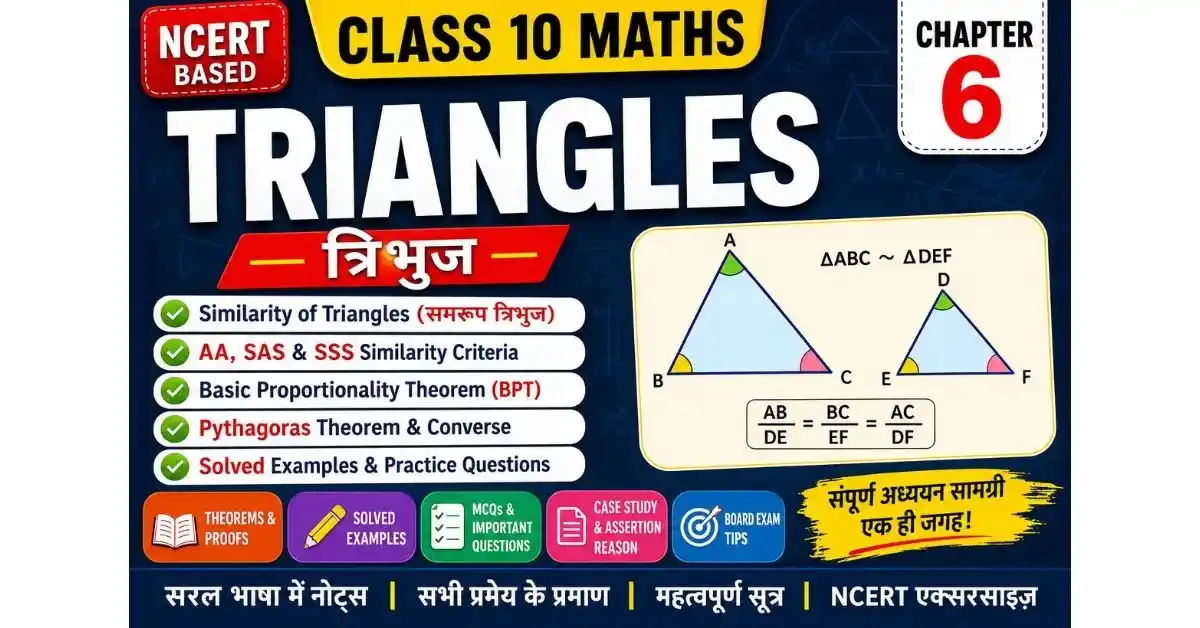
Triangles Class 10 Maths Notes: यदि आप Class 10 Maths Chapter 6 – Triangles (त्रिभुज) के आसान, विस्तृत और परीक्षा-उपयोगी नोट्स खोज रहे हैं, तो यह पोस्ट आपके लिए एक संपूर्ण अध्ययन सामग्री है। यहाँ आपको NCERT आधारित Triangles Notes सरल Hindi + English (Bilingual) भाषा में दिए गए हैं, जिससे प्रत्येक विद्यार्थी कठिन अवधारणाओं को भी आसानी से समझ सके। Download NCERT BOOK PDF.
इस पोस्ट में Similarity of Triangles (समरूप त्रिभुज), AA, SAS एवं SSS Similarity Criteria, Basic Proportionality Theorem (BPT), Pythagoras Theorem, उनके प्रमाण (Proofs), हल किए गए उदाहरण (Solved Examples), महत्वपूर्ण सूत्र (Formulas), बोर्ड परीक्षा के टिप्स, MCQs, Assertion-Reason, Case Study Questions, Previous Year Questions तथा Quick Revision Notes शामिल हैं। यदि आप CBSE बोर्ड परीक्षा में उत्कृष्ट अंक प्राप्त करना चाहते हैं या प्रतियोगी परीक्षाओं की तैयारी कर रहे हैं, तो यह अध्याय आपके लिए एक भरोसेमंद और संपूर्ण अध्ययन गाइड साबित होगा।
Triangles Class 10 Maths Notes: NCERT Chapter 6 Complete Notes
Triangles (त्रिभुज)
Triangles is one of the most important chapters of Class 10 Mathematics. In this chapter, you will learn how to compare two triangles using the concept of Similarity (समानता) instead of Congruence (सर्वांगसमता). You will also study the Basic Proportionality Theorem (BPT), Pythagoras Theorem, and their applications. These concepts are frequently asked in CBSE Board examinations and are also useful in higher mathematics and real-life measurements.
Introduction (परिचय)
In Class 9, you studied Congruent Triangles, where two triangles have the same shape and the same size. In this chapter, you will study Similar Triangles, where two triangles have the same shape but may have different sizes. Similarity helps us calculate unknown heights, distances, and side lengths without direct measurement. Engineers, architects, surveyors, and map makers use this concept in their daily work.
Learning Outcomes (अधिगम उद्देश्य)
After studying this chapter, students will be able to:
- Understand the meaning of Similar Figures.
- Differentiate between Congruent and Similar figures.
- Identify Similar Triangles.
- Apply AA, SAS and SSS Similarity Criteria.
- Solve problems based on Basic Proportionality Theorem (BPT).
- Apply the Pythagoras Theorem in practical situations.
- Calculate unknown sides using proportionality.
- Solve Board Examination and competitive examination questions confidently.
Read More: Arithmetic Progressions Class 10 Notes in Hindi | NCERT Maths Chapter 5 समांतर श्रेणी सम्पूर्ण नोट्स
Prerequisite Knowledge (पूर्व आवश्यक ज्ञान)
Before studying this chapter, students should know:
- Types of triangles.
- Angle Sum Property of Triangle.
- Exterior Angle Property.
- Parallel lines and transversal.
- Congruence criteria (SSS, SAS, ASA, RHS).
- Ratio and Proportion.
- Basic Algebra.
These concepts will help you understand Similarity more easily.
Important Terms (महत्वपूर्ण शब्दावली)
| English | हिन्दी | Meaning |
|---|---|---|
| Triangle | त्रिभुज | Three-sided polygon |
| Similar Figures | समरूप आकृतियाँ | Same shape, different size possible |
| Congruent Figures | सर्वांगसम आकृतियाँ | Same shape and same size |
| Ratio | अनुपात | Comparison of two quantities |
| Proportion | समानुपात | Equality of two ratios |
| Corresponding Sides | संगत भुजाएँ | Matching sides |
| Corresponding Angles | संगत कोण | Matching angles |
| Scale Factor | माप गुणांक | Common ratio of corresponding sides |
| Hypotenuse | कर्ण | Longest side of right triangle |
What are Similar Figures? (समरूप आकृतियाँ क्या हैं?)
Two figures are called Similar Figures if they have the same shape, but their sizes may be different.
Important Points
- Shape remains the same.
- Size may increase or decrease.
- Corresponding angles are equal.
- Corresponding sides are proportional.
- Symbol used is ~
Examples
✔ Small and large circles
✔ Two maps of different scales
✔ Passport photo and enlarged photo
✔ Small and big equilateral triangles
Characteristics of Similar Figures (समरूप आकृतियों की विशेषताएँ)
- Corresponding angles are equal.
- Corresponding sides are proportional.
- Shape remains unchanged.
- Size can change.
- Enlargement and reduction both produce similar figures.
- Every congruent figure is similar.
- Every similar figure is not necessarily congruent.
Congruent Figures vs Similar Figures (सर्वांगसम एवं समरूप आकृतियाँ)
| Congruent Figures | Similar Figures |
|---|---|
| Same Shape | Same Shape |
| Same Size | Size may differ |
| Corresponding sides equal | Corresponding sides proportional |
| Corresponding angles equal | Corresponding angles equal |
| Symbol = ≅ | Symbol = ~ |
Easy Trick
Congruent = Shape + Size Same
Similar = Shape Same Only
Read Also: CBSE Class 10 Science Syllabus 2026–27 (Latest) – Complete Guide, Chapter Wise, PDF Analysis
Similar Polygons (समरूप बहुभुज)
Two polygons are said to be similar when:
- All corresponding angles are equal.
- Corresponding sides are proportional.
- Same order of vertices.
- Shape remains unchanged.
Example:
Two squares of side 4 cm and 8 cm are similar because
Ratio = 4 : 8 = 1 : 2
All angles = 90°
Hence Similar.
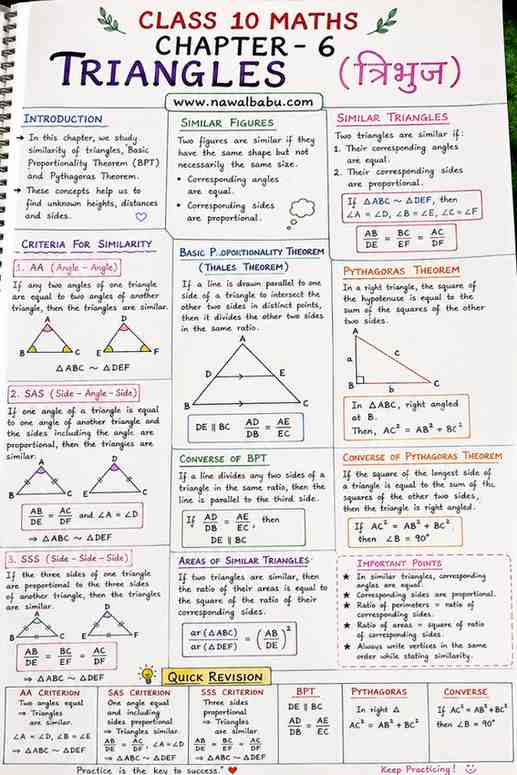
Similar Triangles (समरूप त्रिभुज)
Two triangles are said to be Similar when
Condition 1
Corresponding angles are equal.
Condition 2
Corresponding sides are proportional.
If
ΔABC ~ ΔDEF
Then
∠A = ∠D
∠B = ∠E
∠C = ∠F
and
AB/DE = BC/EF = AC/DF
This common ratio is called the Scale Factor. Similar triangles always have the same shape, but they may have different sizes.
Symbol of Similar Triangles
The symbol of Similarity is
~
Example
ΔABC ~ ΔPQR
Read as
“Triangle ABC is similar to Triangle PQR.”
Remember that the order of letters is very important because it shows the corresponding vertices.
Properties of Similar Triangles (समरूप त्रिभुजों के गुण)
- Corresponding angles are equal.
- Corresponding sides are proportional.
- Ratio of perimeters equals ratio of corresponding sides.
- Ratio of areas equals the square of the ratio of corresponding sides.
- Shape remains the same.
- Heights, medians, and angle bisectors are also proportional.
Scale Factor (माप गुणांक)
The common ratio of corresponding sides of similar triangles is called the Scale Factor.
Example
If
AB = 6 cm
PQ = 9 cm
Then
Scale Factor
= 6/9
= 2/3
This ratio helps us find unknown sides in many questions.
Criteria for Similarity of Triangles (त्रिभुजों की समानता की कसौटियाँ)
NCERT provides three criteria to prove that two triangles are similar:
1. AA (Angle-Angle) Similarity
If two corresponding angles are equal, then triangles are similar.
2. SAS (Side-Angle-Side) Similarity
If one angle is equal and the including sides are proportional, then triangles are similar.
3. SSS (Side-Side-Side) Similarity
If all corresponding sides are proportional, then triangles are similar.
These criteria help avoid checking every angle and side separately.
Difference between Congruence and Similarity
| Congruence | Similarity |
|---|---|
| Shape Same | Shape Same |
| Size Same | Size may differ |
| All sides equal | Sides proportional |
| Angles equal | Angles equal |
| Symbol ≅ | Symbol ~ |
| Scale Factor =1 | Scale Factor may differ |
Real-Life Applications (वास्तविक जीवन में उपयोग)
Similarity is used in many practical situations:
- Measuring height of buildings.
- Measuring height of trees.
- Surveying land.
- Architecture and construction.
- Map drawing.
- Satellite imaging.
- Engineering designs.
- Photography and image enlargement.
- Computer graphics and animation.
Exam Tips (परीक्षा हेतु महत्वपूर्ण सुझाव)
- Always write corresponding vertices in the correct order.
- Never interchange corresponding sides.
- Mention the similarity criterion used (AA, SAS, or SSS).
- Write complete mathematical statements.
- Draw neat diagrams wherever required.
- Learn all important theorems and formulas.
- Practice NCERT Examples before solving exercises.
Quick Revision (त्वरित पुनरावृत्ति)
- Similar Figures → Same Shape
- Congruent Figures → Same Shape + Same Size
- Similarity Symbol → ~
- Congruence Symbol → ≅
- Corresponding Angles → Equal
- Corresponding Sides → Proportional
- Three Similarity Criteria → AA, SAS, SSS
- Scale Factor → Ratio of corresponding sides
AA (Angle-Angle) Similarity Criterion (कोण-कोण समानता प्रमेय)
The AA Similarity Criterion states that if any two corresponding angles of one triangle are equal to the corresponding two angles of another triangle, then the two triangles are similar. The third angle automatically becomes equal because the sum of the angles of every triangle is 180°. This is the easiest and most commonly used similarity criterion in geometry.
Statement (प्रमेय)
If
∠A = ∠D
and
∠B = ∠E
Then
ΔABC ~ ΔDEF
Why does AA Criterion Work? (AA प्रमेय क्यों कार्य करता है?)
When two angles of two triangles are equal, the third angle must also be equal because:
∠A + ∠B + ∠C = 180°
∠D + ∠E + ∠F = 180°
Since
∠A = ∠D
and
∠B = ∠E
Therefore
∠C = ∠F
Now all corresponding angles become equal. Hence both triangles have exactly the same shape. Their corresponding sides are proportional, proving that the triangles are similar.
Proof of AA Similarity Criterion (AA प्रमेय का प्रमाण)
Given
In triangles ABC and DEF,
∠A = ∠D
∠B = ∠E
To Prove
ΔABC ~ ΔDEF
Proof
Since,
∠A = ∠D
∠B = ∠E
Using Angle Sum Property,
∠C = 180° − (∠A + ∠B)
∠F = 180° − (∠D + ∠E)
As
∠A = ∠D
and
∠B = ∠E
Therefore,
∠C = ∠F
Hence,
All corresponding angles are equal.
Therefore,
ΔABC ~ ΔDEF
Hence Proved.
Example of AA Similarity (AA समानता का उदाहरण)
Suppose
∠A = 50°
∠B = 60°
∠D = 50°
∠E = 60°
Find whether the triangles are similar.
Solution
Since
∠A = ∠D
∠B = ∠E
Therefore,
By AA Similarity Criterion,
ΔABC ~ ΔDEF
Hence,
The triangles are similar.
SAS Similarity Criterion (भुजा-कोण-भुजा समानता प्रमेय)
The SAS Similarity Criterion states that if one angle of a triangle is equal to one corresponding angle of another triangle and the two sides including that angle are proportional, then the triangles are similar. Remember that the equal angle must lie between the two proportional sides.
Statement
If
∠A = ∠D
and
AB/DE = AC/DF
Then
ΔABC ~ ΔDEF
Conditions for SAS Similarity (SAS की आवश्यक शर्तें)
For SAS Similarity:
- One corresponding angle must be equal.
- The equal angle should be included between the two proportional sides.
- The ratio of both corresponding sides should be the same.
- If these conditions are satisfied, the triangles are similar.
Many students forget that the angle must be included between the two given sides. This is a common examination mistake.
Proof of SAS Similarity Criterion (SAS प्रमेय का प्रमाण)
Given
In triangles ABC and DEF,
∠A = ∠D
AB/DE = AC/DF
To Prove
ΔABC ~ ΔDEF
Proof (Concept)
Since the included angle is equal and the surrounding sides are proportional, the second triangle can be enlarged or reduced by the same scale factor to match the first triangle. Therefore, all corresponding angles become equal and the remaining sides also become proportional.
Hence,
ΔABC ~ ΔDEF
Example of SAS Similarity (SAS समानता का उदाहरण)
Given
AB = 6 cm
AC = 8 cm
DE = 9 cm
DF = 12 cm
∠A = ∠D
Check similarity.
Solution
AB/DE
= 6/9
= 2/3
AC/DF
= 8/12
= 2/3
Both ratios are equal.
Also,
∠A = ∠D
Therefore,
ΔABC ~ ΔDEF
By SAS Similarity Criterion.
SSS Similarity Criterion (भुजा-भुजा-भुजा समानता प्रमेय)
The SSS Similarity Criterion states that if the three corresponding sides of two triangles are proportional, then the triangles are similar. This criterion is useful when only side lengths are given and no angle measurements are available.
Statement
If
AB/DE = BC/EF = AC/DF
Then
ΔABC ~ ΔDEF
Proof of SSS Similarity Criterion (SSS प्रमेय का प्रमाण)
Given
AB/DE = BC/EF = AC/DF
To Prove
ΔABC ~ ΔDEF
Proof (Concept)
Since all three corresponding sides have the same ratio, one triangle is simply an enlarged or reduced version of the other. Therefore, all corresponding angles become equal.
Hence,
ΔABC ~ ΔDEF
Example of SSS Similarity (SSS समानता का उदाहरण)
Given
AB = 6 cm
BC = 8 cm
AC = 10 cm
DE = 9 cm
EF = 12 cm
DF = 15 cm
Check similarity.
Solution
AB/DE
= 6/9
= 2/3
BC/EF
= 8/12
= 2/3
AC/DF
= 10/15
= 2/3
All three ratios are equal.
Therefore,
ΔABC ~ ΔDEF
By SSS Similarity Criterion.
Comparison of AA, SAS and SSS Criteria (AA, SAS एवं SSS की तुलना)
| Criterion | What is Given? | When Used? |
|---|---|---|
| AA | Two equal angles | When angle measurements are available |
| SAS | One equal angle and two proportional sides | When angle lies between two proportional sides |
| SSS | Three proportional sides | When only side lengths are given |
Solved NCERT Style Example 1
Question
In triangles ABC and DEF,
∠A = ∠D
∠B = ∠E
Prove that the triangles are similar.
Solution
Given
∠A = ∠D
∠B = ∠E
Using Angle Sum Property,
∠C = ∠F
Therefore,
All corresponding angles are equal.
Hence,
ΔABC ~ ΔDEF
By AA Similarity Criterion.
Solved NCERT Style Example 2
Question
AB = 4 cm
BC = 6 cm
AC = 8 cm
PQ = 6 cm
QR = 9 cm
PR = 12 cm
Check whether triangles are similar.
Solution
AB/PQ
= 4/6
= 2/3
BC/QR
= 6/9
= 2/3
AC/PR
= 8/12
= 2/3
All three ratios are equal.
Therefore,
ΔABC ~ ΔPQR
By SSS Similarity Criterion.